MS Square Pipe Weight Chart 2026 – Size & Kg/m + PDF
Last Updated: September, 2026
The MS Square Pipe Weight Chart 2026 is a useful reference for engineers, fabricators, contractors, architects, steel buyers, and procurement professionals who need to calculate the weight of square hollow sections. The weight of an MS square pipe mainly depends on its outside size, wall thickness, steel density, manufacturing tolerances, and length.
An MS square pipe, also called a Square Hollow Section (SHS), has four equal sides and a hollow internal section. Because of its balanced shape, it is widely used in structural fabrication, construction, industrial frameworks, machinery supports, gates, railings, furniture, agricultural equipment, and general engineering applications.
This updated guide provides MS square pipe sizes and kg/m values, explains the weight calculation formula, gives practical examples, discusses theoretical versus actual weight, explains the importance of IS 4923, and provides useful information for estimating material requirements and costs in 2026.
For related calculations, you can also refer to the MS Pipe Weight Chart and MS Rectangular Pipe Weight Chart.
Download the MS Square Pipe Weight Chart 2026 PDF.
Download MS Square Pipe Weight Chart 2026 – PDF
The PDF provides a convenient reference for commonly used MS square pipe sizes, wall thicknesses, theoretical kg/m values, calculation information, and purchasing notes.
It can be useful for:
- Engineers
- Fabricators
- Contractors
- Steel traders
- Quantity surveyors
- Procurement teams
- Project estimators
- Site engineers
- Students and technical professionals
Keep the PDF available for quick reference when calculating the approximate weight of MS square pipes for projects and material requirements.
MS Square Pipe Weight Chart 2026 – Size & Kg/m
The following table provides approximate theoretical weights for commonly used MS square pipe sizes. The calculations are based on an approximate mild steel density of 7850 kg/m³.
| MS Square Pipe Size | Thickness | Approx. Weight (kg/m) |
|---|---|---|
| 20 × 20 mm | 2.0 mm | 1.13 |
| 25 × 25 mm | 2.0 mm | 1.45 |
| 25 × 25 mm | 2.5 mm | 1.77 |
| 30 × 30 mm | 2.0 mm | 1.76 |
| 30 × 30 mm | 3.0 mm | 2.57 |
| 40 × 40 mm | 2.5 mm | 2.94 |
| 40 × 40 mm | 3.0 mm | 3.49 |
| 40 × 40 mm | 4.0 mm | 4.52 |
| 50 × 50 mm | 3.0 mm | 4.43 |
| 50 × 50 mm | 4.0 mm | 5.79 |
| 50 × 50 mm | 5.0 mm | 7.07 |
| 60 × 60 mm | 3.0 mm | 5.37 |
| 60 × 60 mm | 4.0 mm | 7.04 |
| 75 × 75 mm | 3.0 mm | 6.76 |
| 75 × 75 mm | 4.0 mm | 8.91 |
| 80 × 80 mm | 3.0 mm | 7.25 |
| 80 × 80 mm | 5.0 mm | 11.78 |
| 80 × 80 mm | 6.0 mm | 13.99 |
| 100 × 100 mm | 4.0 mm | 12.05 |
| 100 × 100 mm | 5.0 mm | 14.92 |
| 100 × 100 mm | 6.0 mm | 17.73 |
| 100 × 100 mm | 8.0 mm | 23.16 |
| 120 × 120 mm | 5.0 mm | 18.06 |
| 120 × 120 mm | 6.0 mm | 21.53 |
| 150 × 150 mm | 6.0 mm | 27.00 |
| 150 × 150 mm | 8.0 mm | 35.56 |
| 200 × 200 mm | 6.0 mm | 36.41 |
| 200 × 200 mm | 8.0 mm | 48.01 |
| 200 × 200 mm | 10.0 mm | 59.00 |
Note: The values above are approximate theoretical weights for estimation. Actual supplied weight may vary according to dimensional tolerances, corner radius, manufacturing method, material specification, and applicable standard.
What Is an MS Square Pipe?
An MS Square Pipe is a hollow steel section manufactured with a square cross-section. The outside dimensions remain equal on all four sides, while the wall thickness determines the amount of steel used in the section.
For example:
- 40 × 40 × 3 mm means 40 mm outside width
- 40 mm outside height
- 3 mm nominal wall thickness
Square hollow sections are popular because they provide good structural rigidity while keeping the section hollow and relatively material-efficient.
MS square pipes are available in different sizes and thicknesses to suit fabrication, structural, industrial, agricultural, and engineering requirements.
MS Square Pipe Weight Formula
The theoretical weight of an MS square pipe can be calculated using its cross-sectional area and steel density.
Basic Formula
Weight (kg/m) = Cross-Sectional Area × Steel Density
For a square hollow section:
Cross-Sectional Area = Outer Area − Inner Area
Therefore:
Weight (kg/m) = [A² − (A − 2T)²] × 0.00785
Where:
- A = Outside dimension in mm
- T = Wall thickness in mm
- 0.00785 = conversion factor for steel weight
This formula provides a convenient way to calculate the theoretical weight per metre when a particular size is not listed in a standard weight chart.
For larger quantities, the MS Square Pipe Weight Calculator can also be used for quick estimation.
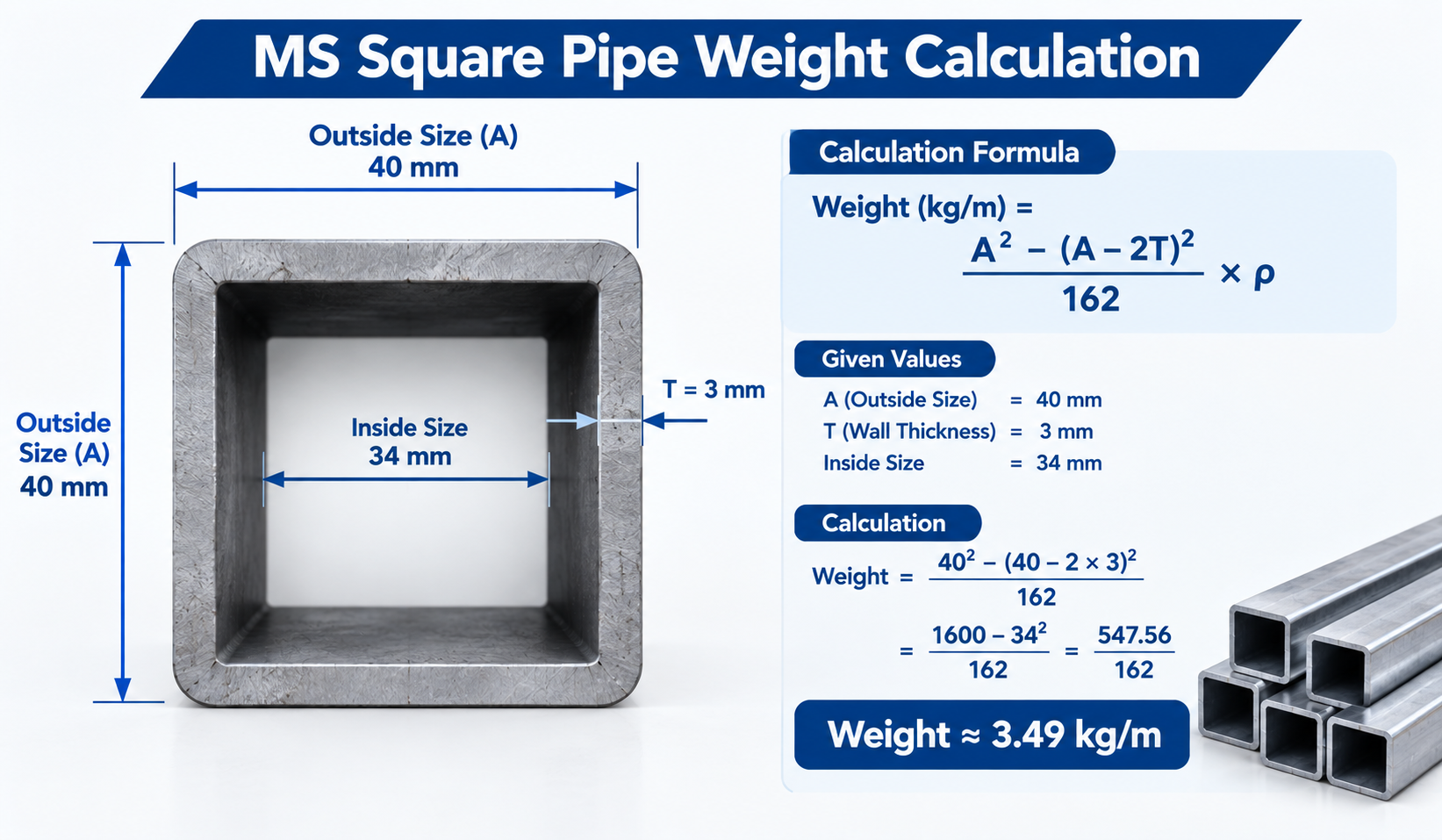
Example: 40 × 40 × 3 mm MS Square Pipe
Consider an MS square pipe with:
Outside size = 40 × 40 mm
Wall thickness = 3 mm
First calculate the inside dimension:
40 − (2 × 3) = 34 mm
Now calculate the cross-sectional area:
40² − 34²
= 1600 − 1156
= 444 mm²
Using the steel conversion factor:
444 × 0.00785 = approximately 3.49 kg/m
Therefore:
40 × 40 × 3 mm MS Square Pipe ≈ 3.49 kg/m
This is a theoretical calculation. The actual manufactured pipe can have a different weight within the applicable dimensional and manufacturing tolerances.
MS Square Pipe Weight Per Foot
Some fabricators and buyers require weight in kilograms per foot rather than kilograms per metre.
The conversion is:
Weight per foot = Weight per meter ÷ 3.28084
For a 40 × 40 × 3 mm square pipe:
3.49 ÷ 3.28084 ≈ 1.06 kg/ft
Therefore, the approximate weight is:
3.49 kg/m
or
1.06 kg/ft
For a 6-meter pipe:
3.49 × 6 = 20.94 kg
So, one 6-meter pipe would have an approximate theoretical weight of 20.94 kg.
How to Calculate Total MS Square Pipe Weight
For a complete order, the total weight can be calculated using:
Total Weight = Weight per meter × Total Length
For example, suppose a project requires 100 pieces of 50 × 50 × 4 mm MS square pipe, each 6 metres long.
Approximate weight:
5.79 kg/m
Length:
6 m
Weight per pipe:
5.79 × 6 = 34.74 kg
For 100 pieces:
34.74 × 100 = 3,474 kg
Therefore:
Total estimated weight = 3.474 metric tons
This calculation can help estimate transportation requirements, storage space, handling requirements, and preliminary material costs.
MS Square Pipe Price 2026
The MS Square Pipe Price in 2026 depends on several commercial and technical factors. Steel prices can change according to raw material costs, market conditions, pipe dimensions, thickness, manufacturing process, order quantity, location, freight, taxes, and supplier terms.
A simple material-cost calculation is
Estimated Material Cost = Total Weight × Price per kg
For example, if an order weighs 3,474 kg, the approximate material value can be calculated by multiplying 3,474 kg by the current quoted price per kg.
However, buyers should obtain a current quotation because steel prices can fluctuate.
Factors Affecting MS Square Pipe Price
- Raw material cost
- Steel market conditions
- Pipe dimensions
- Wall thickness
- Grade and specification
- Order quantity
- Manufacturing process
- Testing requirements
- Certification
- Surface condition
- Packing
- GST and applicable taxes
- Freight
- Delivery location
- Market availability
For an accurate quotation, provide the required size, thickness, length, quantity, standard, grade, documentation, and delivery location.
MS Square Pipe Weight and Length
Length has a direct relationship with the total weight of an MS square pipe.
If a pipe weighs 7.25 kg/m, then:
10 meters = 72.5 kg
20 meters = 145 kg
50 metres = 362.5 kg
100 meters = 725 kg
Therefore:
Total Weight = kg/m × Total Length
This calculation is particularly useful when material requirements are specified in metres instead of individual pipe pieces.
Why Wall Thickness Matters in MS Square Pipes
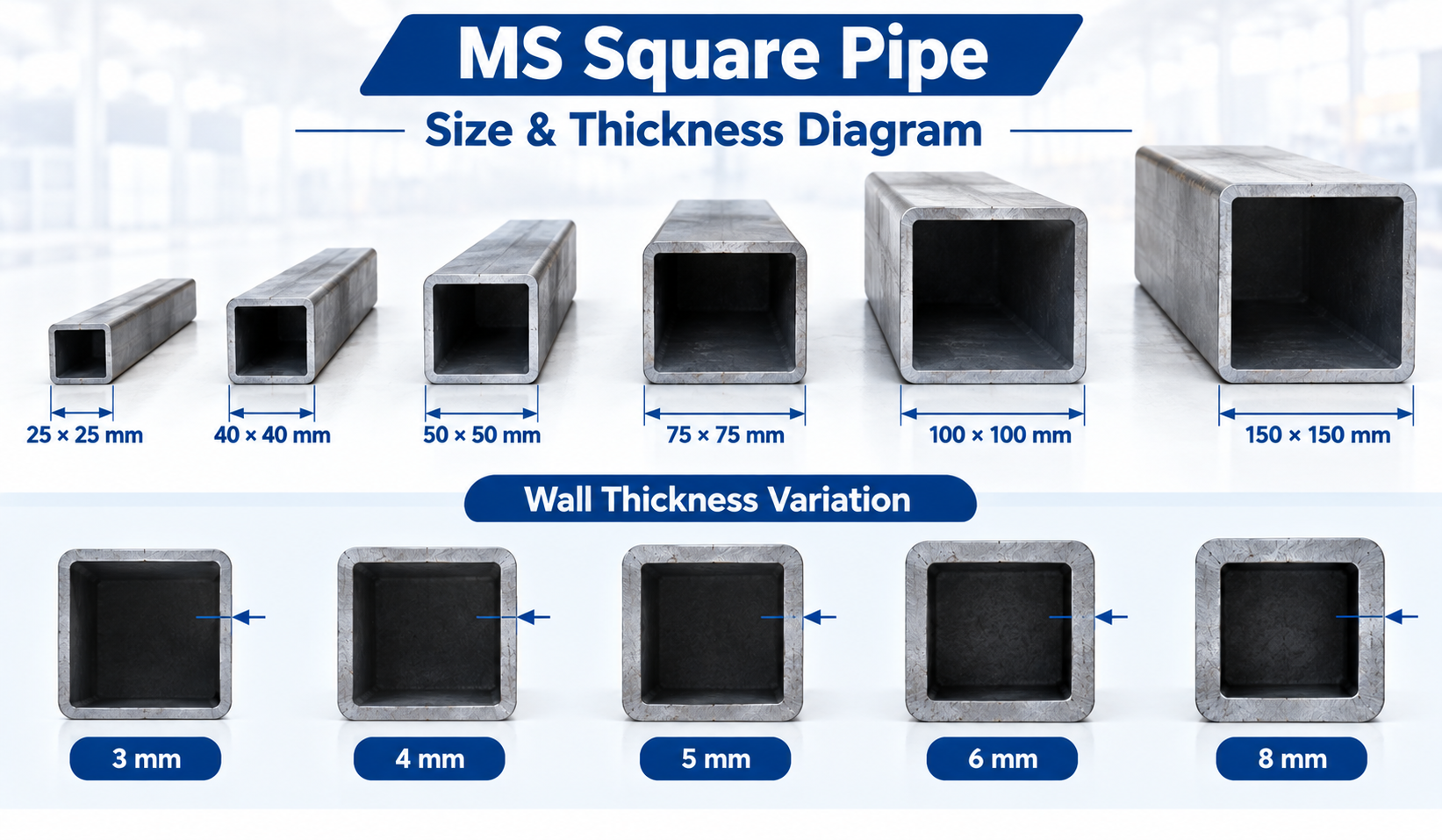
Wall thickness significantly affects the weight of a square pipe.
For the same outside dimension, a thicker wall means:
- Greater steel cross-sectional area
- Higher weight per meter
- Higher material consumption
- Increased structural stiffness
- Greater resistance to deformation
- Potentially greater load capacity, depending on the design
For example, a 50 × 50 × 5 mm square pipe will weigh substantially more than a 50 × 50 × 3 mm square pipe.
However, selecting a pipe only because it has a higher kg/m value is not sufficient. Structural requirements, loads, spans, connections, environmental conditions, design calculations, and applicable standards should be considered when selecting the appropriate section.
MS Square Pipe and IS 4923
IS 4923 is an important Indian specification associated with steel hollow sections for structural applications.
When ordering MS square pipes for structural projects, buyers should clearly specify:
- Outside dimensions
- Wall thickness
- Required grade
- Applicable standard
- Pipe length
- Quantity
- Testing requirements
- Certification
- Surface condition
- Inspection requirements
For projects requiring traceability, buyers may request a Material Test Certificate (MTC) containing relevant chemical and mechanical test information.
The applicable standard and grade should always be confirmed against the project’s technical specification before purchasing.
Theoretical Weight vs. Actual Weight
An important point when using an MS Square Pipe Weight Chart 2026 is that the chart normally provides theoretical weight.
The actual weight of a supplied pipe may vary because of:
- Wall thickness tolerance
- Outside dimension tolerance
- Corner radius
- Length tolerance
- Manufacturing process
- Surface condition
- Measurement method
- Mill practices
Therefore, theoretical kg/m values are useful for estimation, costing, quantity planning, design reference, and transportation planning.
For final commercial reconciliation, the agreed contractual basis and actual supplied material should be considered.
Applications of MS Square Pipes
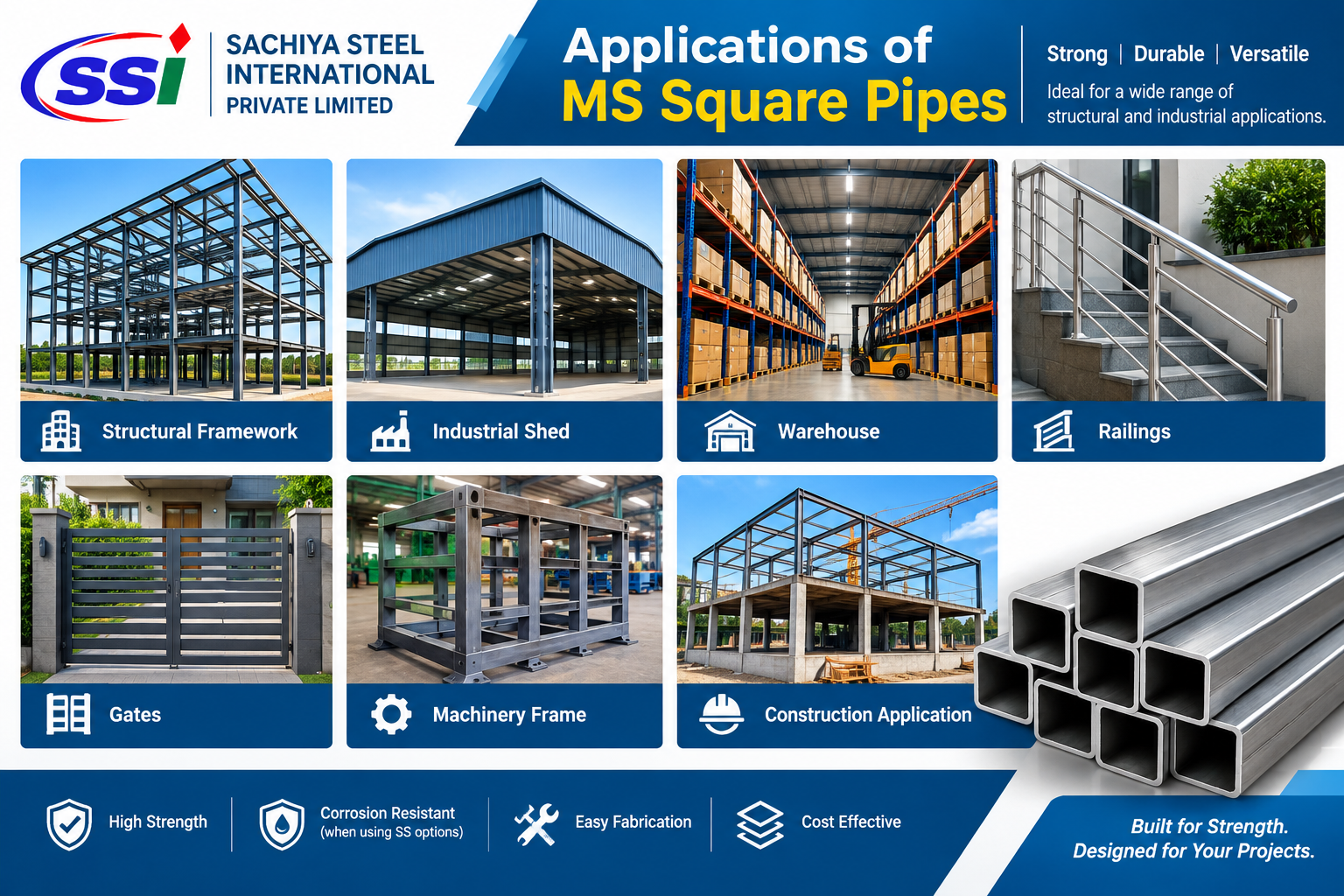
MS square pipes are used across construction, fabrication, infrastructure, engineering, agriculture, and industrial applications.
Construction
Used for structural frameworks, supports, sheds, platforms, and fabrication work.
Industrial Engineering
Square hollow sections are used in machinery frames, equipment supports, industrial structures, and engineering assemblies.
Fabrication
They are commonly used for gates, railings, partitions, frames, and fabricated structures.
Infrastructure
MS square sections can be used in various infrastructure and support structures according to project requirements.
Agriculture
They are used in agricultural equipment, structures, frames, supports, and other fabricated components.
Furniture
Smaller square sections are commonly used for tables, racks, frames, workstations, and other fabricated furniture.
For applications requiring higher corrosion resistance, you can also explore Stainless Steel Pipes and related stainless steel products.
How to Select the Right MS Square Pipe
Choosing the right MS square pipe requires consideration of both technical and commercial requirements.
1. Confirm the Size
Determine the required outside dimension, such as 25 × 25, 40 × 40, 50 × 50, 100 × 100, or another size.
2. Select the Thickness
Choose the wall thickness according to the project’s engineering requirements.
3. Confirm the Standard
Specify the applicable Indian or project standard before placing the order.
4. Check Documentation
For critical projects, determine whether MTC, inspection reports, or other quality documents are required.
5. Calculate Weight
Use the kg/m value to estimate the total material weight.
6. Compare Quotations
Compare suppliers based on specifications, quantity, certification, delivery, freight, taxes, and commercial terms rather than comparing only the quoted price per kilogram.
Why Choose Sachiya Steel International Private Limited?
Sachiya Steel International Private Limited supplies steel products for construction, engineering, fabrication, infrastructure, and industrial applications.
The company supports customers with specification-based material requirements, including dimensions, thicknesses, quantities, standards, documentation, and delivery requirements.
When requesting an MS square pipe quotation, customers should provide complete technical details so the required material can be accurately identified and commercially quoted.
For MS square pipe enquiries, availability, technical specifications, and quotations, visit the Contact Sachiya Steel International page.
Phone: +91 9769056007
Email: [email protected]
Website: www.sachiyasteel.com
Frequently Asked Questions About MS Square Pipe Weight
1. What is the weight of an MS Square Pipe?
The weight depends on the outside dimensions and wall thickness. For example, a theoretical 40 × 40 × 3 mm MS square pipe weighs approximately 3.49 kg/m.
2. How is MS Square Pipe weight calculated?
The theoretical weight can be calculated using:
Weight (kg/m) = [A² − (A − 2T)²] × 0.00785
where A is the outside dimension in mm and T is the wall thickness in mm.
3. What density is used for MS Square Pipe calculations?
A nominal steel density of approximately 7850 kg/m³ is commonly used for theoretical weight calculations.
4. What is the weight of a 40 × 40 × 3 mm square pipe?
The approximate theoretical weight is 3.49 kg/m. A 6-metre length would therefore weigh approximately 20.94 kg.
5. Does wall thickness affect square pipe weight?
Yes. Increasing wall thickness increases the amount of steel in the cross-section and therefore increases the weight per metre.
6. How do I calculate the weight of a 6-metre MS square pipe?
Multiply the kg/m value by 6.
For example:
3.49 × 6 = 20.94 kg
7. Is MS Square Pipe weight shown in kg/m actual weight?
Usually, weight charts provide theoretical or calculated values. Actual supplied weight can differ according to applicable manufacturing and dimensional tolerances.
8. What is IS 4923?
IS 4923 is an Indian Standard associated with steel hollow sections for structural applications. The exact grade, dimensions, edition, and project requirements should be confirmed before ordering.
9. How can I calculate the total weight of an MS square pipe order?
Use:
Total Weight = Weight per metre × Total Length
If calculating individual pipes:
Total Weight = kg/m × pipe length × number of pieces
10. How can I get the latest MS Square Pipe price in 2026?
MS square pipe prices vary according to size, thickness, quantity, market conditions, taxes, freight, and other commercial factors. Contact the supplier with your required specifications and delivery location to obtain a current quotation.
Final Takeaway
The MS Square Pipe Weight Chart 2026 – Size & Kg/m + PDF provides a practical reference for calculating theoretical pipe weight, estimating material quantities, planning transportation, preparing preliminary costing, and comparing project requirements.
The most important factors affecting MS square pipe weight are outside size, wall thickness, steel density, and total length. Using the correct formula makes it possible to estimate kg/m and calculate the approximate weight of individual pipes or complete orders.
However, theoretical weight should not automatically be treated as the actual commercial weight of supplied material. Manufacturing tolerances, corner radius, dimensional variation, applicable standards, and contractual purchasing conditions can affect the final supplied weight.
For structural applications, buyers should also confirm the required standard, grade, dimensions, testing, certification, and MTC requirements before ordering.
For MS Square Pipe requirements, contact Sachiya Steel International Private Limited with your required size, thickness, length, quantity, standard, and delivery location for a project-specific quotation.