MS Pipe Weight Chart 2026 – Kg per Meter, All Sizes + PDF
Last Updated:, 2026
The MS Pipe Weight Chart 2026 – Kg per Meter, All Sizes + PDF is a useful reference for engineers, contractors, fabricators, architects, procurement teams, steel traders, and buyers who need to estimate the weight of mild steel pipes. Pipe weight mainly depends on the outside diameter, wall thickness, steel density, pipe class, and length.
Mild steel pipes are widely used in construction, water supply, industrial piping, structural fabrication, agriculture, scaffolding, fencing, machinery, and general engineering applications. Knowing the MS pipe weight per meter helps users estimate material quantities, transportation loads, project costs, inventory requirements, and approximate purchasing values.
This updated 2026 MS Pipe Weight Chart includes commonly used MS pipe sizes, Class A, Class B and Class C pipe weights, IS 1239 / BS 1387 reference dimensions, weight in kg per meter, weight calculation formula, large-diameter pipe weights, indicative 2026 prices, applications, and a downloadable PDF reference.
MS Pipe Weight Chart 2026 – Kg per Meter
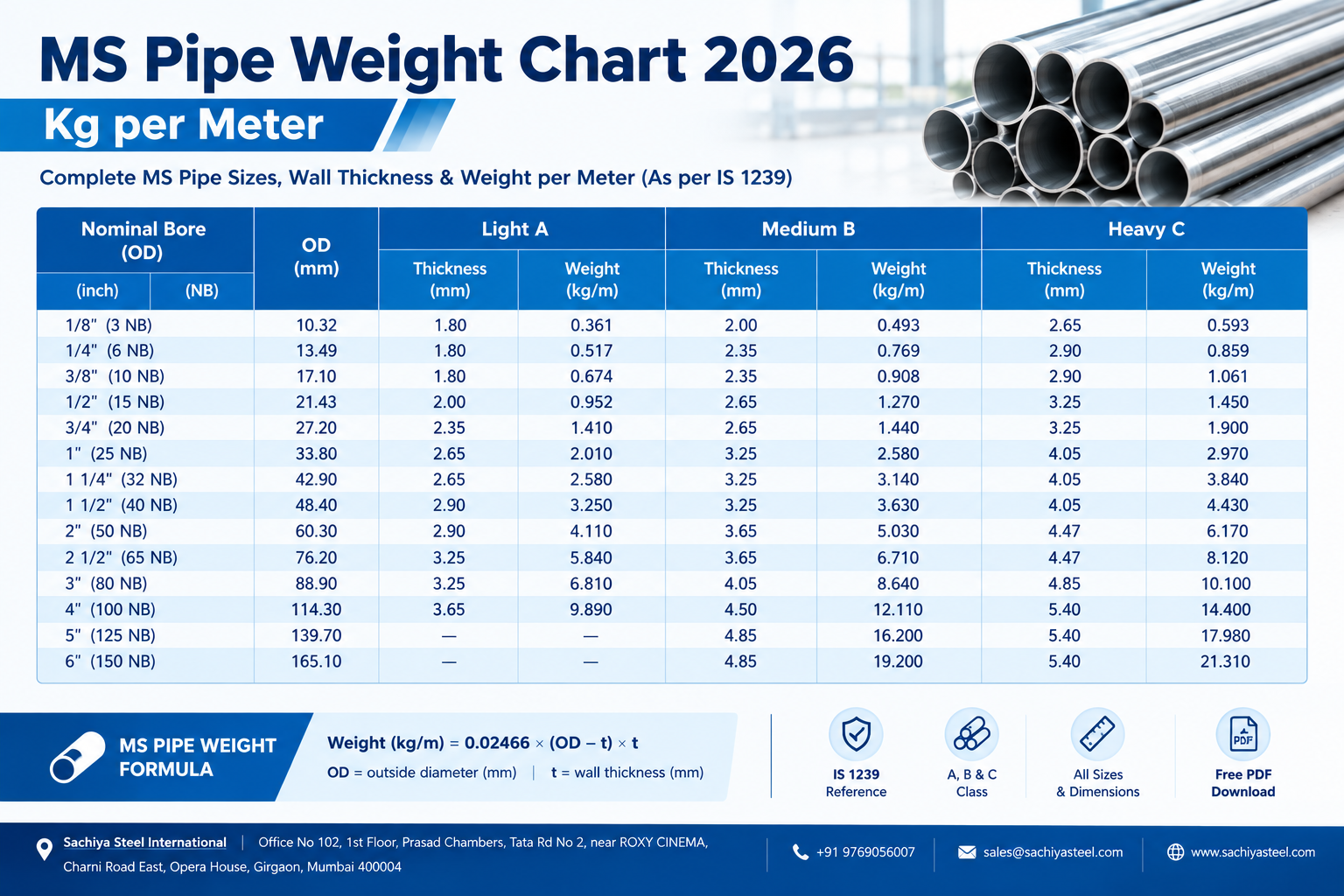
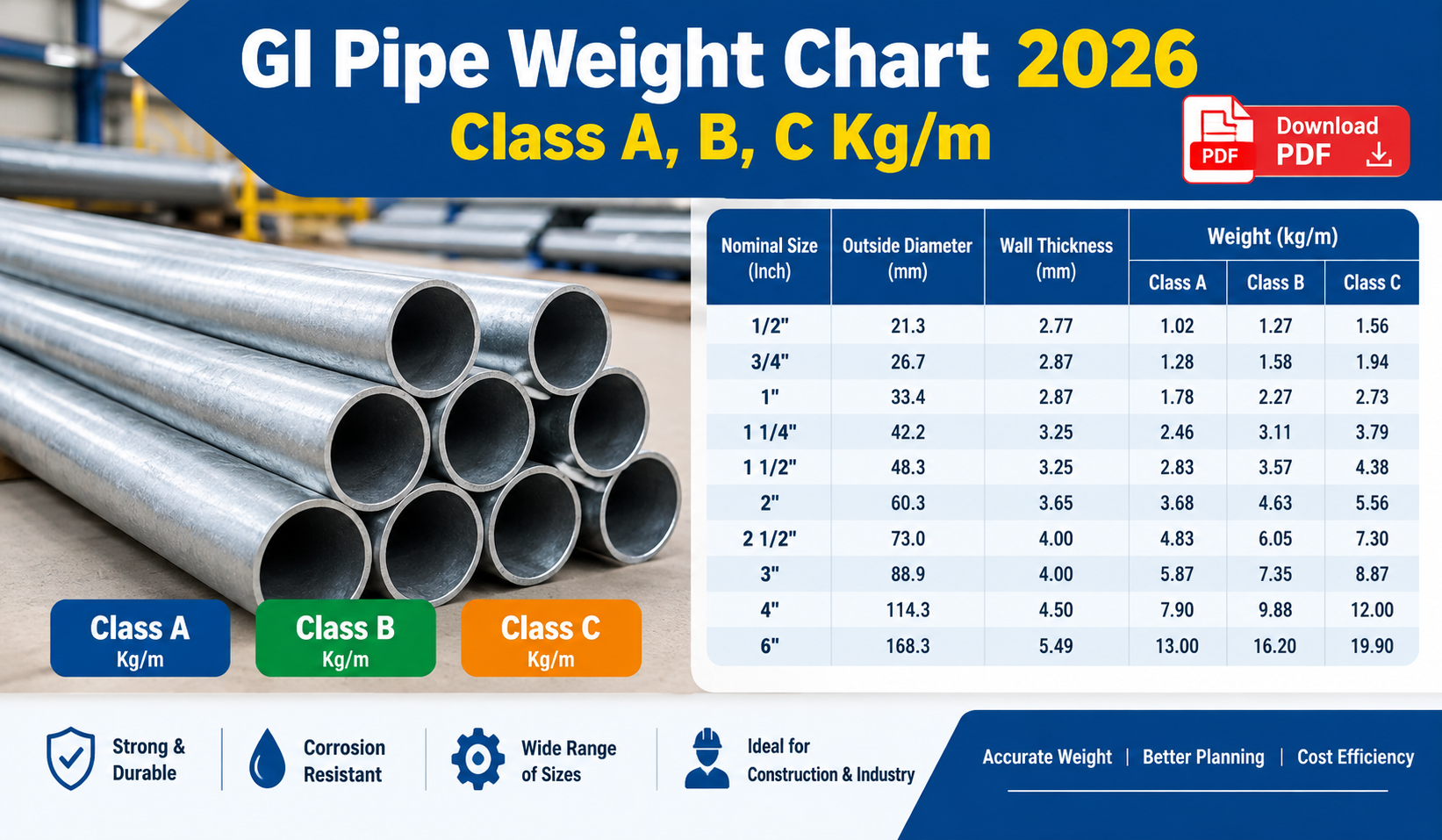
The following chart provides commonly used MS pipe dimensions and their approximate weights in kg per meter.
MS Pipe Weight Chart – IS 1239 / BS 1387 Reference
| Nominal Bore | OD (mm) | Light A Thickness (mm) | Light A Weight (kg/m) | Medium B Thickness (mm) | Medium B Weight (kg/m) | Heavy C Thickness (mm) | Heavy C Weight (kg/m) |
|---|---|---|---|---|---|---|---|
| 1/8″ (3 NB) | 10.32 | 1.80 | 0.361 | 2.00 | 0.493 | 2.65 | 0.593 |
| 1/4″ (6 NB) | 13.49 | 1.80 | 0.517 | 2.35 | 0.769 | 2.90 | 0.859 |
| 3/8″ (10 NB) | 17.10 | 1.80 | 0.674 | 2.35 | 0.908 | 2.90 | 1.061 |
| 1/2″ (15 NB) | 21.43 | 2.00 | 0.952 | 2.65 | 1.270 | 3.25 | 1.450 |
| 3/4″ (20 NB) | 27.20 | 2.35 | 1.410 | 2.65 | 1.440 | 3.25 | 1.900 |
| 1″ (25 NB) | 33.80 | 2.65 | 2.010 | 3.25 | 2.580 | 4.05 | 2.970 |
| 1 1/4″ (32 NB) | 42.90 | 2.65 | 2.580 | 3.25 | 3.140 | 4.05 | 3.840 |
| 1 1/2″ (40 NB) | 48.40 | 2.90 | 3.250 | 3.25 | 3.630 | 4.05 | 4.430 |
| 2″ (50 NB) | 60.30 | 2.90 | 4.110 | 3.65 | 5.030 | 4.47 | 6.170 |
| 2 1/2″ (65 NB) | 76.20 | 3.25 | 5.840 | 3.65 | 6.710 | 4.47 | 8.120 |
| 3″ (80 NB) | 88.90 | 3.25 | 6.810 | 4.05 | 8.640 | 4.85 | 10.100 |
| 4″ (100 NB) | 114.30 | 3.65 | 9.890 | 4.50 | 12.110 | 5.40 | 14.400 |
| 5″ (125 NB) | 139.70 | — | — | 4.85 | 16.200 | 5.40 | 17.980 |
| 6″ (150 NB) | 165.10 | — | — | 4.85 | 19.200 | 5.40 | 21.310 |
Note: Actual supplied weights can vary because of dimensional tolerances, manufacturing method, applicable standards, and the manufacturer’s nominal weight tables. Always verify the manufacturer’s technical documentation before final procurement.
PDF Button – MS Pipe Weight Chart 2026
For engineers, fabricators, contractors, and purchasing teams, having an offline copy of the chart can make material estimation easier.
[DOWNLOAD MS PIPE WEIGHT CHART 2026 PDF]
The PDF can be used as a quick reference for checking pipe sizes, wall thicknesses, classes, and approximate kg-per-meter values during project planning and procurement.
What Is an MS Pipe?
Mild steel pipe is a low-carbon steel tubular product commonly used for construction, fabrication, utility piping, industrial systems, structural work, and engineering applications. Its combination of weldability, ductility, machinability, strength, and relatively economical material cost makes it suitable for many general-purpose applications.
Our Mild Steel Pipes are available in different sizes, wall thicknesses, and specifications according to project requirements.
MS pipes may be supplied in different manufacturing configurations, including ERW and welded pipe products, depending on the required specification and application.
MS Pipe Classes: Class A, Class B, and Class C
MS pipes are commonly discussed in three wall-thickness categories: Class A, Class B, and Class C.
Class A – Light
Class A pipes have comparatively lighter wall thicknesses and lower weight per meter. They may be selected for applications where lower material weight is suitable for the specified service.
Class B – Medium
Class B pipes have medium wall thickness and are commonly used for general-purpose piping and engineering requirements. They provide a balance between material weight, strength, and cost.
For more information, refer to our MS Pipe Class A, B & C Chart.
Class C – Heavy
Class C pipes have heavier wall thicknesses and therefore higher weight per meter. They can be considered when the project specification requires a heavier wall.
See our MS C Class Pipe Thickness Chart for additional reference information.
The appropriate pipe class should always be selected according to the applicable standard, engineering requirements and service conditions.
MS Pipe Sizes and Dimensions
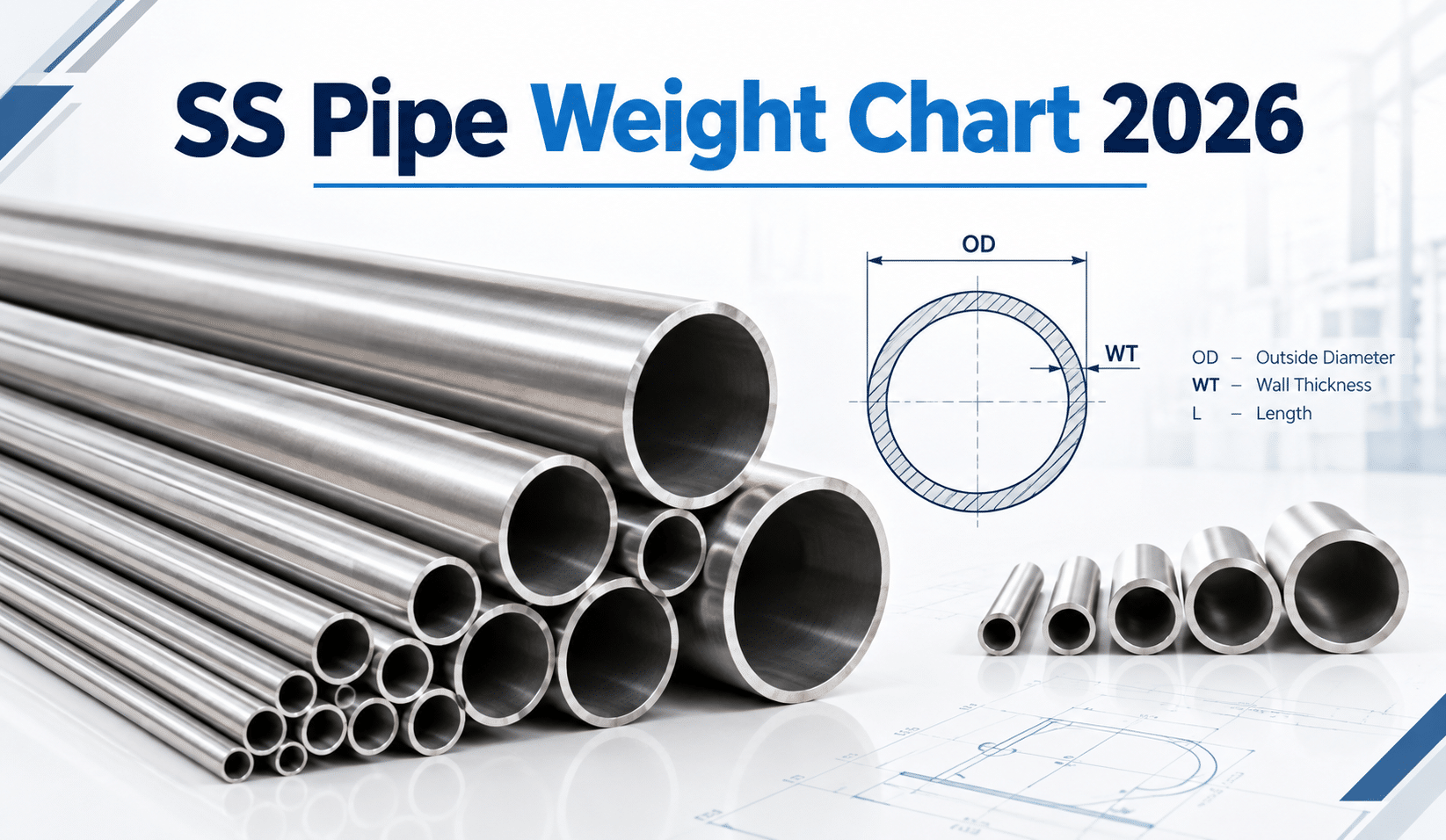
MS pipe dimensions are generally identified using Nominal Bore (NB), Outside Diameter (OD), and Wall Thickness.
Common MS pipe sizes include:
- 15 NB
- 20 NB
- 25 NB
- 32 NB
- 40 NB
- 50 NB
- 65 NB
- 80 NB
- 100 NB
- 125 NB
- 150 NB
Larger sizes can also be supplied according to the applicable specification and required wall thickness.
For additional dimensional information, see our MS Pipe Sizes reference.
How to Calculate MS Pipe Weight Per Meter
The theoretical weight of a circular steel pipe can be calculated using:
Weight (kg/m) = 0.02466 × (OD − t) × t
Where:
- OD = Outside diameter in mm
- t = Wall thickness in mm
- 0.02466 = commonly used steel pipe weight constant
Example
Suppose:
OD = 114.3 mm
Wall thickness = 4.5 mm
Then:
Weight = 0.02466 × (114.3 − 4.5) × 4.5
The theoretical result is approximately
12.18 kg/m
The calculated result should be compared with the applicable manufacturer’s nominal weight because actual dimensions and manufacturing tolerances can affect supplied weight.
MS Pipe Weight Per Meter vs. Weight Per Piece
The terms “kg/m” and “kg/piece” should not be confused.
If an MS pipe weighs 12 kg/m and the pipe length is 6 meters:
Weight per piece = 12 × 6
Weight per piece = 72 kg
Therefore:
- Weight per meter = 12 kg
- Pipe length = 6 m
- Approximate weight per piece = 72 kg
The total quantity can then be estimated according to the required number of pieces.
For larger projects, the total pipe weight can be calculated using:
Total Weight = Weight per Meter × Total Length
For example, if the pipe weighs 14.40 kg/m and the required length is 120 meters:
14.40 × 120 = 1,728 kg
Therefore, the estimated material weight is 1.728 metric tonnes, before considering cutting losses, tolerances or additional procurement allowance.
MS Pipe Weight Calculator
An online MS Pipe Weight Calculator can make theoretical weight calculations faster.
Users can enter the outside diameter, wall thickness, and required length to estimate the pipe’s total weight.
A calculator is particularly useful when working with:
- Different pipe sizes
- Non-standard dimensions
- Large quantities
- Different pipe lengths
- Project material estimates
- Transportation planning
For final procurement, the calculated value should always be checked against the applicable standard and manufacturer’s published nominal weight.
MS Pipe Price Per Kg in India 2026
The price of MS pipe varies according to the steel market, pipe size, wall thickness, class, manufacturer, brand, quantity, delivery location, GST, freight, and testing requirements.
Indicative MS Pipe Price Table – 2026
| MS Pipe Product | Indicative 2026 Price Range |
|---|---|
| MS Pipe | ₹57–₹72/kg |
| MS ERW Pipe | ₹58–₹75/kg |
| MS Round Pipe | ₹60–₹80/kg |
| MS Structural Pipe | ₹60–₹77/kg |
| Heavy Class MS Pipe | ₹65–₹85/kg |
| Large-Diameter MS Pipe | ₹65–₹95/kg |
These figures are indicative market ranges rather than fixed quotations. Actual prices can vary according to specification, brand, quantity, location, taxes, freight, and commercial terms.
For more information, visit our MS Pipe Price page.
How Weight Affects MS Pipe Price
When the quotation is provided on a per-kilogram basis, pipe weight can be used to estimate the approximate price per meter.
Price per meter = Weight per meter × Price per kg
For example:
14.40 kg/m × ₹70/kg = ₹1,008 per meter
For a 6-meter pipe:
₹1,008 × 6 = ₹6,048 per pipe
This is only a material-cost calculation. GST, freight, testing, cutting, coating and other applicable charges may be additional.
Factors That Affect MS Pipe Weight
Several factors influence the weight of an MS pipe.
1. Outside Diameter
A larger outside diameter generally increases the quantity of steel used for a given wall thickness.
2. Wall Thickness
Wall thickness has a direct effect on weight. Increasing thickness increases the amount of steel in the pipe and therefore increases kg per meter.
3. Length
Weight per meter is a dimensional reference, while total weight depends on the complete pipe length.
Total Weight = Weight per Meter × Total Length
4. Steel Density
The theoretical formula uses a standard density-based constant. Small differences can occur because of material composition and manufacturing tolerances.
5. Manufacturing Tolerance
Actual dimensions may vary within the tolerances permitted by the relevant product specification.
Large Diameter MS Pipe Weight
Large-diameter MS pipes require separate consideration because their dimensions and applicable manufacturing specifications may differ from commonly listed smaller pipe sizes.
| Nominal Size | Approx. OD | Wall Thickness | Approx. Weight |
|---|---|---|---|
| 7″ | 193.7 mm | 4.85 mm | 22.59 kg/m |
| 8″ | 219.1 mm | 5.20 mm | 27.45 kg/m |
| 10″ | 273.0 mm | 5.60 mm | 36.85 kg/m |
| 12″ | 323.9 mm | 6.00 mm | 47.06 kg/m |
| 14″ | 355.6 mm | 6.35 mm | 54.65 kg/m |
| 16″ | 406.4 mm | 7.01 mm | 68.99 kg/m |
Large-diameter pipe weights should be verified against the applicable product specification and actual supplied dimensions before commercial use.
Why the MS Pipe Weight Chart Is Important
The MS Pipe Weight Chart 2026 provides a convenient way to convert pipe dimensions into practical material quantities. Instead of calculating each pipe individually, buyers can refer to the chart to estimate approximate kg per meter.
The chart can help with:
- Material estimation
- Project quantity calculations
- Transportation planning
- Procurement
- Cost estimation
- Fabrication planning
- Inventory management
- Tender and BOQ preparation
- Warehouse stock estimation
- Logistics planning
For example, knowing the kg/m value allows a procurement team to estimate the approximate total tonnage required for a project before requesting a quotation.
Applications of MS Pipes
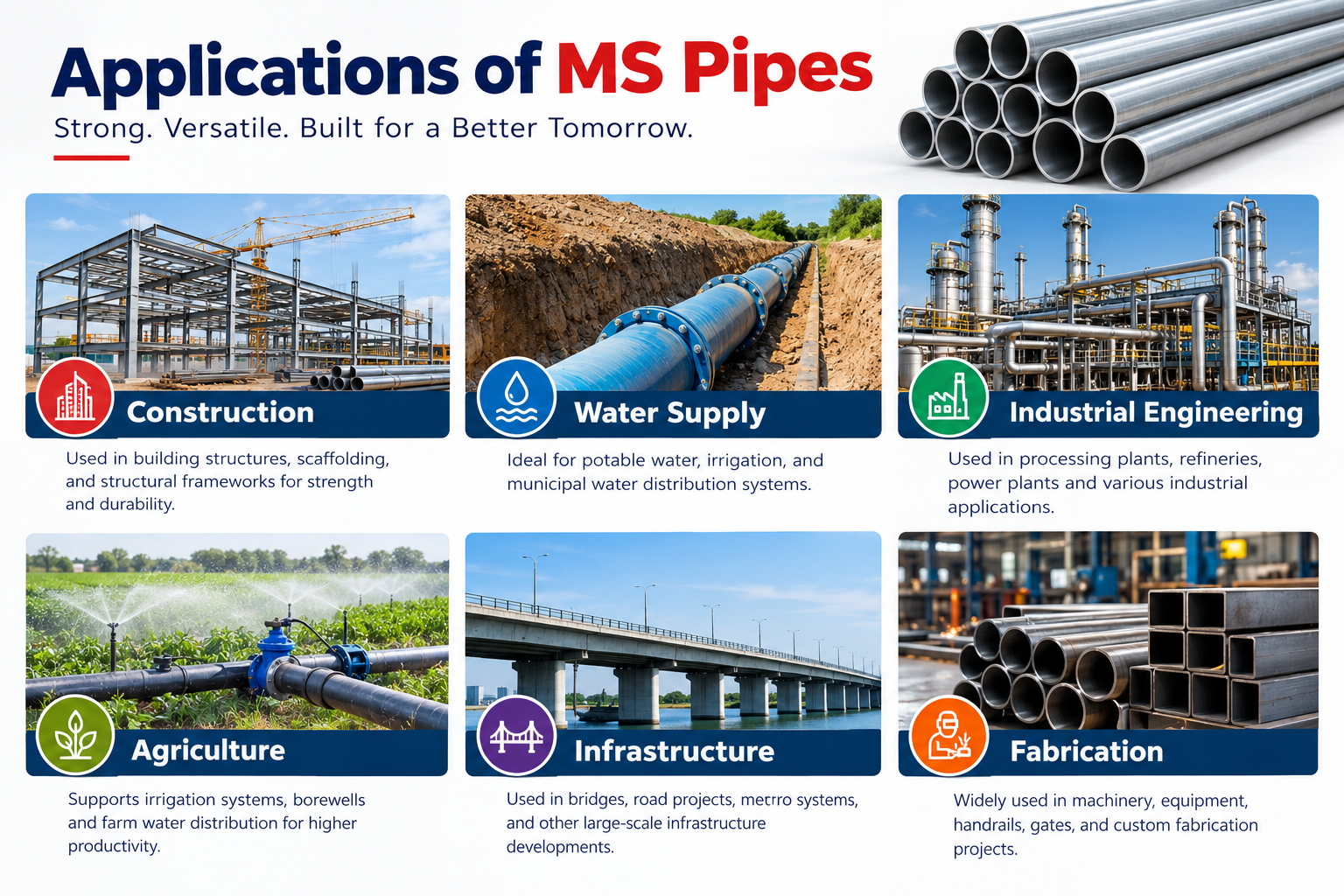
MS pipes are used across many industries and engineering applications.
Construction
Used for structural supports, frameworks, railings, scaffolding, fencing, and general fabrication.
Water Supply
Suitable MS pipe specifications may be used for water transmission and utility systems where carbon steel is appropriate.
Industrial Engineering
Used for equipment supports, utility lines, fabrication, plant structures, and general engineering applications.
Agriculture
Used in irrigation systems, agricultural structures, water conveyance, and farm infrastructure.
Infrastructure
Used for barriers, utility supports, protective structures, poles, and other infrastructure requirements.
Fabrication
Mild steel’s weldability and machinability make it suitable for fabricated structures, frames, and mechanical assemblies.
Advantages of MS Pipes
MS pipes are widely used because they provide a combination of fabrication flexibility, availability, and mechanical properties.
Key advantages include:
- Good weldability
- Good ductility
- Easy fabrication
- Wide size availability
- Multiple wall-thickness options
- Suitable for structural applications
- Easy cutting and machining
- Broad availability
- Competitive material cost
However, MS pipes are not inherently corrosion-proof. Depending on the service environment, painting, galvanizing, coating, lining or another suitable corrosion-control method may be required.
How to Select the Correct MS Pipe
Selecting an MS pipe should not be based only on weight. Buyers should consider the complete technical and commercial requirement.
Step 1: Identify the Nominal Bore
Determine the required nominal pipe size.
Step 2: Confirm the Outside Diameter
Check the OD specified by the applicable standard.
Step 3: Select Wall Thickness
Choose the required wall thickness based on the engineering and service requirements.
Step 4: Select Pipe Class
Where applicable, identify whether Light, Medium or Heavy class is required.
Step 5: Check the Applicable Standard
Verify the relevant IS, BS, ASTM, API or project specification.
Step 6: Calculate Required Quantity
Determine the required length and approximate total weight.
Step 7: Request a Current Quotation
Provide the exact size, thickness, class, quantity and delivery location to obtain a specification-specific quotation.
FAQ – MS Pipe Weight Chart 2026
1. What is an MS Pipe Weight Chart?
An MS Pipe Weight Chart is a reference table showing the approximate weight of mild steel pipes according to nominal size, outside diameter, wall thickness and pipe class.
2. What is the formula for MS pipe weight per meter?
The commonly used theoretical formula is:
Weight (kg/m) = 0.02466 × (OD − t) × t
Here, OD is the outside diameter in millimeters and t is the wall thickness in millimeters.
3. What is the weight of a 4-inch MS pipe?
The weight depends on wall thickness and pipe class. For example, a 4-inch pipe with approximately 114.3 mm OD and 4.5 mm wall thickness has a theoretical weight of around 12.18 kg/m.
4. What is the difference between Class A, Class B, and Class C MS pipes?
Class A generally represents a lighter wall category, Class B a medium wall category, and Class C a heavier wall category. Exact dimensions should be checked against the applicable specification.
5. How do I calculate the total weight of MS pipes?
Multiply the weight per meter by the total required length.
Total Weight = Weight per Meter × Total Length
For example, 10 kg/m × 100 m = 1,000 kg.
6. What factors affect MS pipe weight?
Pipe weight is affected by outside diameter, wall thickness, length, steel density, and manufacturing tolerances.
7. What is the MS pipe price per kg in India in 2026?
Indicative September 2026 market references in this article show different rates according to pipe type and supplier. Several common MS/ERW categories are listed around ₹57–₹75/kg, while larger or heavier products may have higher rates. Buyers should request a current quotation for the exact specification.
8. What is the standard length of an MS pipe?
Six meters is a common commercial pipe length, although other lengths, such as 3 m, 9 m, 12 m, and customized lengths, may be available depending on the product and supplier.
9. Can an MS pipe weight calculator calculate different pipe sizes?
Yes. A calculator can estimate theoretical pipe weight using the outside diameter and wall thickness. The calculated result should be compared with the manufacturer’s nominal weight for procurement.
10. Can this MS Pipe Weight Chart be used for procurement?
The chart is useful for preliminary estimation, costing, logistics, and material planning. For final procurement, buyers should verify the applicable standard, dimensions, tolerances, manufacturer’s data, inspection requirements, and current quotation.
Download MS Pipe Weight Chart 2026 PDF
For quick offline reference, download the MS Pipe Weight Chart 2026 PDF containing the relevant pipe size and weight information.
[DOWNLOAD MS PIPE WEIGHT CHART 2026 PDF]
Final Note
The MS Pipe Weight Chart 2026 – Kg per Meter, All Sizes + PDF provides a practical reference for understanding MS pipe dimensions, wall thickness, pipe class, and approximate weight per meter. Combining the chart with an online calculator can simplify material estimation, project planning, transportation calculations, and preliminary cost analysis.
For commercial purchasing, weight should not be considered the only selection factor. Always confirm the pipe standard, nominal size, outside diameter, wall thickness, class, grade, quantity, testing requirements, delivery location, and current market price before placing an order.
For MS pipe requirements, bulk quantities, technical specifications, and current quotations, contact Sachiya Steel International with your required pipe size, thickness, and quantity.