Blogs

titanium vs stainless steel

Difference between Stainless Steel and Titanium?

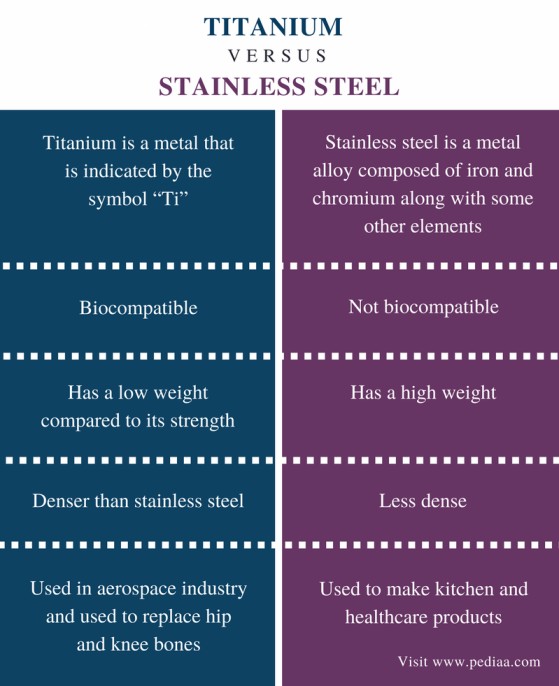
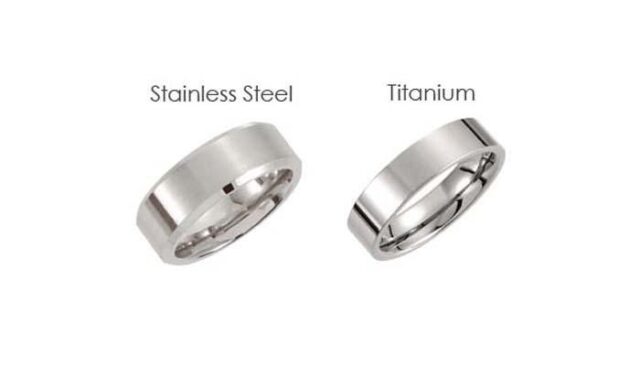
The main difference between stainless steel and titanium is simply that titanium is a metal while stainless steel is an alloy metal. Titanium’s characteristics are naturally found within it, while stainless steel characteristics are created by adding alloying metals to it. For use in a specific project or activity circumstances exist that often suggest one substance is better suited than the other.

titanium vs stainless steel

titanium vs stainless steel

Stainless steel is preferred by industries that place a higher significance on weight than strength. It is highly suitable for specific industries, such as aerospace, an industry that requires lower density in addition to strength. Due to the unique qualities of titanium that deliver strength and durability along with low density it is often preferred by some manufacturers. Therefore titanium is often preferred when weight is a more important consideration than strength.

Titanium is more expensive than stainless steel which makes it cost-prohibitive for some industries where large quantity is required such as for construction. Therefore, when money is an important part of the equation, stainless steel is chosen over titanium if both substances are deemed suitable.

Titanium is extremely biocompatible, means that it is nontoxic to the human body. It is an excellent source for replacement parts such as knee replacements, hip implants, cases for pacemakers and craniofacial plates for the human body. Hence it is used regularly in the medical industry. It is also useful in the dental industry for dental implants, a growing area of the dentistry field. Titanium alloy is commonly used to make jewelry due to its biocompatibility and lightweight nature compared to stainless steel.

stainless steel vs.titanium

stainless steel vs.titanium

Stainless steel provides formability and weldability both, which allows it to be easily shaped. Stainless steel material is popular for use in a number of industries due to its shiny appearance. It is useful to make household items such as kitchen pans and pots, as well as to make healthcare products, such as portable carts, sinks, shelving, tables and countertops.

Titanium is highly resistant to fatigue caused by fluctuating changes in temperature, while stainless steel is subject to shattering and fatigue. Therefore, titanium is a better choice when variations in temperature lead to extreme highs or lows.
Titanium and stainless steel are used in many industries around the world. Both are highly strong, durable and corrosion resistant. Generally it is the nature of its use decides which metal is to be selected.

What is stainless steel?

Stainless Steel is an alloy of iron with minimum chromium of 10.5%. On the surface of the steel chromium produces a thin layer of oxide which is known as ‘passive layer’. And this helps to prevent any further corrosion of the surface. The increased amount of chromium gives an increased resistance to corrosion. Stainless Steel additionally contains varied amounts of Carbon, Silicon and Manganese. Other elements such as Nickel and Molybdenum may be added to impart other helpful properties like enhanced formability and increased corrosion resistance. Stainless Steel is combined with one or more elements in order to change its characteristics.

What is Titanium?

Titanium is a metallic element it has silver to grey color. It is an atomic number 12 and Ti is it symbol as a chemical element. Titanium alloy offers a high heat transfer efficiency and high resistant to corrosion. It also offers high strength-to-weight ratio, creating an extremely strong substance. Hence it is highly desirable where temperature changes and the elements of weather can create adverse effects on structural components, for example, in construction industries. Titanium alloy provides a high level of mechanical resistance which makes it extremely durable. The lightweight due to low density makes it desirable to certain industries. Its corrosion resistance is found across a wide field, which makes it highly resistant to corrosion created by a wide assortment of acids, alkalis, natural waters and industrial chemicals.

Price List 

Titanium $32.00-$48.00/ Kilogram
Stainless Steel $1.00-$1.40/ Kilogram

Sachiya Steel International are manufacturers suppliers dealers exporters of Pipes, Tubes ,Pipe Fitting, Fasteners.

Sachiya Steel International are manufacturers of Pipes And Tubes ,bolts nuts screws washers and other fasteners such as rings and threaded rods. We manufacture and supply industrial fasteners to major Indian cities.

Sachiya Steel International is India’s largest exporter of Pipes, Tubes And Fasteners such as Bolts, Nuts, Screws, Washers, Threaded Rods and Rings. Sachiya Steel International is an internationally acclaimed fastener manufacturing company that exports to more than 50 countries worldwide. We export our high-quality fasteners in Saudi Arabia, Oman, UAE, Dubai, Kuwait, Qatar, Mexico, USA, Malaysia, Iran and many other countries.

By |2025-11-12T11:54:43+05:30January 21st, 2022|Blogs|

Stainless Steel Pipe Manufacturers In India

Stainless Steel Pipe Manufacturers In India

Sachiya Steel International Is Leading Stainless Steel Pipe Manufacturer In India. Our Stainless Steel Pipes are available in different sizes, shapes, and grades. We supply these Pipes in most of the major Indian cities in more than 20 States. We Sachiya Steel International offer different types of grades like Stainless Steel Pipes, Super Duplex Pipes, Duplex  Pipes, Carbon Steel Pipes, Alloys Steel Pipes, Nickel Alloys Pipes, Titanium, Aluminium Pipes, etc.

stainless steel pipe

Stainless Steel Pipe Manufacturers In India

Steel pipes are long, hollow Pipes that are used for a variety of purposes. Stainless Steel Pipes and Tubes have excellent corrosion resistance and smooth finishing characteristics. stainless steel pipe manufacturers. The corrosion resistance of the welded steel pipe is the same as the base metal and the strength higher than the base metal. For these reasons, they are used in demanding industries.

Applications of Steel Pipes

  • Textile Machinery
  • Chemicals
  • Fertilizers
  • Dairy and Food Processing
  • Power Plants
  • Pesticides
  • Construction
  • Modern Architecture
  • Pharmaceuticals
  • Sugar
Steel Pipes Specifications
Schedule SCH5, SCH10, SCH20, SCH30, SCH40, STD, SCH80, XS, SCH60, SCH80, SCH120,SCH140, SCH160, XXS
Standard ASME/ANSI B16.11, MSS-SP-97, MSS-SP-79, JIS B2316, BS 3799
Pipes Size 1/8″NB to 24″NB & 1/4″OD TO 24″OD AND 6.35mm to 254mm OD Thickness: 0.6mm to 20mm
Type Seamless/ erw/ welded/semi welded in round, square, rectangular, coil form, u shape and hydraulic. Pipes
Grades
Stainless Steel ASTM / ASME 201, 202, 301, 304, 304L, 310, 310S, 316L, 316TI, 317, 317L, 321, 347, 409, 409M, 409L, 410, 410S, 420, 430, 431, 441, 444, 446, 17.4PH, 904L
Super Duplex Steel S32750
Duplex Steel ASTM / ASME SA 790 UNS NO S 31803 , S 32205 , S 32550 , S 32750 , S 32760.
Carbon Steel ASTM / ASME A 335 GRP 1 , P 5 , P 9 , P 11 , P 12 , P 22 , P 23 , P 91
Alloys Steel ASTM / ASME A 691 GRP1 CR , 1 1/4 CR , 2 1/4 CR , 5 CR , 9CR , 91.
Nickel Alloys Nickel Alloys 200, Nickel Alloys 201
Titanium Grade 1, Grade 4, Grade 5(Ti 6Al-4V), Grade 6(Ti 5Al-2.5Sn), Grade 7, Grade 11, Grade 12, 8Ai-1Mo-1V, Grade 9(3Al-2.5V), 6Al-6V-25n, 6Al-2Sn-4Zr-2Mo, 6Al-7Nb, Grade 23(Ti 6AL-4V ELI), Grade 5 ELI
Inconel Inconel 600, Inconel 601, Inconel 625, Inconel 625LCF, Inconel 686, Inconel 718, Inconel 800, Inconel 825, Inconel X-750 , Inconel 690, Inconel 602, Inconel 617, Inconel 925, Inconel A-289, Inconel AL-6XN, AL-904L
Hastelloy Hastelloy C-22, Hastelloy C-276, Hastelloy C-2000, Hastelloy C-4, Hastelloy X, Hastelloy B, Hastelloy N, Hastelloy G
Molybdenum ASTM / ASME A 182 GR F 5, F 9 , F 11 , F 12 , F 22 , F 91, ASTM B387, Ferro Molybdenum
Cobalt Cobalt HS-6, Cobalt HS-4, Cobalt HS-25, Sterlite Grade 1, Sterlite Grade 6, Sterlite Grade 12, Sterlite Grade 21
Niobium ASTM B394, R04200 R04210
Nimonic Nimonic75, Nimonic80, Nimonic85, Nimonic90, Nimonic263, etc
Tungsten W1 WAl1, W61, etc, Carbonide Tungsten, Copper Tungsten, Nickel Tungsten
Nichrome Nichrome90, Nichrome80, Nichrome80A, Nichrome RW80, Nichrome75, etc
Magnesium Magnesium AL017100, AL017140, AL017150, AL017160, AL017200, AL017210, AL017250, etc.
Tantalum Tantalum – Grade 1.
Monel Monel 400, Monel k500
MU-METAL MU-METAL
Zirconium Zirconium 702, Zirconium 705,Zirconium 705, Zirconium-2, Zirconium-4
Beryllium Copper Alloy 25 UNSC17200
Aluminium 1050,1100, 2017, 7150, 7178, 7575, 2050, 7085, 2011 A92011, 2014A A92014, 2024 A92024, 2219, 5052 A95052, 5083 A95083, 5754, 6061 A96061 A86061, 6063, 6082 A96082, 7071 7020, 7050 A97050, 7075 A97075 A87075, 7175
Copper Alloys C 11000, C 10200, C 12200, C 51100, C 51000, C 51900, C 52000, C 52100, C 74500, C 75700, C 75400, C 76400, C 77000, C 21000, C 22000, C 23000, C 24000, C 26000, C 26800, C 27000, C 27200, C 28000


Product Stainless Steel Pipes
Type Seamless, Welded, ERW, 100% X-Ray Welded
Size OD (mm) 6.00 to 610.00
Thickness (mm) 0.5mm to 30mm
Length (mm) 6000, 3000, 2000, 12000, Custom Length
Finish Annealed & Pickled, 2B, No.4, Mirror, Polish
Packing Bundled Packing
Services Cutting, Beveling, Threading, Polishing

Stainless Steel Pipes Manufacturing Specifications

ASTM A312: Seamless and straight-seam welded austenitic pipe intended for high temperature and general corrosive service. Filler metal not permitted during welding.

ASTM A358: Electric fusion welded austenitic pipe for corrosive and/or high-temperature service. Typically only pipe up to 8 inches is produced to this specification. The addition of filler metal is permitted during welding.

ASTM A790: Seamless and straight-seam welded ferritic/austenitic (duplex) pipe intended for general corrosive service, with a particular emphasis on resistance to stress corrosion cracking.

ASTM A409: Straight-seam or spiral-seam electric fusion welded large diameter austenitic light-wall pipe in sizes 14” to 30” with walls Sch5S and Sch 10S for corrosive and/or high

ASTM A376: Seamless austenitic pipe for high-temperature applications.

ASTM A813: Single-seam, single- or double- welded austenitic pipe for high temperature and general corrosive applications.

ASTM A814: Cold-worked welded austenitic pipe for high temperature and general corrosive service.

If you are looking for the best prices for stainless steel pipes & tubes, email us on [email protected] or call us on +91 22 66518863, +91 9769056007.

Chemical Composition of Stainless Steel Pipes, as per ASTM A312 Manufacturing Standard

A312 GRADES UNS C Mn P S Si Cr Ni Mo Ti Nb N
TP304 S30400 0.08 2 0.045 0.03 1 18.0-20.0 8.0-11.0
TP304L S30403 0.035 2 0.045 0.03 1 18.0-20.0 8.0-13.0
TP304H S30409 0.04-0.10 2 0.045 0.03 1 18.0-20.0 8.0-11.0
TP304N S30451 0.08 2 0.045 0.03 1 18.0-20.0 8.0-18.0 0.10-0.16
TP304LN S30453 0.035 2 0.045 0.03 1 18.0-20.0 8.0-12.0 0.10-0.16
TP309S S30908 0.08 2 0.045 0.03 1 22.0-24.0 12.0-15.0 0.75
TP309H S30909 0.04-0.10 2 0.045 0.03 1 22.0-24.0 12.0-15.0
TP309Cb S30940 0.08 2 0.045 0.03 1 22.0-24.0 12.0-16.0 0.75 10xC min
1.10 max
TP309HCb S30941 0.04-0.10 2 0.045 0.03 1 22.0-24.0 12.0-16.0 0.75 10xC min
1.10 max
TP310S S3108 0.08 2 0.045 0.03 1 24.0-26.0 19.0-22.0 0.75
TP310H S3109 0.04-0.10 2 0.045 0.03 1 24.0-26.0 19.0-22.0
TP310Cb S31040 0.08 2 0.045 0.03 1 24.0-26.0 19.0-22.0 0.75 10xC min
1.10 max
TP310HCb S31041 0.04-0.10 2 0.045 0.03 1 24.0-26.0 19.0-22.0 0.75 10xC min
1.10 max
TP316 S3160 0.08 2 0.045 0.03 1 16.0-18.0 11.0-14.0 2.0-3.0
TP316L S31603 0.035 2 0.045 0.03 1 16.0-18.0 10.0-14.0 2.0-3.0
TP316H S31609 0.04-0.10 2 0.045 0.03 1 16.0-18.0 11.0-14.0 2.0-3.0
TP316Ti S31635 0.08 2 0.045 0.03 0.75 16.0-18.0 10.0-14.0 2.0-3.0 5x 0.1
(C-N)
-0.7
TP316N S31651 0.08 2 0.045 0.03 1 16.0-18.0 10.0-14.0 2.0-3.0 0.10-0.16
TP316LN S31653 0.035 2 0.045 0.03 1 16.0-18.0 11.0-14.0 2.0-3.0 0.10-0.16
TP317 S3170 0.08 2 0.045 0.03 1 18.0-20.0 10.0-14.0 3.0-4.0
TP317L S31703 0.035 2 0.045 0.03 1 18.0-20.0 11.0-15.0 3.0-4.0
TP321 S3210 0.08 2 0.045 0.03 1 17.0-19.0 9.0-12.0 0.1
TP321H S32109 0.04-0.10 2 0.045 0.03 1 17.0-19.0 9.0-12.0 0.1
TP347 S3470 0.08 2 0.045 0.03 1 17.0-19.0 9.0-13.0
TP347H S34709 0.04-0.10 2 0.045 0.03 1 17.0-19.0 9.0-13.0
TP347LN S34751 0.05-0.02 2 0.045 0.03 1 17.0-19.0 9.0-13.0 0.20- 0.06-0.10
50
TP348 S3480 0.08 2 0.045 0.03 1 17.0-19.0 9.0-13.0
TP348H S34809 0.04-0.10 2 0.045 0.03 1 17.0-19.0 9.0-13.0

Mechanical Properties of Stainless Steel Pipes, as per ASTM A312

ASTM A312 Mechanical Properties
Material Heat Temperature  Tensile Strength Yield Strength Elongation %, Min
Treatment Min. Ksi (MPa), Min. Ksi (MPa), Min.
º F(º C)
TP304 Solution 1900 (1040) 75(515) 30(205) 35
TP304L Solution 1900 (1040) 70(485) 25(170) 35
TP304H Solution 1900 (1040) 75(515) 30(205) 35
TP310S Solution 1900 (1040) 75(515) 30(205) 35
TP316 Solution 1900(1040) 75(515) 30(205) 35
TP316L Solution 1900(1040) 70(485) 25(170) 35
TP316H Solution 1900(1040) 75(515) 30(205) 35
TP316Ti Solution 1900(1040) 75(515) 30(205) 35
TP321 Solution 1900(1040) 75(515) 30(205) 35
TP321H Solution Cold: 2000(1100) 75(515) 30(205) 35
Hot: 1925(1050)
TP347 Solution 1900(1040) 75(515) 30(205) 35
TP347H Solution Cold: 2000(1100) 75(515) 30(205)
Hot: 1925(1050)


By |2024-06-03T17:20:00+05:30January 22nd, 2020|Blogs|

MS Pipe Weight Chart 2026 – Kg per Meter, All Sizes + PDF

MS Pipe Weight Chart 2026 – Kg per Meter, All Sizes + PDF

Last Updated:, 2026

The MS Pipe Weight Chart 2026 – Kg per Meter, All Sizes + PDF is a useful reference for engineers, contractors, fabricators, architects, procurement teams, steel traders, and buyers who need to estimate the weight of mild steel pipes. Pipe weight mainly depends on the outside diameter, wall thickness, steel density, pipe class, and length.

Mild steel pipes are widely used in construction, water supply, industrial piping, structural fabrication, agriculture, scaffolding, fencing, machinery, and general engineering applications. Knowing the MS pipe weight per meter helps users estimate material quantities, transportation loads, project costs, inventory requirements, and approximate purchasing values.

This updated 2026 MS Pipe Weight Chart includes commonly used MS pipe sizes, Class A, Class B and Class C pipe weights, IS 1239 / BS 1387 reference dimensions, weight in kg per meter, weight calculation formula, large-diameter pipe weights, indicative 2026 prices, applications, and a downloadable PDF reference.

MS Pipe Weight Chart 2026 – Kg per Meter

MS Pipe Weight Chart 2026 – Kg per Meter

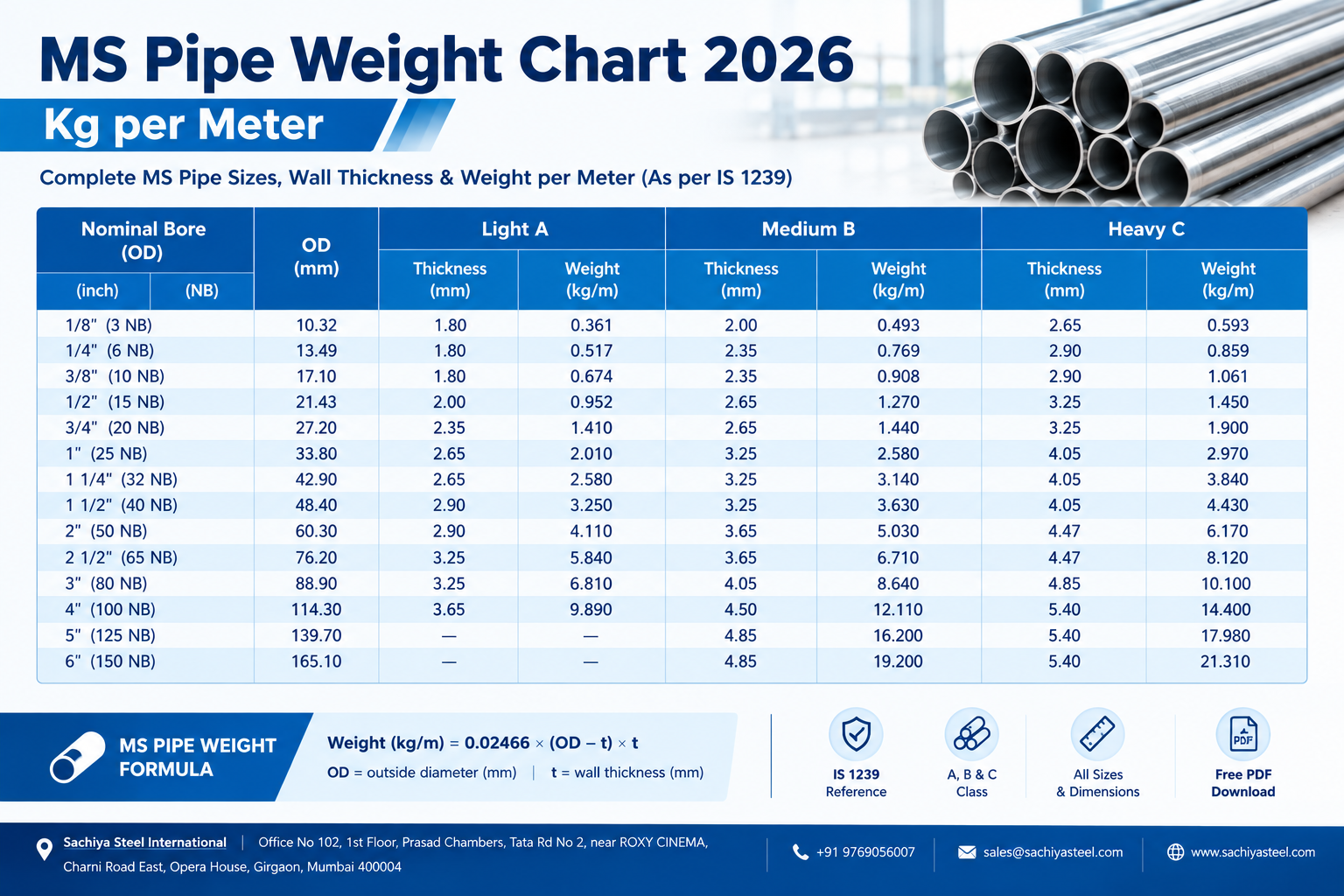
The following chart provides commonly used MS pipe dimensions and their approximate weights in kg per meter.

MS Pipe Weight Chart – IS 1239 / BS 1387 Reference

Nominal Bore OD (mm) Light A Thickness (mm) Light A Weight (kg/m) Medium B Thickness (mm) Medium B Weight (kg/m) Heavy C Thickness (mm) Heavy C Weight (kg/m)
1/8″ (3 NB) 10.32 1.80 0.361 2.00 0.493 2.65 0.593
1/4″ (6 NB) 13.49 1.80 0.517 2.35 0.769 2.90 0.859
3/8″ (10 NB) 17.10 1.80 0.674 2.35 0.908 2.90 1.061
1/2″ (15 NB) 21.43 2.00 0.952 2.65 1.270 3.25 1.450
3/4″ (20 NB) 27.20 2.35 1.410 2.65 1.440 3.25 1.900
1″ (25 NB) 33.80 2.65 2.010 3.25 2.580 4.05 2.970
1 1/4″ (32 NB) 42.90 2.65 2.580 3.25 3.140 4.05 3.840
1 1/2″ (40 NB) 48.40 2.90 3.250 3.25 3.630 4.05 4.430
2″ (50 NB) 60.30 2.90 4.110 3.65 5.030 4.47 6.170
2 1/2″ (65 NB) 76.20 3.25 5.840 3.65 6.710 4.47 8.120
3″ (80 NB) 88.90 3.25 6.810 4.05 8.640 4.85 10.100
4″ (100 NB) 114.30 3.65 9.890 4.50 12.110 5.40 14.400
5″ (125 NB) 139.70 — — 4.85 16.200 5.40 17.980
6″ (150 NB) 165.10 — — 4.85 19.200 5.40 21.310

Note: Actual supplied weights can vary because of dimensional tolerances, manufacturing method, applicable standards, and the manufacturer’s nominal weight tables. Always verify the manufacturer’s technical documentation before final procurement.

PDF Button – MS Pipe Weight Chart 2026

For engineers, fabricators, contractors, and purchasing teams, having an offline copy of the chart can make material estimation easier.

[DOWNLOAD MS PIPE WEIGHT CHART 2026 PDF]

The PDF can be used as a quick reference for checking pipe sizes, wall thicknesses, classes, and approximate kg-per-meter values during project planning and procurement.

What Is an MS Pipe?

Mild steel pipe is a low-carbon steel tubular product commonly used for construction, fabrication, utility piping, industrial systems, structural work, and engineering applications. Its combination of weldability, ductility, machinability, strength, and relatively economical material cost makes it suitable for many general-purpose applications.

Our Mild Steel Pipes are available in different sizes, wall thicknesses, and specifications according to project requirements.

MS pipes may be supplied in different manufacturing configurations, including ERW and welded pipe products, depending on the required specification and application.

MS Pipe Classes: Class A, Class B, and Class C

MS pipes are commonly discussed in three wall-thickness categories: Class A, Class B, and Class C.

Class A – Light

Class A pipes have comparatively lighter wall thicknesses and lower weight per meter. They may be selected for applications where lower material weight is suitable for the specified service.

Class B – Medium

Class B pipes have medium wall thickness and are commonly used for general-purpose piping and engineering requirements. They provide a balance between material weight, strength and cost.

For more information, refer to our MS Pipe Class A, B & C Chart.

Class C – Heavy

Class C pipes have heavier wall thicknesses and therefore higher weight per meter. They can be considered when the project specification requires a heavier wall.

See our MS C Class Pipe Thickness Chart for additional reference information.

The appropriate pipe class should always be selected according to the applicable standard, engineering requirements and service conditions.

MS Pipe Sizes and Dimensions

MS pipe dimensions are generally identified using Nominal Bore (NB), Outside Diameter (OD), and Wall Thickness.

Common MS pipe sizes include:

  • 15 NB
  • 20 NB
  • 25 NB
  • 32 NB
  • 40 NB
  • 50 NB
  • 65 NB
  • 80 NB
  • 100 NB
  • 125 NB
  • 150 NB

Larger sizes can also be supplied according to the applicable specification and required wall thickness.

For additional dimensional information, see our MS Pipe Sizes reference.

How to Calculate MS Pipe Weight Per Meter

The theoretical weight of a circular steel pipe can be calculated using:

Weight (kg/m) = 0.02466 × (OD − t) × t

Where:

  • OD = Outside diameter in mm
  • t = Wall thickness in mm
  • 0.02466 = commonly used steel pipe weight constant

Example

Suppose:

OD = 114.3 mm
Wall thickness = 4.5 mm

Then:

Weight = 0.02466 × (114.3 − 4.5) × 4.5

The theoretical result is approximately

12.18 kg/m

The calculated result should be compared with the applicable manufacturer’s nominal weight because actual dimensions and manufacturing tolerances can affect supplied weight.

MS Pipe Weight Per Meter vs. Weight Per Piece

The terms “kg/m” and “kg/piece” should not be confused.

If an MS pipe weighs 12 kg/m and the pipe length is 6 meters:

Weight per piece = 12 × 6

Weight per piece = 72 kg

Therefore:

  • Weight per meter = 12 kg
  • Pipe length = 6 m
  • Approximate weight per piece = 72 kg

The total quantity can then be estimated according to the required number of pieces.

For larger projects, the total pipe weight can be calculated using:

Total Weight = Weight per Meter × Total Length

For example, if the pipe weighs 14.40 kg/m and the required length is 120 meters:

14.40 × 120 = 1,728 kg

Therefore, the estimated material weight is 1.728 metric tonnes, before considering cutting losses, tolerances or additional procurement allowance.

MS Pipe Weight Calculator

An online MS Pipe Weight Calculator can make theoretical weight calculations faster.

Users can enter the outside diameter, wall thickness, and required length to estimate the pipe’s total weight.

A calculator is particularly useful when working with:

  • Different pipe sizes
  • Non-standard dimensions
  • Large quantities
  • Different pipe lengths
  • Project material estimates
  • Transportation planning

For final procurement, the calculated value should always be checked against the applicable standard and manufacturer’s published nominal weight.

MS Pipe Price Per Kg in India 2026

The price of MS pipe varies according to the steel market, pipe size, wall thickness, class, manufacturer, brand, quantity, delivery location, GST, freight, and testing requirements.

Indicative MS Pipe Price Table – 2026

MS Pipe Product Indicative 2026 Price Range
MS Pipe ₹57–₹72/kg
MS ERW Pipe ₹58–₹75/kg
MS Round Pipe ₹60–₹80/kg
MS Structural Pipe ₹60–₹77/kg
Heavy Class MS Pipe ₹65–₹85/kg
Large-Diameter MS Pipe ₹65–₹95/kg

These figures are indicative market ranges rather than fixed quotations. Actual prices can vary according to specification, brand, quantity, location, taxes, freight, and commercial terms.

For more information, visit our MS Pipe Price page.

How Weight Affects MS Pipe Price

When the quotation is provided on a per-kilogram basis, pipe weight can be used to estimate the approximate price per meter.

Price per meter = Weight per meter × Price per kg

For example:

14.40 kg/m × ₹70/kg = ₹1,008 per meter

For a 6-meter pipe:

₹1,008 × 6 = ₹6,048 per pipe

This is only a material-cost calculation. GST, freight, testing, cutting, coating and other applicable charges may be additional.

Factors That Affect MS Pipe Weight

Several factors influence the weight of an MS pipe.

1. Outside Diameter

A larger outside diameter generally increases the quantity of steel used for a given wall thickness.

2. Wall Thickness

Wall thickness has a direct effect on weight. Increasing thickness increases the amount of steel in the pipe and therefore increases kg per meter.

3. Length

Weight per meter is a dimensional reference, while total weight depends on the complete pipe length.

Total Weight = Weight per Meter × Total Length

4. Steel Density

The theoretical formula uses a standard density-based constant. Small differences can occur because of material composition and manufacturing tolerances.

5. Manufacturing Tolerance

Actual dimensions may vary within the tolerances permitted by the relevant product specification.

Large Diameter MS Pipe Weight

Large-diameter MS pipes require separate consideration because their dimensions and applicable manufacturing specifications may differ from commonly listed smaller pipe sizes.

Nominal Size Approx. OD Wall Thickness Approx. Weight
7″ 193.7 mm 4.85 mm 22.59 kg/m
8″ 219.1 mm 5.20 mm 27.45 kg/m
10″ 273.0 mm 5.60 mm 36.85 kg/m
12″ 323.9 mm 6.00 mm 47.06 kg/m
14″ 355.6 mm 6.35 mm 54.65 kg/m
16″ 406.4 mm 7.01 mm 68.99 kg/m

Large-diameter pipe weights should be verified against the applicable product specification and actual supplied dimensions before commercial use.

Why the MS Pipe Weight Chart Is Important

The MS Pipe Weight Chart 2026 provides a convenient way to convert pipe dimensions into practical material quantities. Instead of calculating each pipe individually, buyers can refer to the chart to estimate approximate kg per meter.

The chart can help with:

  • Material estimation
  • Project quantity calculations
  • Transportation planning
  • Procurement
  • Cost estimation
  • Fabrication planning
  • Inventory management
  • Tender and BOQ preparation
  • Warehouse stock estimation
  • Logistics planning

For example, knowing the kg/m value allows a procurement team to estimate the approximate total tonnage required for a project before requesting a quotation.

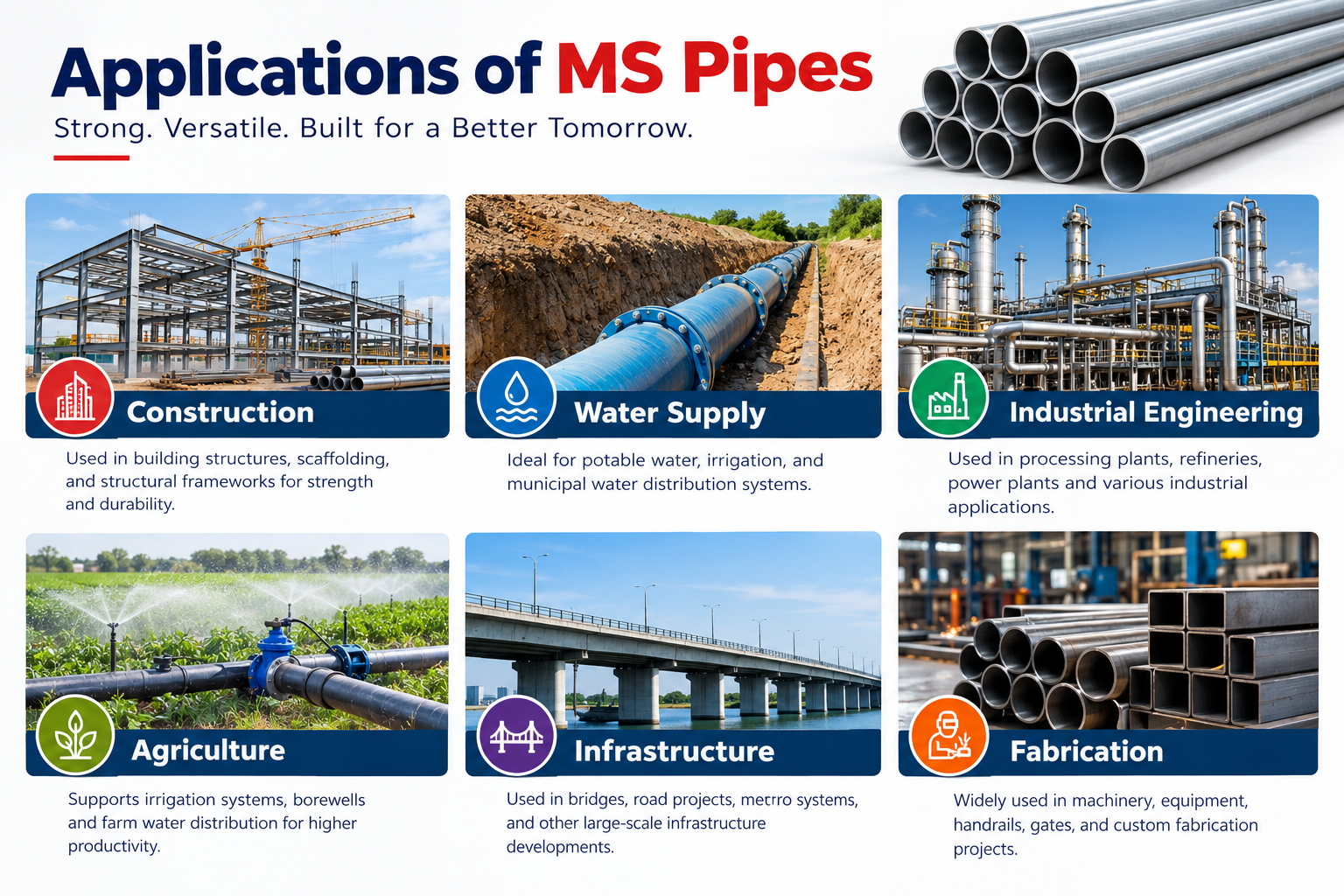
Applications of MS Pipes

MS Pipe Weight Chart 2026

MS pipes are used across many industries and engineering applications.

Construction

Used for structural supports, frameworks, railings, scaffolding, fencing, and general fabrication.

Water Supply

Suitable MS pipe specifications may be used for water transmission and utility systems where carbon steel is appropriate.

Industrial Engineering

Used for equipment supports, utility lines, fabrication, plant structures, and general engineering applications.

Agriculture

Used in irrigation systems, agricultural structures, water conveyance, and farm infrastructure.

Infrastructure

Used for barriers, utility supports, protective structures, poles, and other infrastructure requirements.

Fabrication

Mild steel’s weldability and machinability make it suitable for fabricated structures, frames, and mechanical assemblies.

Advantages of MS Pipes

MS pipes are widely used because they provide a combination of fabrication flexibility, availability, and mechanical properties.

Key advantages include:

  • Good weldability
  • Good ductility
  • Easy fabrication
  • Wide size availability
  • Multiple wall-thickness options
  • Suitable for structural applications
  • Easy cutting and machining
  • Broad availability
  • Competitive material cost

However, MS pipes are not inherently corrosion-proof. Depending on the service environment, painting, galvanizing, coating, lining or another suitable corrosion-control method may be required.

How to Select the Correct MS Pipe

Selecting an MS pipe should not be based only on weight. Buyers should consider the complete technical and commercial requirement.

Step 1: Identify the Nominal Bore

Determine the required nominal pipe size.

Step 2: Confirm the Outside Diameter

Check the OD specified by the applicable standard.

Step 3: Select Wall Thickness

Choose the required wall thickness based on the engineering and service requirements.

Step 4: Select Pipe Class

Where applicable, identify whether Light, Medium or Heavy class is required.

Step 5: Check the Applicable Standard

Verify the relevant IS, BS, ASTM, API or project specification.

Step 6: Calculate Required Quantity

Determine the required length and approximate total weight.

Step 7: Request a Current Quotation

Provide the exact size, thickness, class, quantity and delivery location to obtain a specification-specific quotation.

FAQ – MS Pipe Weight Chart 2026

1. What is an MS Pipe Weight Chart?

An MS Pipe Weight Chart is a reference table showing the approximate weight of mild steel pipes according to nominal size, outside diameter, wall thickness and pipe class.

2. What is the formula for MS pipe weight per meter?

The commonly used theoretical formula is:

Weight (kg/m) = 0.02466 × (OD − t) × t

Here, OD is the outside diameter in millimeters and t is the wall thickness in millimeters.

3. What is the weight of a 4-inch MS pipe?

The weight depends on wall thickness and pipe class. For example, a 4-inch pipe with approximately 114.3 mm OD and 4.5 mm wall thickness has a theoretical weight of around 12.18 kg/m.

4. What is the difference between Class A, Class B, and Class C MS pipes?

Class A generally represents a lighter wall category, Class B a medium wall category, and Class C a heavier wall category. Exact dimensions should be checked against the applicable specification.

5. How do I calculate the total weight of MS pipes?

Multiply the weight per meter by the total required length.

Total Weight = Weight per Meter × Total Length

For example, 10 kg/m × 100 m = 1,000 kg.

6. What factors affect MS pipe weight?

Pipe weight is affected by outside diameter, wall thickness, length, steel density, and manufacturing tolerances.

7. What is the MS pipe price per kg in India in 2026?

Indicative September 2026 market references in this article show different rates according to pipe type and supplier. Several common MS/ERW categories are listed around ₹57–₹75/kg, while larger or heavier products may have higher rates. Buyers should request a current quotation for the exact specification.

8. What is the standard length of an MS pipe?

Six meters is a common commercial pipe length, although other lengths, such as 3 m, 9 m, 12 m, and customized lengths, may be available depending on the product and supplier.

9. Can an MS pipe weight calculator calculate different pipe sizes?

Yes. A calculator can estimate theoretical pipe weight using the outside diameter and wall thickness. The calculated result should be compared with the manufacturer’s nominal weight for procurement.

10. Can this MS Pipe Weight Chart be used for procurement?

The chart is useful for preliminary estimation, costing, logistics, and material planning. For final procurement, buyers should verify the applicable standard, dimensions, tolerances, manufacturer’s data, inspection requirements, and current quotation.

Download MS Pipe Weight Chart 2026 PDF

For quick offline reference, download the MS Pipe Weight Chart 2026 PDF containing the relevant pipe size and weight information.

[DOWNLOAD MS PIPE WEIGHT CHART 2026 PDF]

Final Note

The MS Pipe Weight Chart 2026 – Kg per Meter, All Sizes + PDF provides a practical reference for understanding MS pipe dimensions, wall thickness, pipe class, and approximate weight per meter. Combining the chart with an online calculator can simplify material estimation, project planning, transportation calculations, and preliminary cost analysis.

For commercial purchasing, weight should not be considered the only selection factor. Always confirm the pipe standard, nominal size, outside diameter, wall thickness, class, grade, quantity, testing requirements, delivery location, and current market price before placing an order.

For MS pipe requirements, bulk quantities, technical specifications, and current quotations, contact Sachiya Steel International with your required pipe size, thickness, and quantity.

By |2026-09-26T10:44:33+05:30January 18th, 2020|Blogs, Weight Chart|

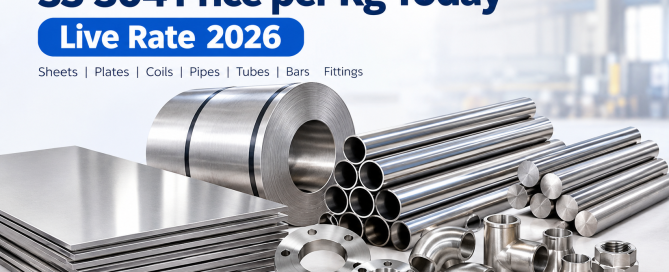
SS 304 Price per Kg. Today – Live Rate, 2026

SS 304 Price per Kg. Today – Live Rate, 2026

Last Updated: September 2026

SS 304 Price per Kg. Today in India—Live Rate 2026

The SS 304 price per kg today in India depends on the product form, thickness, finish, manufacturing process, quantity, supplier, testing requirements, taxes, freight, and delivery location. There is no single fixed rate applicable to every SS 304 product.

As a September 2026 market reference, standard SS 304 material is broadly around ₹210–₹280 per kg, while individual products such as sheets, coils, pipes, tubes, bars, flanges, fittings, and fasteners can be quoted at different rates.

Current market references also track SS 304 according to specific specifications. For example, BigMint lists SS 304 cold-rolled material in the 1–3 mm, 2B-finish category and hot-rolled material in the 3–25 mm, No. 1-finish category for the Mumbai market. This demonstrates why buyers should request a product-specific quotation rather than relying only on a general SS 304 price per kg.

SS 304 Price Chart 2026

SS 304 Product Indicative 2026 Price Range
SS 304 Standard Material ₹210–₹280/kg
SS 304 Cold Rolled Sheet ₹220–₹325/kg
SS 304 Hot Rolled Sheet ₹185–₹235/kg
SS 304 Coil ₹225–₹300/kg
SS 304 Plate ₹195–₹280/kg
SS 304 Welded Pipe ₹215–₹330/kg
SS 304 Seamless Pipe ₹235–₹355/kg
SS 304 Tube ₹215–₹330/kg
SS 304 Round Bar ₹220–₹300/kg
SS 304 Bright Bar ₹230–₹315/kg
SS 304 Flanges ₹280–₹420/kg
SS 304 Butt Weld Fittings ₹275–₹420/kg
SS 304 Fasteners ₹290–₹450/kg

Important: These are indicative market reference ranges for 2026 and should not be treated as fixed quotations. The final SS 304 price can change according to grade, specification, dimensions, finish, quantity, brand, testing, GST, freight, and availability.

What Is the SS 304 Price per Kg Today?

The SS 304 price per kg today can vary significantly depending on what type of material you are purchasing.

For example, a standard stainless steel sheet may have a different price from a polished sheet. Similarly, a welded SS 304 pipe may cost less per kg than a seamless pipe because the manufacturing process, inspection, tolerances, and finishing requirements are different.

Current market data supports specification-based pricing rather than a single universal rate. BigMint’s September 2026 listings separately identify SS 304 HRC, CRC, black round bars, bright bars, and other product categories.

For an accurate quotation, buyers should provide the supplier with:

  • SS grade
  • Product type
  • Thickness or diameter
  • Length and width
  • Surface finish
  • Quantity
  • Applicable standard
  • Testing requirements
  • Delivery location

SS 304 Sheet Price per Kg 2026

SS 304 sheets are widely used for fabrication, kitchen equipment, food-processing machinery, tanks, enclosures, architectural products, and industrial equipment.

The SS 304 sheet price per kg depends mainly on:

  • Thickness
  • Width and length
  • Cold-rolled or hot-rolled condition
  • 2B finish
  • BA finish
  • No. 4 finish
  • Mirror finish
  • Manufacturer or mill
  • Quantity
  • Cutting requirements
  • Testing and certification

Indicative 2026 references can vary from approximately ₹185/kg for certain hot-rolled specifications to higher prices for cold-rolled and finished material.

A February 2026 Mumbai-market reference included indicative basic rates for particular SA 240 Type 304 thickness ranges, illustrating how thickness and manufacturing condition can affect pricing.

SS 304 Sheet Price Reference

Sheet Type Indicative Reference
SS 304 CR 1–3 mm Around ₹205/kg and upward
SS 304 HR 4–12 mm Around ₹185/kg and upward
SS 304 HR 13–100 mm Around ₹195/kg and upward
Finished Sheet Usually higher
Mirror Finish Sheet Usually higher

These figures are reference values only. Always request a current quotation for the exact specification.

SS 304 Pipe Price per Kg 2026
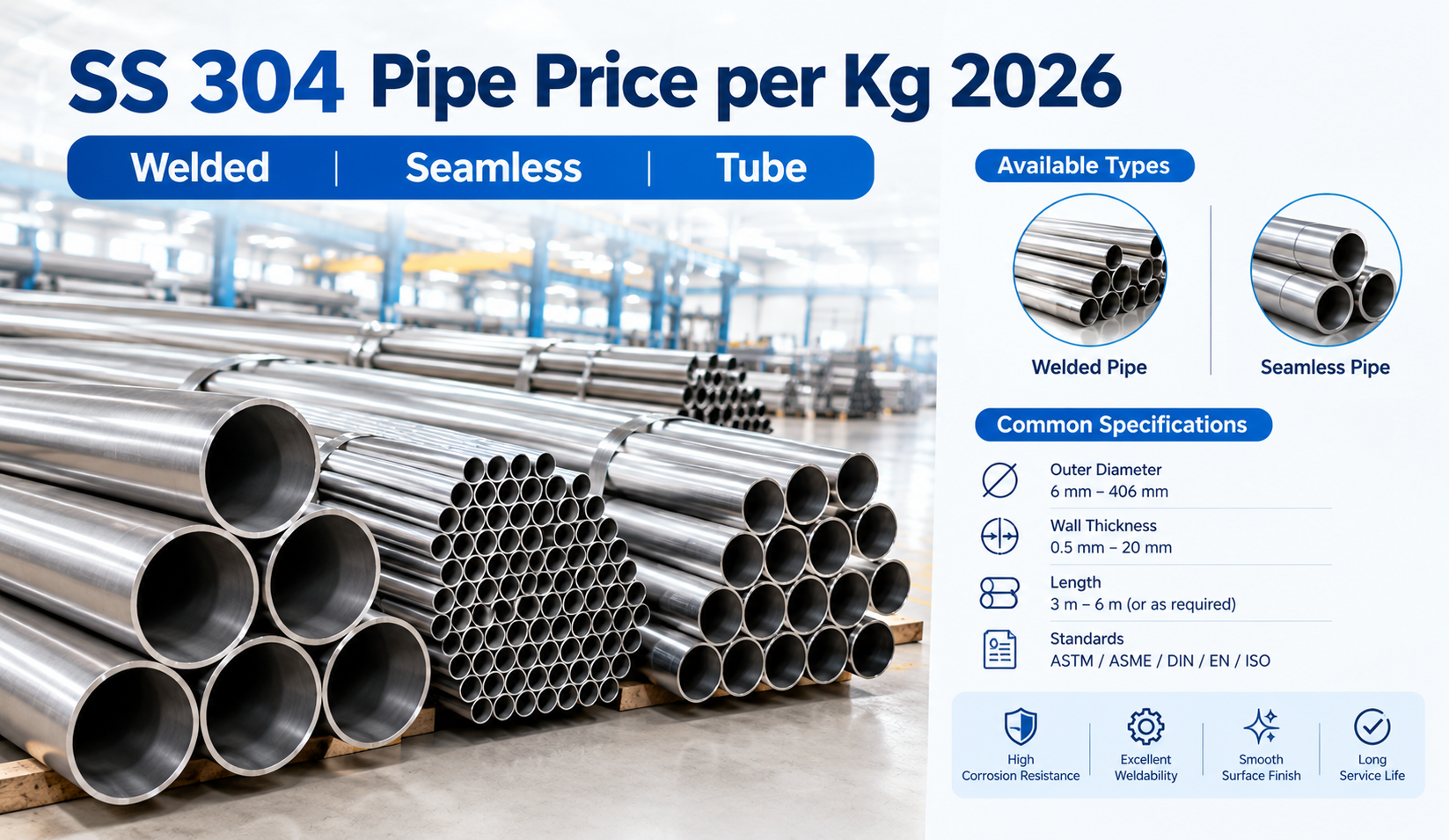
SS 304 pipe price per kg 2026 welded seamless tube

The SS 304 pipe price per kg depends on diameter, wall thickness, schedule, manufacturing method, finish, testing, and quantity.

SS 304 pipes are commonly used in:

  • Food-processing plants
  • Pharmaceutical equipment
  • Water systems
  • Chemical-processing applications
  • Industrial process lines
  • Heat exchangers
  • General fabrication
  • Engineering projects

SS 304 Pipe Price Chart

Pipe Type Indicative 2026 Range
SS 304 Welded Pipe ₹215–₹330/kg
SS 304 Seamless Pipe ₹235–₹355/kg
Small-Diameter Pipe Specification dependent
Heavy-Wall Pipe Specification dependent
Polished Pipe Additional finishing cost
Large-Diameter Pipe Project-specific

For pipes, buyers should compare price per kg and price per meter, because the weight per meter changes with outside diameter and wall thickness.

SS 304 Coil Price per Kg 2026

SS 304 coils are commonly purchased by fabricators and manufacturers requiring continuous material for cutting, stamping, forming, and further processing.

The indicative 2026 SS 304 coil price range is approximately ₹225–₹300 per kg.

The quotation can depend on:

  • Coil width
  • Thickness
  • Coil weight
  • 2B or No. 1 finish
  • Edge condition
  • Mill source
  • Slitting requirements
  • Packing
  • Quantity
  • Delivery location

BigMint’s current market listings distinguish SS 304 cold-rolled and hot-rolled material according to thickness and finish, reinforcing the importance of specifying these details in an RFQ.

SS 304 Round Bar Price per Kg 2026

SS 304 round bars are used for shafts, fasteners, machined components, engineering parts, fabrication, and industrial equipment.

Indicative 2026 pricing can be around ₹220–₹300/kg, while bright bars and precision-machined products may have additional processing costs.

The final rate depends on:

  • Diameter
  • Black or bright condition
  • Length
  • Tolerance
  • Surface finish
  • Straightness
  • Quantity
  • Testing
  • Cutting

BigMint separately tracks SS 304 black round bars and bright bars, so these products should not automatically be assumed to have identical prices.

SS 304 Flanges and Fittings Price 2026

SS 304 flanges and fittings generally have a higher price per kg than basic sheet or coil because they require additional forming, machining, dimensional control, and inspection.

Product Indicative 2026 Range
SS 304 Slip-On Flange ₹280–₹390/kg
SS 304 Weld Neck Flange ₹300–₹420/kg
SS 304 Blind Flange ₹290–₹410/kg
SS 304 Elbow ₹275–₹390/kg
SS 304 Tee ₹280–₹400/kg
SS 304 Reducer ₹280–₹410/kg
SS 304 Coupling ₹280–₹400/kg

The actual price should be requested against the required pressure class, dimensions, standard, finish, quantity, and testing requirements.

Why Does SS 304 Price Change?

The SS 304 market does not operate on one fixed annual price. Several factors influence the final quotation.

Nickel and Chromium

SS 304 is an austenitic chromium-nickel stainless steel. Its commonly specified chemistry includes approximately 18–20% chromium and 8–10.5% nickel. Changes in alloy input costs can influence stainless steel pricing.

Product Form

Sheet, plate, pipe, tube, round bar, flange, and fitting products require different manufacturing processes. Therefore, the same SS 304 grade can have different prices per kg.

Surface Finish

2B, BA, No. 4, brushed, polished, and mirror finishes require different processing levels. Additional finishing can increase the final price.

Thickness

Standard stock thicknesses can be easier to source than special or non-standard thicknesses. Special production or limited availability can affect the quotation.

Quantity

Large industrial orders and small quantities may receive different rates because procurement, handling, cutting, packing, and logistics costs are distributed differently.

Freight

A Mumbai ex-stock price may not be the same as a delivered price to another Indian state. Freight should therefore be considered when comparing quotations.

Testing and Certification

PMI, third-party inspection, EN 10204 3.1 documentation, chemical analysis, mechanical testing, and other project-specific requirements may increase the final order value.

SS 304 Chemical Composition

Element SS 304
Carbon (C) Max. 0.08%
Manganese (Mn) Max. 2.00%
Silicon (Si) Max. 0.75%
Phosphorus (P) Max. 0.045%
Sulfur (S) Max. 0.030%
Chromium (Cr) 18.00–20.00%
Nickel (Ni) 8.00–10.50%
Nitrogen (N) Max. 0.10%

SS 304’s chromium-nickel composition contributes to its corrosion resistance, fabrication characteristics, and broad industrial use. Current 2026 technical guidance also identifies these typical chromium and nickel ranges.

SS 304 Mechanical Properties

Mechanical Property Typical / Minimum Reference
Tensile Strength 515 MPa minimum
Yield Strength, 0.2% 205 MPa minimum
Elongation 40% minimum
Rockwell Hardness HRB 92 maximum
Brinell Hardness HB 201 maximum

Mechanical properties can vary according to product form, condition, cold working, and the applicable material specification.

SS 304 Physical Properties

Property Approximate Value
Density 8,000 kg/m³
Elastic Modulus 193 GPa
Thermal Expansion Approximately 17.2 × 10⁻⁶/°C
Thermal Conductivity Approximately 16–17 W/m·K
Specific Heat Approximately 500 J/kg·K
Electrical Resistivity Approximately 0.72 μΩ·m

These values are general engineering references. Project calculations should use the values specified by the applicable design standard.

SS 304 Equivalent Grades

Standard Designation
UNS S30400
EN Material Number 1.4301
EN Grade X5CrNi18-10
JIS SUS 304
British Designation 304S31
AISI 304

Equivalent designations should always be checked against the applicable product standard before material substitution.

SS 304 vs Other Stainless Steel Grades Price 2026

Grade General Price Relationship
SS 201 Generally below SS 304
SS 202 Generally below SS 304
SS 304 Broad reference ₹210–₹280/kg
SS 304L Can be around or above 304 depending on product
SS 316 Generally higher than SS 304
SS 316L Generally higher than SS 304
SS 321 Generally higher than SS 304
SS 310/310S Generally higher than SS 304
SS 430 Often below SS 304

This is a general comparison rather than a fixed price list. Product form, market conditions, alloy inputs, finish, quantity, and supplier can change the actual difference.

SS 304 Applications in 2026
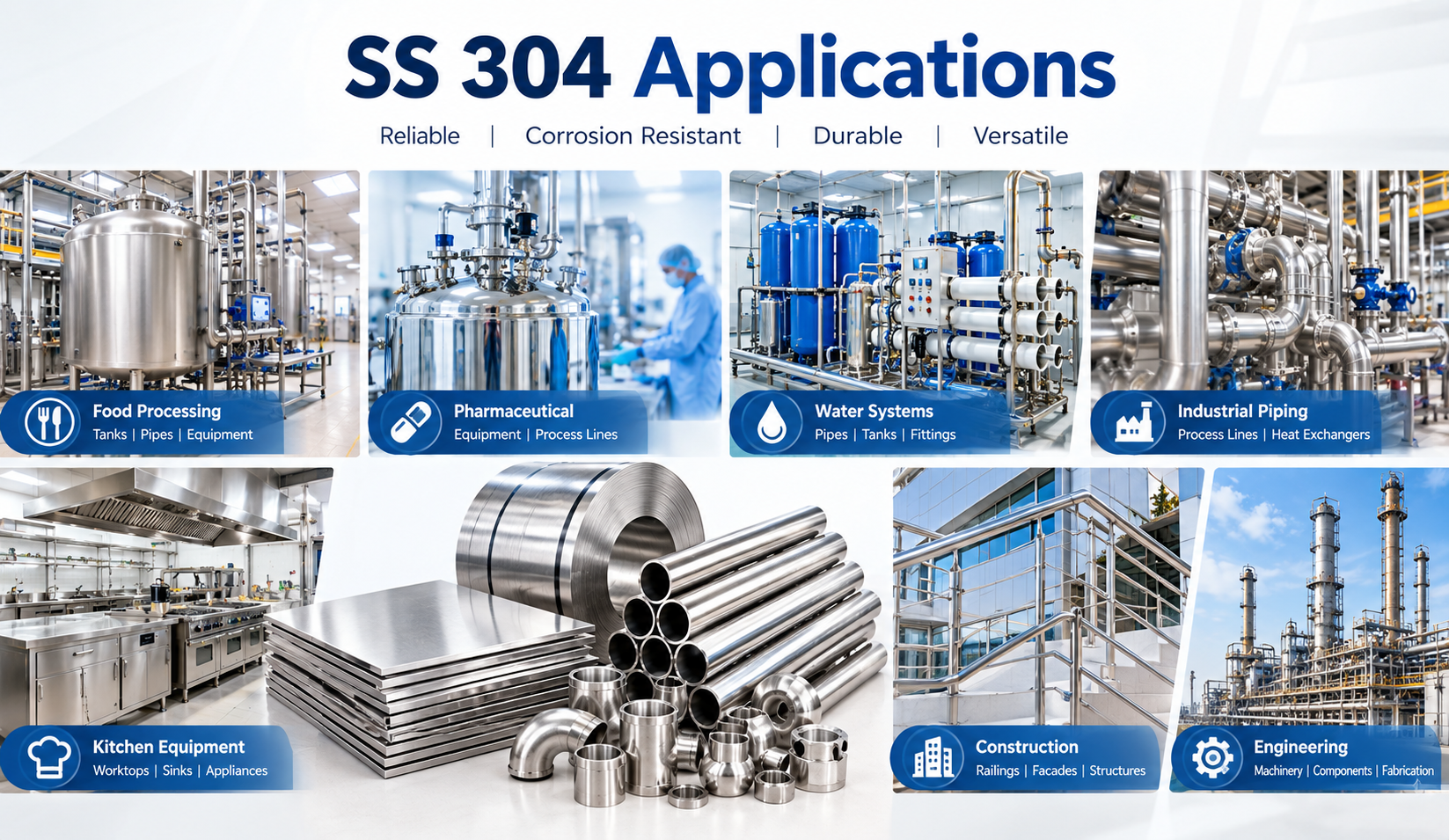
SS 304 stainless steel applications 2026

SS 304 continues to be widely used because of its combination of corrosion resistance, formability, weldability, availability, and general engineering performance. Tata Nexarc’s September 2026 technical overview also identifies food processing, pharmaceutical equipment, water systems, infrastructure, and industrial fabrication among its applications.

Food Processing

SS 304 is commonly used in food-processing equipment, preparation areas, tanks, conveyors, commercial kitchens, and food-handling equipment.

Pharmaceutical Industry

It can be used for equipment and components where clean surfaces, corrosion resistance, and fabrication characteristics are required.

Chemical Processing

SS 304 can be suitable for many general chemical applications, although the exact chemical environment must always be evaluated before selecting the material.

Water Systems

The grade is used for tanks, pipes, tubes, fittings, and water-handling equipment.

Construction

Architectural panels, railings, decorative products, fabricated components, and other construction products can be manufactured from SS 304.

Automotive and Engineering

SS 304 is used in various machined parts, brackets, fabricated components, and general engineering applications.

Is SS 304 Suitable for Coastal Areas?

SS 304 provides good general corrosion resistance, but it should not be considered completely immune to chloride exposure.

Coastal and saltwater environments can increase the risk of staining and localized corrosion. Material selection should consider:

  • Chloride concentration
  • Temperature
  • Exposure period
  • Cleaning conditions
  • Surface finish
  • Crevice conditions
  • Required service life

For severe chloride exposure, engineers may evaluate SS 316/316L or another suitable corrosion-resistant alloy.

SS 304 vs SS 304L

SS 304 and SS 304L have similar general characteristics, but SS 304L has a lower carbon content.

The lower carbon version is commonly selected for welded fabrication when reduced sensitization risk is an important consideration.

The selection should consider:

  • Welding requirements
  • Applicable design standard
  • Service environment
  • Heat-treatment requirements
  • Product availability
  • Project specifications

How to Calculate SS 304 Material Cost

A simple purchasing calculation is:

Total Material Cost = Material Weight × Price per Kg

Example

Suppose you require 500 kg of SS 304 and the quoted rate is ₹240/kg.

500 × ₹240 = ₹120,000

Therefore, the basic material value is ₹120,000.

If cutting, polishing, machining, testing, packing, GST, or freight is charged separately, those costs should be added to the final purchase value.

How to Get the Correct SS 304 Price Today

To receive an accurate quotation instead of a generic market rate, provide complete technical and commercial information.

1. Specify the Grade

Clearly mention SS 304 or SS 304L.

2. Specify the Product

Mention whether you require:

  • Sheet
  • Plate
  • Coil
  • Pipe
  • Tube
  • Round bar
  • Flange
  • Fitting
  • Fastener

3. Provide Dimensions

Include:

  • Thickness
  • Diameter
  • Length
  • Width
  • Schedule
  • Pressure class where applicable

4. Mention Surface Finish

For sheets and coils, specify 2B, BA, No. 4, brushed, polished, or mirror finish where required.

5. State Quantity

Mention the requirement in pieces, kilograms, metres, or metric tonnes.

6. Specify Certification

Where required, mention:

  • EN 10204 3.1
  • EN 10204 3.2
  • PMI
  • Third-party inspection
  • Chemical analysis
  • Mechanical testing

7. Give Delivery Location

The delivery location is important because freight can materially affect the final landed price.

SS 304 Quality Testing and Documentation

Industrial buyers may require more than a commercial invoice. Depending on the project specification, documentation can include:

  • Material Test Certificate
  • Chemical Composition Report
  • Mechanical Test Report
  • PMI Report
  • EN 10204 3.1 Certificate
  • EN 10204 3.2 Certificate
  • Dimensional Inspection Report
  • Hydrostatic Test Report for applicable pipes
  • Radiography Report where applicable
  • Third-Party Inspection Report
  • Packing List
  • Certificate of Origin
  • Heat Number Traceability

Testing requirements should be agreed before order placement because additional inspection can affect both cost and delivery time.

SS 304 Price per Kg Today – What Buyers Should Monitor

Because stainless steel prices can change during the year, buyers should monitor the major factors that influence the market.

Factor Why It Matters
Nickel Important alloying input for SS 304
Chromium Major stainless-steel alloying element
Stainless Scrap Influences raw-material economics
Domestic Mill Rates Directly affects Indian quotations
Import Availability Can influence supply
Market Demand Affects stock and pricing
Currency Movement Relevant to imported inputs
Freight Changes delivered cost
GST and Taxes Affect final purchase value
Product Availability Can influence short-term quotations

Current September 2026 market listings demonstrate that SS 304 is being tracked by specific product forms and specifications rather than one universal market number.

SS 304 Stockist and Supplier in India

Sachiya Steel International Private Limited supplies stainless steel products for industrial, engineering, fabrication, and project requirements.

Buyers can request quotations for SS 304 sheets, plates, pipes, tubes, round bars, flanges, fittings, fasteners, and other stainless steel products.

For an accurate quotation, provide:

Grade: SS 304
Product: Sheet / Plate / Pipe / Tube / Bar / Fitting
Size: Required dimensions
Thickness: Required thickness
Finish: Required finish
Quantity: Kg / MT / Pieces
Testing: MTC / PMI / Third-party inspection if required
Delivery: Required location

Contact: +91 9769056007
Email: [email protected]
Website: https://sachiyasteel.com/

Frequently Asked Questions About SS 304 Price per Kg Today

1. What is the SS 304 price per kg today in India in 2026?

The broad September 2026 reference range for standard SS 304 is approximately ₹210–₹280 per kg. Actual prices vary according to product form, thickness, finish, quantity, supplier, testing, taxes, freight, and location.

2. What is the SS 304 sheet price per kg?

SS 304 sheet prices depend on thickness, finish, and whether the material is hot rolled or cold rolled. Indicative 2026 references can range from around ₹185/kg for certain hot-rolled specifications to higher rates for cold-rolled and finished products.

3. What is the SS 304 pipe price per kg?

Indicative 2026 SS 304 pipe and tube prices can fall approximately within ₹215–₹355/kg, depending on welded or seamless construction, diameter, wall thickness, finish, testing, and quantity.

4. What is SS 304 made of?

SS 304 primarily consists of iron, chromium, and nickel, with commonly specified chromium of approximately 18–20% and nickel of approximately 8–10.5%.

5. Is SS 304 magnetic?

Annealed SS 304 is generally considered non-magnetic, although cold working can produce some magnetic response.

6. Is SS 304 suitable for food applications?

Yes. SS 304 is widely used in food-processing equipment, commercial kitchens, tanks, and food-handling applications because of its corrosion resistance, cleanability, and fabrication characteristics.

7. What is the difference between SS 304 and SS 304L?

SS 304L is the lower-carbon version of SS 304 and is frequently selected for welded fabrication where lower carbon content is required.

8. Does SS 304 rust?

SS 304 has good corrosion resistance but is not completely corrosion-proof. Chloride-rich, coastal, and aggressive chemical environments can cause staining or localized corrosion.

9. Is SS 316 more expensive than SS 304?

SS 316 generally has a higher price than SS 304 because its alloy chemistry includes molybdenum and its raw-material requirements differ. The actual difference depends on the product and market conditions.

10. How can I get the latest SS 304 price per kg?

Provide the supplier with the exact grade, product form, dimensions, thickness, finish, quantity, standard, testing requirements, and delivery location. This allows the supplier to provide a specification-specific quotation.

Final SS 304 Price Update – 2026

The SS 304 price per kg today should be treated as an indicative market reference rather than a fixed universal price. Current market references show that pricing varies by product form, thickness, finish, specification, and delivery basis.

For an exact current quotation, buyers should provide the complete material specification, required quantity, finish, testing requirements, and delivery location.

Price Disclaimer: All prices mentioned in this article are indicative 2026 market references and are provided for budgeting and general information. Stainless steel prices can change because of nickel and chromium costs, stainless scrap, mill rates, demand, supply, product specifications, finish, quantity, testing, freight, taxes, currency movements, and stock availability. Always obtain a current supplier quotation before placing an order.

By |2026-10-02T11:36:08+05:30January 13th, 2020|Blogs|

SS Seamless Pipe Manufacturers in India

Stainless Steel Seamless Pipe Manufacturers In India

Sachiya Steel International Private Limited stands out as a premier seamless pipe manufacturers in India, thanks to our dedication to quality and cutting-edge technology. Every seamless pipe we produce bears the hallmark of excellence; when you choose Sachiya Steel International as your seamless pipe supplier, you are selecting not just a manufacturer; instead you are selecting reliability and durability in every inch of its seamless pipe production. With extensive expertise in the manufacture of stainless steel seamless pipes, Sachiya Steel International utilizes advanced manufacturing facilities and technical capabilities to deliver superior products.

In India the top carbon steel and seamless steel alloy pipe producers include Jindal SAW, Maharashtra Seamless Limited, Ratnamani Pipes & Tubes and ISMT. We are equipped to cater to specific customer requirements, offering customized solutions, customer-supplied raw materials, and minimum order quantities for specialized applications. In the case of stainless steel, based on our estimates, 70 percent of the items are imported, due to the huge costs for making in India. There are different types of stainless steel pipes available, including seamless, welded, and ERW pipes, manufactured in various standards such as ASTM and ASME, and a wide range of sizes to meet diverse industrial needs. Our prices for seamless pipes in India start at just ₹120 per kilogram, ensuring that you receive the highest quality products at a highly competitive rate.

Stainless Steel Seamless Pipe Manufacturers In India

Below is a list of the top high-end Seamless Pipe Manufacturers In India and carbon steel pipe manufacturer in india. For immediate delivery or factory-priced seamless pipe please get in touch with Sachiya Steel International Private Limited. With our vast inventory of raw materials, we can offer tailored solutions to meet each customer’s specific requirements, and our daily sales exceeding 250 tones allow us to give you the best price as well as lower cost of the factory directly.

Jindal SAW Ltd India

Maharashtra Seamless Ltd.

India
ISMT

Pune

Ratnamani Pipes & Tubes

India

Sachiya Steel International and the companies listed above are recognized as leading tubes manufacturers in India, with expertise in producing both pipes and tubes for a wide range of industries including marine, petroleum, power, and construction.

SS Seamless Pipe Manufacturers in India

Introduction to Stainless Steel

Stainless steel is a highly versatile and durable alloy, renowned for its exceptional corrosion resistance and strength. This unique combination of properties makes stainless steel an essential material across a wide range of industries, including construction, aerospace, manufacturing, and more. Stainless steel pipes and tubes are especially valued for their ability to withstand harsh environments, high pressures, and demanding operational conditions, ensuring long-lasting performance and safety.

As a leading manufacturer and supplier of stainless steel pipes and tubes in India, companies such as Oshwin Overseas, Nisco Steel India, Rashmi Seamless, and Divine Tubes Pvt. Ltd are committed to delivering products that meet stringent international standards. Their stainless steel pipes and tubes are manufactured using advanced processes and high-quality materials, resulting in products that offer superior durability, reliability, and corrosion resistance. Whether used in construction projects, industrial plants, or aerospace applications, stainless steel pipes and tubes provide the strength and performance required for critical operations. The wide range of available grades, sizes, and specifications ensures that customers can find the perfect solution for their specific needs, making stainless steel a preferred choice for industries seeking quality and longevity.


Types of Pipes

The world of industrial piping offers several types of pipes, each designed to meet specific application requirements. The most common categories include seamless pipes, welded pipes, and ERW (Electric Resistance Welded) pipes.

Seamless pipes are produced by piercing a solid billet of steel and then extruding it into a hollow tube, resulting in a product with no seams or welds. This seamless construction provides superior strength, uniformity, and resistance to cracking, making stainless steel seamless pipes ideal for high-pressure and high-temperature environments. Manufacturers like Rashmi Seamless are known for producing stainless steel seamless pipes that deliver outstanding durability and corrosion resistance, ensuring reliable performance in demanding applications.

Welded pipes are created by joining two pieces of metal together along a seam using various welding techniques. While welded pipes are suitable for many applications, the presence of a seam can make them less suitable for certain high-pressure or corrosive environments compared to seamless pipes.

ERW pipes are manufactured using an electric resistance welding process, where the edges of steel strips are fused together using electric current. This method produces pipes with a consistent wall thickness and smooth finish, suitable for a variety of structural and low-pressure uses.

Each type of pipe—seamless, welded, and ERW—offers distinct advantages depending on the intended use. Stainless steel seamless pipes, in particular, are favored for their high strength, excellent corrosion resistance, and suitability for critical, high-pressure applications in industries such as oil and gas, chemical processing, and power generation.


Pipes and Tubes

Pipes and tubes are fundamental components in the transport of fluids, gases, and other materials across a wide range of industries. While both are cylindrical in shape, they can differ in terms of dimensions, wall thickness, and intended applications. Stainless steel pipes and tubes are especially popular due to their outstanding corrosion resistance, strength, and durability, making them suitable for use in harsh environments and demanding industrial processes.

Available in a variety of materials—including stainless steel, alloy steel, and carbon steel—pipes and tubes come in different shapes such as round, square, and rectangular, with a broad range of diameters and wall thicknesses to suit specific requirements. The wall thickness is a critical factor, as it determines the pipe or tube’s ability to withstand internal pressure and mechanical stress. Leading manufacturers like Divine Tubes Pvt. Ltd and Nisco Steel India offer stainless steel pipes and tubes in a wide array of dimensions and specifications, ensuring compatibility with diverse industry needs.

The manufacturing process for pipes and tubes involves several precise steps, including annealing to enhance ductility, pickling to remove surface impurities, and straightening to ensure dimensional accuracy. To guarantee the highest quality and performance, third party inspection and rigorous testing are conducted at various stages of production. This ensures that every pipe and tube meets international standards and detailed specifications for strength, corrosion resistance, and durability. Whether used in construction, chemical processing, or hydraulic systems, stainless steel pipes and tubes deliver reliable performance and long service life, making them a preferred choice for industries across India and around the world.

Seamless Pipe Manufacturing Process

Seamless steel pipes, an essential component in industries including oil and gas, are manufactured with extreme precision and quality control. Precise dimension control is critical in the manufacture of seamless pipes to ensure consistent quality, accurate sizing, and optimal performance in demanding applications. In contrast to welded pipes that feature visible weld seams, carbon steel seamless pipes are created without visible weld seams for complete homogeneity. Manufacturing processes typically begin with selecting high-grade raw materials, then cold drawing of pipes formed without seams for seamless operation and to ensure structural integrity and freedom from imperfections. The production of ss seamless pipes offers significant advantages for high-pressure applications due to their superior strength and absence of welds.

Specialized pipe mills rely on cutting-edge technology to refine dimensions and surface finish for superior products, while quality control measures play a vital role throughout production to guarantee reliable steel seamless tubes for critical applications. From raw material selection to final production, seamless pipes represent precision engineering excellence at its finest.

Steel pipes used in the oil and gas industry require considerable care in their manufacturing to ensure they’re strong yet smooth, without visible seams that would weaken them over time. We begin this process by selecting top-grade materials; next, a process known as cold drawing shapes them without seams for maximum strength while giving an ideal smooth surface finish.

Modern machines located within special pipe factories help ensure these seamless pipes reach just the desired dimensions with perfect sizing; finally we test each pipe throughout production to make sure they meet our highest quality expectations so we know they’re top quality enough for essential roles within oil & gas industries worldwide.

Seamless Pipes Specifications

Schedule

SCH5, SCH10, SCH20, SCH30, SCH40, STD, SCH80, XS, SCH60, SCH80, SCH120,SCH140, SCH160, XXS
Standard

ASME/ANSI B16.11, MSS-SP-97, MSS-SP-79, JIS B2316, BS 3799

Pipes Size

1/8″NB to 24″NB & 1/4″OD TO 24″OD AND 6.35mm to 254mm OD Thickness: 0.6mm to 20mm
Type

Seamless/ erw/ welded/semi welded in round, square, rectangular, coil form, u shape and hydraulic. Pipes

Grades

Stainless Steel

ASTM / ASME 201, 202, 301, 304, 304L, 310, 310S, 316L, 316TI, 317, 317L, 321, 347, 409, 409M, 409L, 410, 410S, 420, 430, 431, 441, 444, 446, 17.4PH, 904L

Super Duplex Steel

S32750
Duplex Steel

ASTM / ASME SA 790 UNS NO S 31803 , S 32205 , S 32550 , S 32750 , S 32760.

Carbon Steel

ASTM / ASME A 335 GRP 1 , P 5 , P 9 , P 11 , P 12 , P 22 , P 23 , P 91
Alloys Steel

ASTM / ASME A 691 GRP1 CR , 1 1/4 CR , 2 1/4 CR , 5 CR , 9CR , 91.

Nickel Alloys

Nickel Alloys 200, Nickel Alloys 201
Titanium

Grade 1, Grade 4, Grade 5(Ti 6Al-4V), Grade 6(Ti 5Al-2.5Sn), Grade 7, Grade 11, Grade 12, 8Ai-1Mo-1V, Grade 9(3Al-2.5V), 6Al-6V-25n, 6Al-2Sn-4Zr-2Mo, 6Al-7Nb, Grade 23(Ti 6AL-4V ELI), Grade 5 ELI

Inconel

Inconel 600, Inconel 601, Inconel 625, Inconel 625LCF, Inconel 686, Inconel 718, Inconel 800, Inconel 825, Inconel X-750 , Inconel 690, Inconel 602, Inconel 617, Inconel 925, Inconel A-289, Inconel AL-6XN, AL-904L
Hastelloy

Hastelloy C-22, Hastelloy C-276, Hastelloy C-2000, Hastelloy C-4, Hastelloy X, Hastelloy B, Hastelloy N, Hastelloy G

Molybdenum

ASTM / ASME A 182 GR F 5, F 9 , F 11 , F 12 , F 22 , F 91, ASTM B387, Ferro Molybdenum
Cobalt

Cobalt HS-6, Cobalt HS-4, Cobalt HS-25, Sterlite Grade 1, Sterlite Grade 6, Sterlite Grade 12, Sterlite Grade 21

Niobium

ASTM B394, R04200 R04210
Nimonic

Nimonic75, Nimonic80, Nimonic85, Nimonic90, Nimonic263, etc

Tungsten

W1 WAl1, W61, etc, Carbonide Tungsten, Copper Tungsten, Nickel Tungsten
Nichrome

Nichrome90, Nichrome80, Nichrome80A, Nichrome RW80, Nichrome75, etc

Magnesium

Magnesium AL017100, AL017140, AL017150, AL017160, AL017200, AL017210, AL017250, etc.
Tantalum

Tantalum – Grade 1.

Monel

Monel 400, Monel k500
MU-METAL

MU-METAL

Zirconium

Zirconium 702, Zirconium 705,Zirconium 705, Zirconium-2, Zirconium-4
Beryllium Copper

Alloy 25 UNSC17200

Aluminium

1050,1100, 2017, 7150, 7178, 7575, 2050, 7085, 2011 A92011, 2014A A92014, 2024 A92024, 2219, 5052 A95052, 5083 A95083, 5754, 6061 A96061 A86061, 6063, 6082 A96082, 7071 7020, 7050 A97050, 7075 A97075 A87075, 7175
Copper Alloys

C 11000, C 10200, C 12200, C 51100, C 51000, C 51900, C 52000, C 52100, C 74500, C 75700, C 75400, C 76400, C 77000, C 21000, C 22000, C 23000, C 24000, C 26000, C 26800, C 27000, C 27200, C 28000

Note: Pipes are also available in SCH XXS (extra extra strong) for high-pressure and specialized applications.

Also Read : SS 304 Price Per Kg

There are many top quality Seamless Pipe Manufacturers In India And around the world who offer Goods with full certifications and quicker responses. We can assist you in finding the highest quality pipe from the best supplier at a reasonable cost at any Seamless Pipe Manufacturers In India Or around the world.

Company Names

City / Country Names
Sachiya Steel International Private Limited

Mumbai , India

Tenaris

Luxembourg
Vallourec

France

JFE Steel Corporation

Japan
Nippon Steel & Sumitomo Metal Corporation

Japan

TMK (Trubnaya Metallurgicheskaya Kompaniya)

Russia
ArcelorMittal

Luxembourg

Schoeller-Bleckmann (SBO)

Austria
Tubacex

Spain

Plymouth Tube Company

United States
Severstal

Russia

Sandvik

Sweden

Zhejiang Tsingshan Steel Pipe Co., Ltd

China

Salzgitter Mannesmann Stainless Tubes

Germany

Maharashtra Seamless Limited

Mumbai, India
Jindal SAW Ltd

Mumbai, India

ISMT (Indian Seamless Metal Tubes)

Mumbai, India
Chengdu Derbo Steel Co., Ltd.

China

Zhejiang Jinpu Alloy Steel Pipe Co., Ltd.

China
Tioga Pipe

United States

Ameron Water Transmission Group

United States

We are leading Seamless Pipe Manufacturers In India. Our Seamless Pipes are available in different sizes, shapes, and grades. We supply these Pipes in most of the major Indian cities in more than 20 States. SS pipe and ss pipes are offered in a variety of grades and standards to meet diverse industrial requirements.

Buy Seamless Pipe Online or Call +91 22 66518863 or email at [email protected]

Pipes according to ASTM A312

Grade

C Mn P S Si Cr Ni Mo
TP 304 0.08 2.0 0.045 0.030 1.0 18.0-20.0

8.0-11.0

TP 304L

0.035 2.0 0.045 0.030 1.0 18.0-20.0 8.0-13.0
TP 316L 0.035 2.0 0.045 0.030 1.0 16.0-18.0 10.0-14.0

2.0-3.0

Note: For small diameter or thin walls or both, where many drawing passes are required, a Carbon maximum of 0.040% is necessary in grades TP 304L and TP 316L. Small outside diameter tubes are defined as those less than 0.50 in. [12.7 mm] in outside diameter and light wall tubes as those less than 0.049 in. [1.20 mm] in average wall thickness (0.044 in. [1.10 mm] in minimum wall thickness).

Seamless Pipes may be furnished bare or coated and with capped ends. pipes up to 3” OD will be supplied in bundles. In order to prevent rust during sea shipment, bundles of Seamless Pipes may be wrapped with polypropylene sheets, and secured with flat steel bands. Over 3” OD will be supplied loose.

Sachiya Steel International is an industry-leading Seamless Pipe Manufacturers In India specializing in producing premium grade alloy steel seamless pipes as well as stainless steel seamless pipes, meeting stringent industry standards with our state-of-the-art facilities and cold drawn seamless pipes of exceptional quality. Our range includes stainless steel pipe and stainless steel tubes, widely used in various industries and compliant with ASTM and ASME standards. Sachiya Steel International prides itself on offering exceptional durability, corrosion resistance and reliability with every product we make – one of India’s premier seamless pipe manufacturers, we ensure excellence tailored to meet the specific requirements of every project we work on! Experience excellence tailored to suit your needs with premium grade pipes; contact us now to learn more about our wide product offerings!

When comparing seamless and welded options, stainless steel seamless tubes provide superior strength and corrosion resistance due to their seamless construction, while welded tubes, though more cost-effective, may have a seam that is more susceptible to corrosion and cracking.

The mechanical properties of our pipes, including yield strength, are carefully tested to ensure each pipe can withstand deformation under load and meet the rigorous demands of industrial applications.

Application Industries

  • Off-Shore Oil Drilling Companies
  • Power Generation
  • Petrochemicals
  • Gas Processing
  • Specialty Chemicals
  • Pharmaceuticals
  • Pharmaceutical Equipment
  • Chemical Equipment
  • Sea Water Equipment
  • Heat Exchangers
  • Condensers
  • Pulp and Paper Industry

Test Certificates

We at Sachiya Steel International provide Manufacturer TC (Test Certificate) in accordance to EN 10204/3.1B, Raw Materials Certificate, 100% Radiography Test Report, Third Party Inspection Report. We also provide Standard certificates like EN 10204 3.1 and additional requirement like. NACE MR 01075. FERRIT CONTENT as per norms if requested by clients.

  • EN 10204/3.1B
  • Raw Materials Certificate
  • 100% Radiography Test Report
  • Third Party Inspection Report, etc

Material Testing

We at Sachiya Steel International ensure that all our materials go through strict quality tests before dispatching them to our clients.

  • Mechanical Testing Such as Tensile of Area
  • Hardness Test
  • Chemical Analysis – Spectro Analysis
  • Positive Material Identification – PMI Testing
  • Flattening Test
  • Micro and Macro Test
  • Pitting Resistance Test
  • Flaring Test
  • Intergranular Corrosion (IGC) Test

Documentation

  • Commercial Invoice which includes HS Code
  • Packing List including net weight and gross weight, number of boxes, Marks and Numbers
  • Certificate of Origin legalized/attested by Chamber of Commerce or Embassy
  • Fumigation Certificates
  • Raw Material Test Reports
  • Material Traceability Records
  • Quality Assurance Plan (QAP)
  • Heat Treatment Charts
  • Test Certificates certifying NACE MR0103, NACE MR0175
  • Material Test Certificates (MTC) as per EN 10204 3.1 and EN 10204 3.2
  • Guarantee Letter
  • NABL approved Laboratory Test Reports
  • Welding Procedure Specification/Procedure Qualification Record, WPS/PQR
  • Form A for the purposes of the Generalized System of Preferences (GSP)

Country’s We Export

Venezuela, Iraq, United Kingdom, Russia, United Arab Emirates, Croatia, Indonesia, Oman, Kazakhstan, Israel, Kenya, Iran, Bahrain, Bhutan, Colombia, Serbia, Pakistan, Czech Republic, Turkey, Ukraine, Poland, Bulgaria, France, Chile, Slovakia, Belgium, Iran, Ireland, Qatar, Sri Lanka, Sweden, Brazil, Bolivia, Taiwan, Jordan, South Africa, Switzerland, Tibet, Norway, India, Ghana, Costa Rica, Hungary, New Zealand, Vietnam, Ecuador, Afghanistan, Algeria, Peru, Netherlands, Argentina, Austria, Malaysia, Thailand, Portugal, Zimbabwe, Mongolia, Lebanon, Trinidad & Tobago, Tunisia, Mexico, Greece, Angola, Hong Kong, Denmark, Nepal, Finland, Chile, Poland, Yemen, Nigeria, Italy, Bangladesh, Australia, Macau, Azerbaijan, Saudi Arabia, Japan, Gabon, Philippines, Singapore, United States, Namibia, Romania, South Korea, Germany, Puerto Rico, Estonia, Morocco, Belarus, Nigeria, Mexico, Spain, China, Canada, Libya, Lithuania, Kuwait, Gambia, Egypt.

Seamless Pipe Manufacturers in Mumbai?

Some of the top seamless pipe manufacturers in Mumbai include:

1) Sachiya Steel International Pvt. Ltd. – A renowned name in the manufacturing of stainless steel and alloy steel seamless pipes.

2) Jindal SAW Ltd. – Known for its high-quality pipes used in oil and gas, power, and other industrial applications.

3) Maharashtra Seamless Ltd. – Specializes in seamless steel pipes with a focus on international standards and industrial usage.

4) ISMT Ltd. – Offers a wide range of seamless pipes made with the latest technology for various sectors.

These companies are recognized for producing durable and high-quality seamless pipes in Mumbai.

Top Seamless Pipe Manufacturers in India

India has several top manufacturers known for their seamless pipes:

1) Sachiya Steel International Pvt. Ltd. – Known for premium quality seamless pipes.

2) Jindal SAW Ltd. – One of the largest manufacturers of seamless pipes in India.

3) Maharashtra Seamless Ltd. – Specializes in high-quality carbon steel and alloy seamless pipes.

4) Ratnamani Pipes & Tubes Ltd. – Offers seamless pipes with excellent mechanical properties.

These manufacturers are recognized for their ability to provide durable and high-strength seamless pipes for various industrial applications.

Top 5 Seamless Pipe Manufacturers in India

The top 5 seamless pipe manufacturers in India are:

1) Sachiya Steel International Pvt. Ltd. – Offers premium quality seamless pipes in various grades.

2) Jindal SAW Ltd. – A leading manufacturer of seamless pipes for oil and gas, power, and more.

3) Maharashtra Seamless Ltd. – Known for a strong focus on seamless pipes with global standards.

4) ISMT Ltd. – A manufacturer specializing in seamless tubes and pipes for critical applications.

5) Ratnamani Pipes & Tubes Ltd. – Renowned for high-strength seamless steel pipes.

These companies ensure high-quality manufacturing, timely deliveries, and compliance with international standards.

List of Seamless Pipe Manufacturers in India

A comprehensive list of notable seamless pipe manufacturers in India:

1) Sachiya Steel International Pvt. Ltd.

2) Jindal SAW Ltd.

3) Maharashtra Seamless Ltd.

4) ISMT Ltd.

5) Ratnamani Pipes & Tubes Ltd.

By |2025-11-10T13:54:54+05:30January 10th, 2020|Blogs|
Go to Top