GI Pipe Weight Chart 2026 – Class A, B, C Kg/m + PDF
Last Updated: September 2026
The GI Pipe Weight Chart 2026 is a useful reference for contractors, engineers, fabricators, architects, procurement professionals, and buyers who need accurate information about galvanised iron pipe weight per metre. GI pipe weight is important for material estimation, transportation planning, structural load calculations, purchasing, inventory management, and project cost estimation.
GI pipes are available in different nominal sizes, outside diameters, wall thicknesses, and pipe classes. As the pipe diameter and wall thickness increase, the weight per metre generally increases. A reliable GI pipe weight chart in kg/m therefore helps users estimate the quantity and approximate weight of pipes required for a project.
This guide provides GI pipe weight for Class A, Class B and Class C; GI pipe dimensions; weight per metre; price references; calculation formulas; applications; Indian standards; and frequently asked questions.
Download the GI Pipe Weight Chart 2026 PDF.
[Download GI Pipe Weight Chart 2026]
The PDF can be useful for contractors, engineers, procurement teams, fabricators, and buyers who need a quick reference while preparing quotations, material estimates, purchase orders, transportation plans, and project calculations.
GI Pipe Weight Chart 2026 – Class A, B, C Kg/m
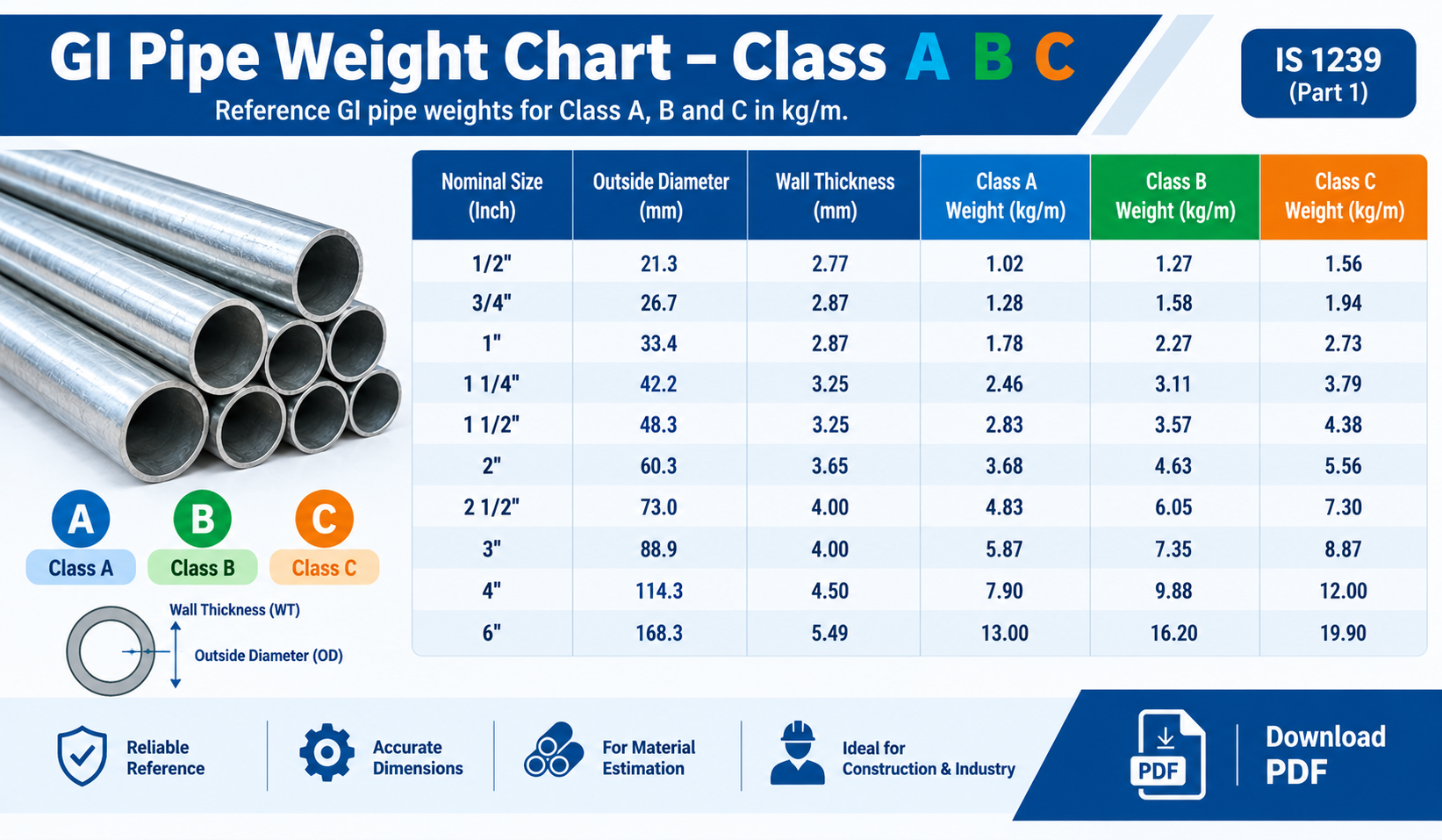
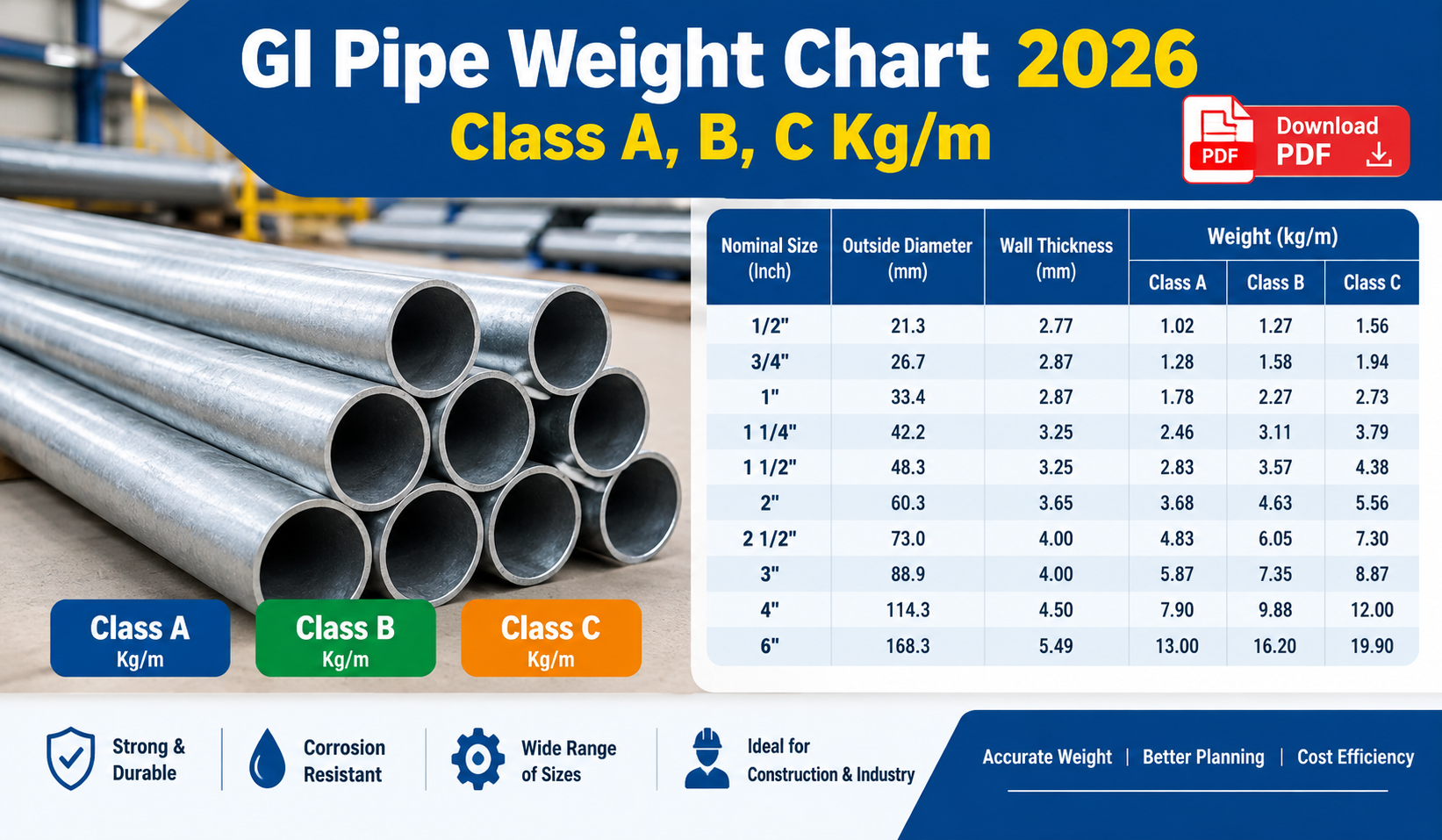
The following reference table provides GI pipe size, outside diameter, wall thickness, and approximate weight per meter for commonly used round GI pipes.
GI Pipe Weight Chart – Round Pipes
| Nominal Size | Outside Diameter (mm) | Wall Thickness (mm) | Class A Weight (kg/m) | Class B Weight (kg/m) | Class C Weight (kg/m) |
|---|---|---|---|---|---|
| 1/2″ | 21.3 | 2.77 | 1.02 | 1.27 | 1.56 |
| 3/4″ | 26.7 | 2.87 | 1.28 | 1.58 | 1.94 |
| 1″ | 33.4 | 2.87 | 1.78 | 2.27 | 2.73 |
| 1 1/4″ | 42.2 | 3.25 | 2.46 | 3.11 | 3.79 |
| 1 1/2″ | 48.3 | 3.25 | 2.83 | 3.57 | 4.38 |
| 2″ | 60.3 | 3.65 | 3.68 | 4.63 | 5.56 |
| 2 1/2″ | 73.0 | 4.00 | 4.83 | 6.05 | 7.30 |
| 3″ | 88.9 | 4.00 | 5.87 | 7.35 | 8.87 |
| 4″ | 114.3 | 4.50 | 7.90 | 9.88 | 12.00 |
| 6″ | 168.3 | 5.49 | 13.00 | 16.20 | 19.90 |
Note: The values above are reference values. Actual supplied pipe weights can vary according to applicable standards, manufacturing tolerances, pipe dimensions, and zinc coating. Your supplied source identifies the table as a reference for round GI pipes.
Download the GI Pipe Weight Chart 2026 PDF.
[Download GI Pipe Weight Chart 2026]
Keep this PDF available for quick reference when comparing pipe sizes, estimating material quantities, or preparing project calculations.
GI Pipe Price Per Kg & Price Per Meter 2026
GI pipe prices can vary depending on several factors, including pipe size, wall thickness, pipe class, manufacturer, zinc coating, order quantity, steel market conditions, GST, freight, and delivery location.
GI pipes may be quoted on a per-kilogram, per-meter, or per-length basis. Therefore, buyers should understand the weight per meter before comparing supplier quotations.
For project estimation, the supplied reference content uses an indicative GI pipe price range of ₹65–₹82 per kg. The approximate price per meter can then be calculated using the Class B weight per metre.
| GI Pipe Size | Class B Weight (kg/m) | Indicative Price (₹/kg) | Approx. Price (₹/m) |
|---|---|---|---|
| 1/2″ | 1.27 | ₹65–₹82 | ₹82.55–₹104.14 |
| 3/4″ | 1.58 | ₹65–₹82 | ₹102.70–₹129.56 |
| 1″ | 2.27 | ₹65–₹82 | ₹147.55–₹186.14 |
| 1 1/4″ | 3.11 | ₹65–₹82 | ₹202.15–₹255.02 |
| 1 1/2″ | 3.57 | ₹65–₹82 | ₹232.05–₹292.74 |
| 2″ | 4.63 | ₹65–₹82 | ₹300.95–₹379.66 |
| 2 1/2″ | 6.05 | ₹65–₹82 | ₹393.25–₹496.10 |
| 3″ | 7.35 | ₹65–₹82 | ₹477.75–₹602.70 |
| 4″ | 9.88 | ₹65–₹82 | ₹642.20–₹810.16 |
| 6″ | 16.20 | ₹65–₹82 | ₹1,053.00–₹1,328.40 |
These prices are indicative reference values, not fixed quotations. The final price should be confirmed with the supplier based on size, class, specification, quantity, GST, freight, and delivery location.
GI Pipe Price Disclaimer
GI pipe prices are subject to market fluctuations. Steel prices, manufacturer, pipe class, wall thickness, zinc coating, order quantity, GST, freight charges, and delivery location can affect the final price.
The prices shown in this article should therefore be treated as reference information only. Buyers should request a current quotation based on the required GI pipe size, class, specification, quantity, and delivery location.
What Is a GI Pipe Weight Chart?
A GI Pipe Weight Chart is a reference table showing the approximate weight of galvanised iron pipes according to nominal size, outside diameter, wall thickness, pipe class, and weight per metre.
Weight is commonly expressed in kilograms per metre (kg/m). Once the weight per metre is known, the total weight of a required pipe quantity can be calculated easily.
For example, if a GI pipe weighs 7.35 kg/m and a project requires 100 metres:
7.35 × 100 = 735 kg
Therefore, the estimated pipe weight is approximately 735 kg.
GI pipe weight charts are useful for material estimation, purchasing, transportation, structural calculations, warehouse planning, and project budgeting.
How to Read a GI Pipe Weight Chart
Understanding the main specifications makes a GI pipe weight chart easier to use.
Nominal Pipe Size
Nominal pipe size is generally expressed in inches. Common sizes include:
- 1/2 inch
- 3/4 inch
- 1 inch
- 1 1/4 inch
- 1 1/2 inch
- 2 inch
- 2 1/2 inches
- 3 inch
- 4 inch
- 6 inch
Outside Diameter
Outside diameter, or OD, represents the external diameter of the pipe and is generally specified in millimeters.
Wall Thickness
Wall thickness represents the thickness of the steel pipe wall. A thicker wall generally results in a higher weight per meter.
Weight Per Meter
Weight per meter is expressed in kg/m and indicates the approximate weight of one meter of pipe.
Pipe Class
The pipe class identifies a particular dimensional or weight category. Your supplied reference describes Class A, B and C as progressively different weight/wall-thickness categories.
GI Pipe Weight Calculation Formula
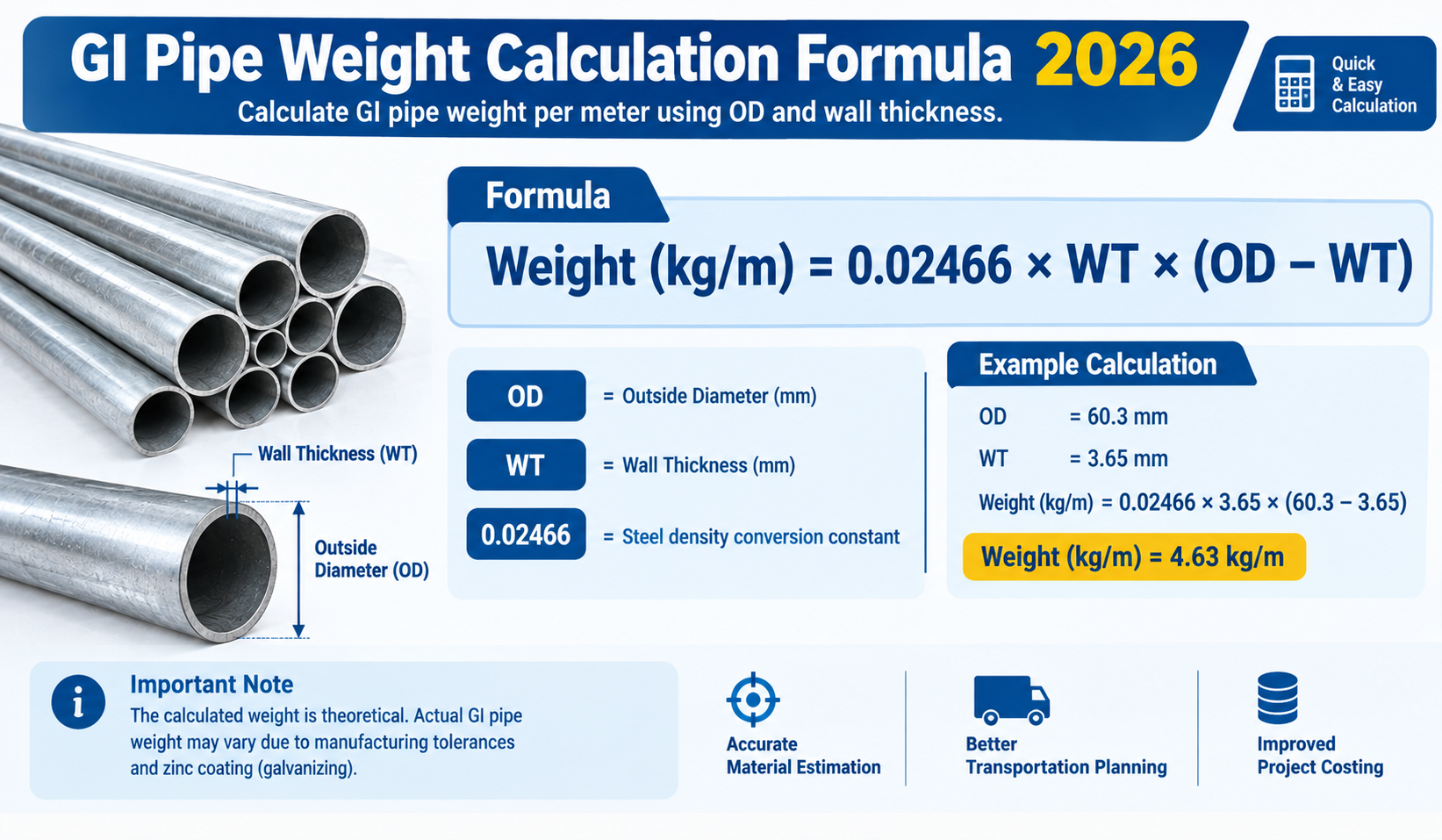
The theoretical weight of a steel pipe can be estimated from its outside diameter and wall thickness.
Formula
Weight (kg/m) = 0.02466 × WT × (OD − WT)
Where:
- OD = Outside Diameter in mm
- WT = Wall Thickness in mm
- 0.02466 = Steel density conversion constant
This formula provides a theoretical estimate. The actual finished GI pipe weight can differ because of manufacturing tolerances and the zinc coating applied during galvanising.
For critical procurement requirements, buyers should verify the actual dimensions and manufacturer-certified weight.
How to Calculate Total GI Pipe Weight
The total pipe weight can be calculated using:
Total Pipe Weight = Weight Per Meter × Total Pipe Length
For example, if the GI pipe weight is 8 kg/m and the required quantity is 1,000 metres:
8 × 1,000 = 8,000 kg
Therefore:
Total estimated weight = 8,000 kg = 8 tonnes
This calculation is particularly useful for transportation planning, procurement, warehouse management, and project estimation.
How to Calculate GI Pipe Price Per Meter
When a supplier provides a price per kilogram, the approximate price per metre can be calculated using:
GI Pipe Price Per Meter = GI Pipe Weight Per Meter × Price Per Kg
Example
Suppose:
- GI Pipe Weight = 5 kg/m
- GI Pipe Price = ₹80/kg
Then:
5 × ₹80 = ₹400 per meter
For a 6-metre pipe:
₹400 × 6 = ₹2,400 per pipe
This is an example calculation only. Actual commercial pricing may include GST, freight, loading, unloading, cutting, packaging, and other charges.
Class A GI Pipes
Class A GI pipes are generally associated with lighter-duty applications and lower weight compared with heavier pipe classes.
Their lighter construction can be useful where lower material weight is required and the application does not demand a heavier wall thickness.
Before selecting a Class A GI pipe, users should verify the required application, pressure requirements, dimensions, and applicable product specification.
Class B GI Pipes
Class B GI pipes are commonly considered for general plumbing, water supply, construction, and engineering requirements.
They provide a practical balance between pipe weight, strength, durability, and cost for applications where the selected dimensions and specifications are appropriate.
The GI Pipe Weight Chart 2026 above provides Class B weight values in kg/m, allowing users to estimate total pipe requirements and approximate material weight.
Class C GI Pipes
Class C GI pipes are generally associated with heavier-duty requirements where greater wall thickness and higher pipe weight are required.
The higher weight should be considered when planning transportation, lifting, storage, pipe supports, and structural requirements.
The correct class should always be selected according to the application and applicable specification rather than weight alone.
GI Pipe vs MS Pipe Weight
GI pipes and MS pipes are both steel-based products, but GI pipes have a zinc coating applied through the galvanising process.
The zinc coating provides corrosion protection and can contribute to the finished weight of the galvanised pipe. Therefore, buyers should not automatically assume that the weight of a galvanised pipe will be identical to an equivalent uncoated MS pipe.
The final GI pipe weight can depend on:
- Pipe dimensions
- Wall thickness
- Steel specification
- Zinc coating
- Manufacturing tolerance
- Manufacturer
For large projects, even relatively small differences in weight can influence transportation and material calculations.
Indian Standards for GI Pipes
Indian standards are important when selecting GI pipes because they define relevant requirements for dimensions, manufacturing, testing, and product quality.
IS 1239 Part 1
IS 1239 Part 1 covers steel tubes and identifies classes, including Light, Medium and Heavy, with requirements relating to dimensions and mass. BIS documentation also identifies galvanised and black surface conditions within the product scope.
For procurement, the exact applicable edition and specification should be confirmed against the project requirement and supplier documentation.
IS 4736
IS 4736 is referenced in relation to zinc coating requirements for galvanised steel products. BIS laboratory documentation also references IS 4736 for uniformity of zinc coating in testing associated with IS 1239 Part 1.
IS 3589
IS 3589 covers steel pipes for water and sewage applications and may be relevant depending on the pipe type, dimensions, and intended service.
Important: The applicable Indian Standard should always be confirmed before procurement, particularly for critical engineering, water, infrastructure, or industrial projects. Your source likewise recommends verifying the applicable standard and product specification.
Factors Affecting GI Pipe Weight
Several factors can affect the final weight of a GI pipe.
Pipe Diameter
Larger pipe diameters generally require more steel material and therefore can have a higher weight per metre.
Wall Thickness
Wall thickness is one of the most important factors affecting pipe weight. A thicker wall generally increases the mass per metre.
Zinc Coating
The galvanising process adds a zinc coating to the steel surface, which contributes to the finished product.
Manufacturing Tolerances
Actual pipe dimensions can vary within permitted manufacturing tolerances, creating differences between theoretical and actual weight.
Steel Specification
The steel specification used for manufacturing can influence the product characteristics and applicable requirements.
Manufacturer
Manufacturing and galvanising practices can vary between suppliers. For important projects, manufacturer-specific technical documentation should be checked.
Applications of GI Pipe Weight Charts
A GI pipe weight chart is useful across a wide range of construction and engineering activities.
Material Estimation
Contractors can estimate the approximate total material weight required for a project.
Transportation Planning
Total pipe weight helps buyers estimate vehicle capacity and transportation requirements.
Structural Load Calculations
Engineers can consider pipe weight when calculating loads on supports, racks, hangers, and structures.
Procurement Planning
Procurement teams can compare quantities and supplier quotations more effectively when the expected pipe weight is known.
Warehouse Management
Weight information can assist with storage planning, handling equipment, racks, and floor-loading considerations.
Crane and Lifting Planning
For larger quantities or heavier pipe, estimated weight can assist with selecting appropriate lifting and handling arrangements.
GI Pipe Weight for Project Cost Estimation
GI pipe weight is also useful when suppliers quote material on a weight basis.
For example, suppose a project requires:
Required pipe weight = 5,000 kg
and the applicable rate is:
₹80/kg
Then:
5,000 × ₹80 = ₹4,00,000
Therefore, the estimated material cost is ₹4,00,000 before applicable additional charges.
The final project cost can vary after GST, transportation, loading, unloading, fabrication, packaging, and other commercial costs are included.
Benefits of Using a GI Pipe Weight Chart
Using a GI Pipe Weight Chart 2026 can provide several practical benefits:
-
Faster material estimation
-
Better transportation planning
-
Improved project budgeting
-
Easier supplier quotation comparison
-
Better inventory planning
-
Improved structural load calculations
-
More accurate procurement
-
Reduced estimation errors
-
Better lifting and handling planning
-
Improved project efficiency
A properly organized weight chart can save time during project planning and procurement.
GI Pipe Measurement and Purchase Checklist
Before purchasing GI pipes, buyers should confirm:
-
Nominal pipe size
-
Outside diameter
-
Wall thickness
-
Pipe class
-
Weight per meter
-
Pipe length
-
Galvanizing specification
-
Applicable standard
-
Manufacturer
-
Required quantity
-
Delivery location
-
Commercial terms
Providing complete technical specifications to the supplier can reduce confusion and improve quotation accuracy.
How to Choose the Right GI Pipe
GI pipe selection should be based on the application and required specification rather than weight alone.
Application
Determine whether the pipe will be used for water supply, plumbing, irrigation, construction, industrial service, fire protection, or another application.
Pressure Requirement
Consider the operating conditions and applicable specification when selecting the pipe.
Pipe Size
Select the appropriate nominal size and outside diameter according to the system requirements.
Wall Thickness
Choose the required wall thickness according to the application and applicable product specification.
Corrosion Environment
Consider the expected environmental conditions and appropriate galvanizing requirements.
Quantity
Bulk quantities may require additional transportation, storage, handling, and commercial planning.
Manufacturer Specification
For critical purchases, always review the manufacturer’s technical documentation before finalizing the order.
Frequently Asked Questions About GI Pipe Weight Chart 2026
1. What is a GI Pipe Weight Chart?
A GI Pipe Weight Chart is a reference table showing the approximate weight of galvanized iron pipes according to size, outside diameter, wall thickness, class, and weight per meter.
2. What is the weight of a 2-inch GI pipe?
The weight of a 2-inch GI pipe depends on its class and wall thickness. In the reference chart above, the Class A weight is 3.68 kg/m, Class B is 4.63 kg/m, and Class C is 5.56 kg/m.
3. How do I calculate GI pipe weight?
The theoretical weight can be estimated using:
Weight (kg/m) = 0.02466 × WT × (OD − WT)
OD is the outside diameter in millimetres and WT is wall thickness in millimetres.
4. What is the GI pipe price per kg in 2026?
There is no single fixed GI pipe price per kg. Price depends on size, class, manufacturer, zinc coating, quantity, steel market conditions, GST, freight, and delivery location. The reference pricing in this article uses ₹65–₹82/kg for estimation purposes.
5. What is the GI pipe price per meter?
GI pipe price per meter depends on the weight per meter and the applicable price per kilogram. It can be estimated using:
Price per meter = Weight per meter × Price per kg
The final supplier quotation should be confirmed before purchasing.
6. Does galvanizing increase GI pipe weight?
Yes. The zinc coating applied during galvanizing contributes to the finished pipe weight. Actual weight can also be affected by manufacturing tolerances and coating requirements.
7. What is the difference between Class A, Class B and Class C GI pipes?
Class A, Class B and Class C represent different pipe weight and wall-thickness categories in the reference used for this article. Generally, the heavier category has greater wall thickness and higher weight per meter.
8. How much does a 6-meter GI pipe weigh?
Multiply the GI pipe weight per meter by six.
For example, if a pipe weighs 5 kg/m:
5 × 6 = 30 kg
Therefore, the estimated weight of a 6-metre pipe is 30 kg.
9. Which standard is commonly used for GI pipes in India?
IS 1239 Part 1 is a commonly referenced standard for steel tubes, including Light, Medium and Heavy classes and galvanized surface conditions. The exact applicable standard and edition should be confirmed for the specific product and application.
10. Why is GI pipe weight important?
GI pipe weight is important for material estimation, transportation planning, structural load calculations, procurement, inventory management, lifting, and project cost estimation.
Get the Latest GI Pipe Price
Looking for GI pipes in different sizes, classes, and specifications?
Sachiya Steel International supplies GI pipes and other steel products for industrial, commercial, construction, infrastructure, and project requirements.
For current GI pipe prices, bulk quantities, product specifications, and project quotations, contact the sales team.
Phone: +91 9769056007
Email: [email protected]
Website: www.sachiyasteel.com
Request a Quote for GI Pipes
Contact Sachiya Steel International with your required GI pipe size, class, wall thickness, quantity, applicable standard, and delivery location to request a current quotation.
Related Steel Resources
For additional weight and specification information, explore our related resources:
-
MS Pipe Weight Chart 2026 – weight per meter for different MS pipe sizes and classes.
-
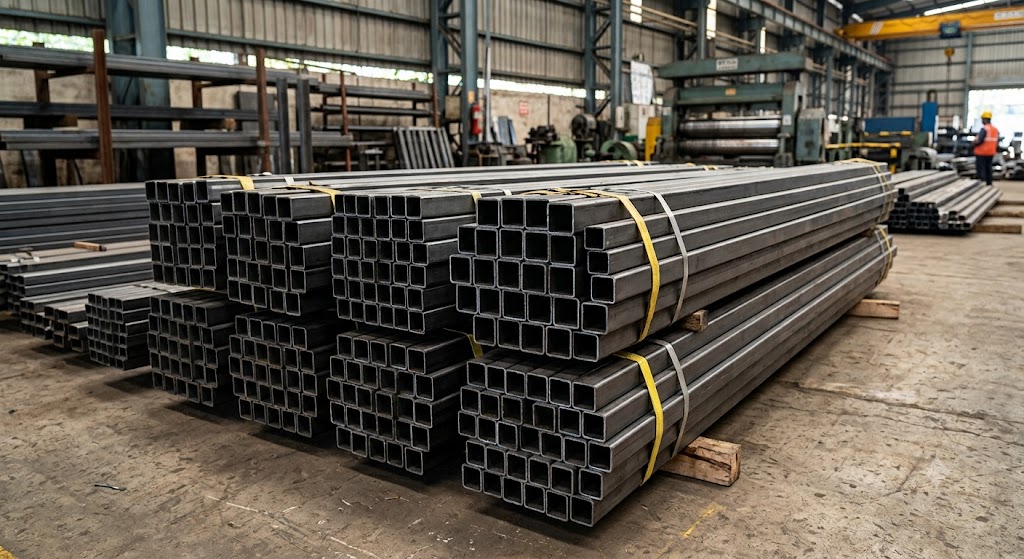
MS Square Pipe Weight Chart 2026 – square hollow section weight and calculation reference.
-
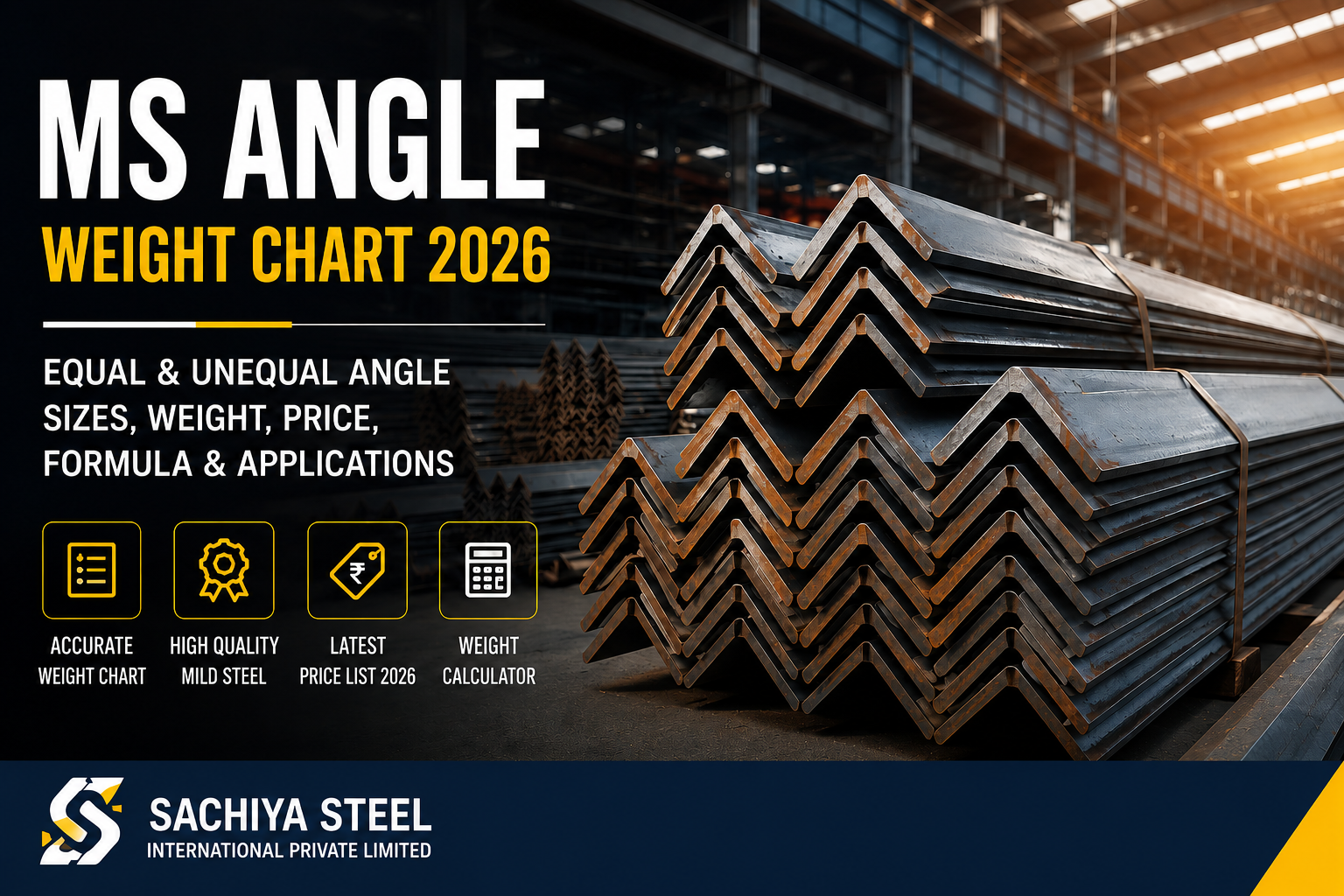
MS Angle Weight Chart 2026 – angle sizes and kg/m reference.
-
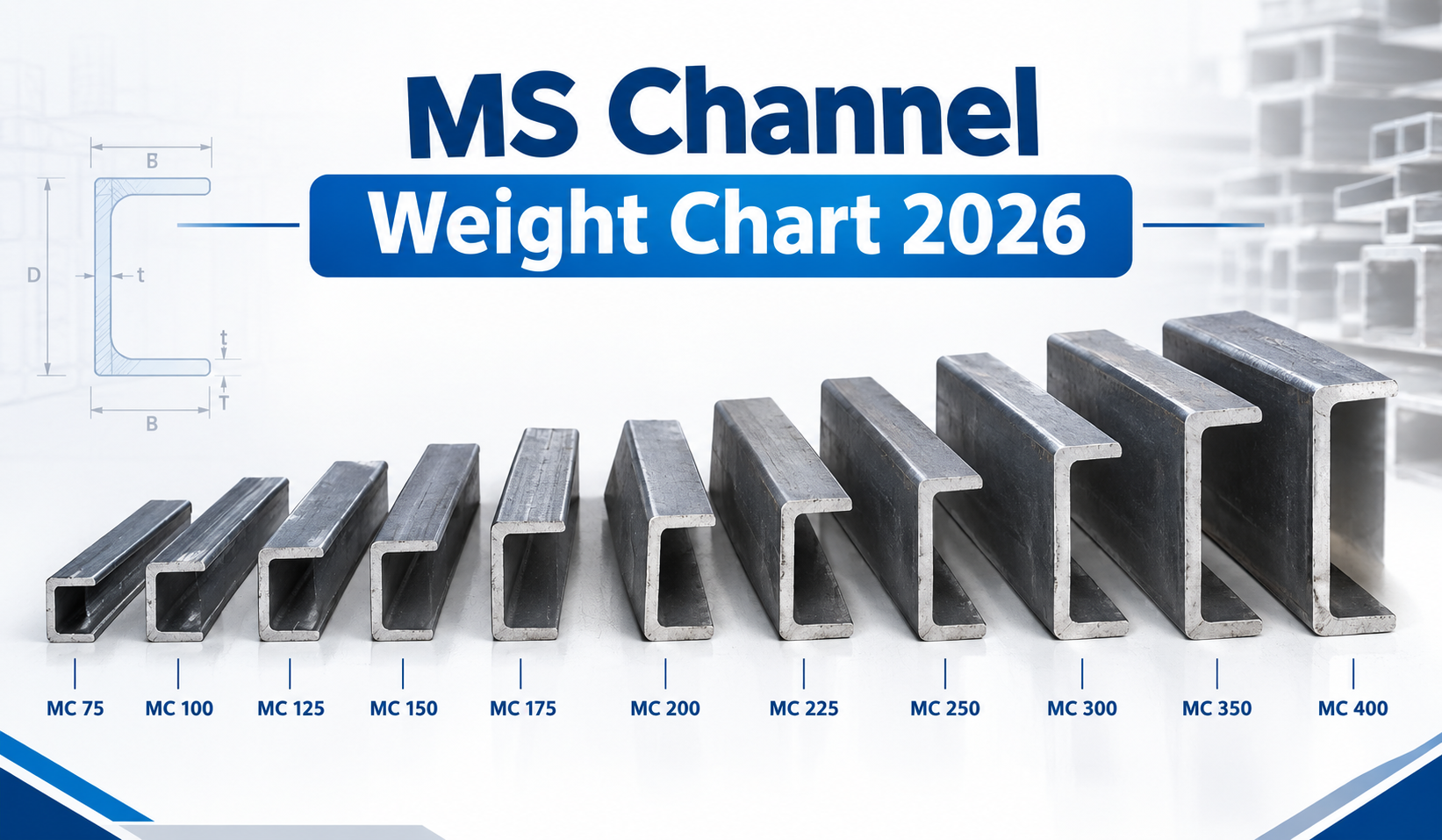
MS Channel Weight Chart 2026 – ISMC channel sizes and weight per meter.
-
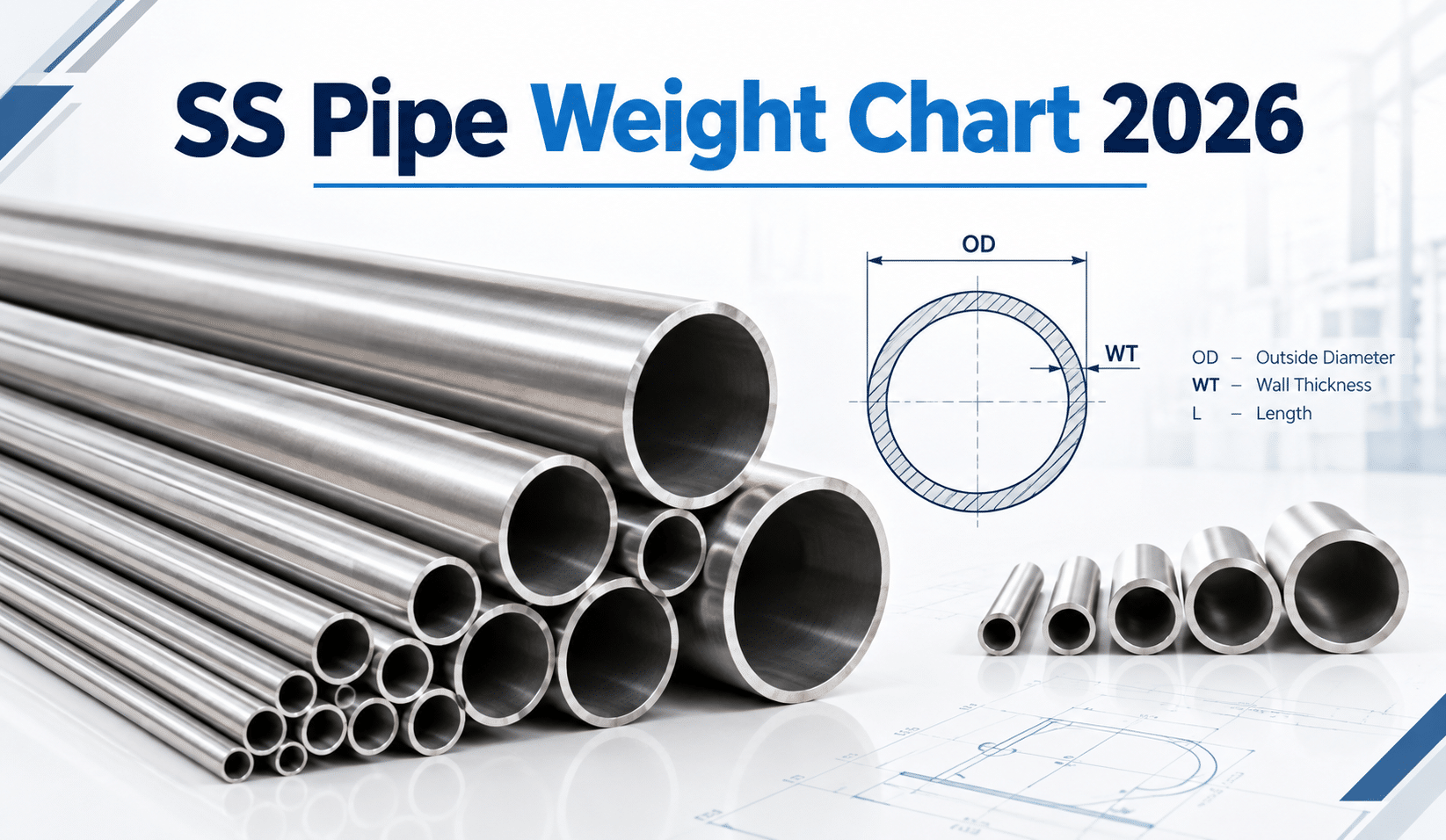
Stainless Steel Pipe Weight Chart – useful for stainless steel pipe weight calculations.
Conclusion
The GI Pipe Weight Chart 2026 – Class A, B, C Kg/m + PDF provides a practical reference for understanding GI pipe size, outside diameter, wall thickness, and approximate weight per meter. Class A, Class B, and Class C values can help contractors, engineers, procurement teams, fabricators, and buyers estimate material requirements for different projects.
GI pipe weight is affected by several factors, including nominal size, outside diameter, wall thickness, pipe class, manufacturing tolerances, steel specification, and galvanizing requirements. For this reason, chart values should be treated as reference information and compared with the manufacturer’s technical documentation before final procurement.
GI pipe pricing also changes according to steel market conditions, pipe size, wall thickness, manufacturer, zinc coating, quantity, GST, freight, and delivery location. Therefore, the price references provided in this article should not be treated as a fixed quotation.
For accurate project planning, buyers should combine the GI Pipe Weight Chart 2026, applicable product specification, current supplier pricing, required quantity, and delivery requirements. This approach helps improve material estimation, transportation planning, procurement, inventory management, and project cost calculations.
Download the GI Pipe Weight Chart 2026 PDF for a convenient reference when planning GI pipe requirements.