Plates

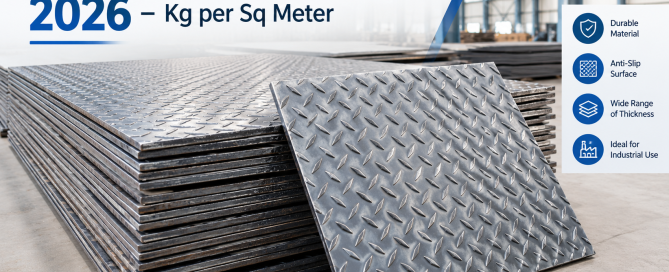
MS Chequered Plate Weight Per Square Meter 2026: Complete Guide

Weight Chart, Calculator, Formula, Sizes, Specifications, Price & Applications

Last Updated: September 8, 2026

Mild steel chequered plates are widely used for industrial flooring, platforms, staircases, walkways, ramps, machine areas, trailers, and other applications where a durable and slip-resistant surface is required. Knowing the approximate weight of a plate is important for material estimation, transportation planning, structural calculations, inventory management, and purchasing.

This complete guide explains the MS chequered plate weight per square meter, reference weight values, calculation methods, dimensions, specifications, applications, price factors, and frequently asked questions.

The values provided in this article are intended as reference values. Actual finished weight can vary depending on plate thickness, raised pattern geometry, dimensional tolerances, surface condition, and manufacturer specifications.

Download Free MS Chequered Plate Weight Chart PDF 2026

Keep a downloadable PDF version of this guide for engineers, contractors, fabricators, buyers, and procurement teams.

Download Free MS Chequered Plate Weight Chart PDF – 2026

MS Chequered Plate Weight Calculator

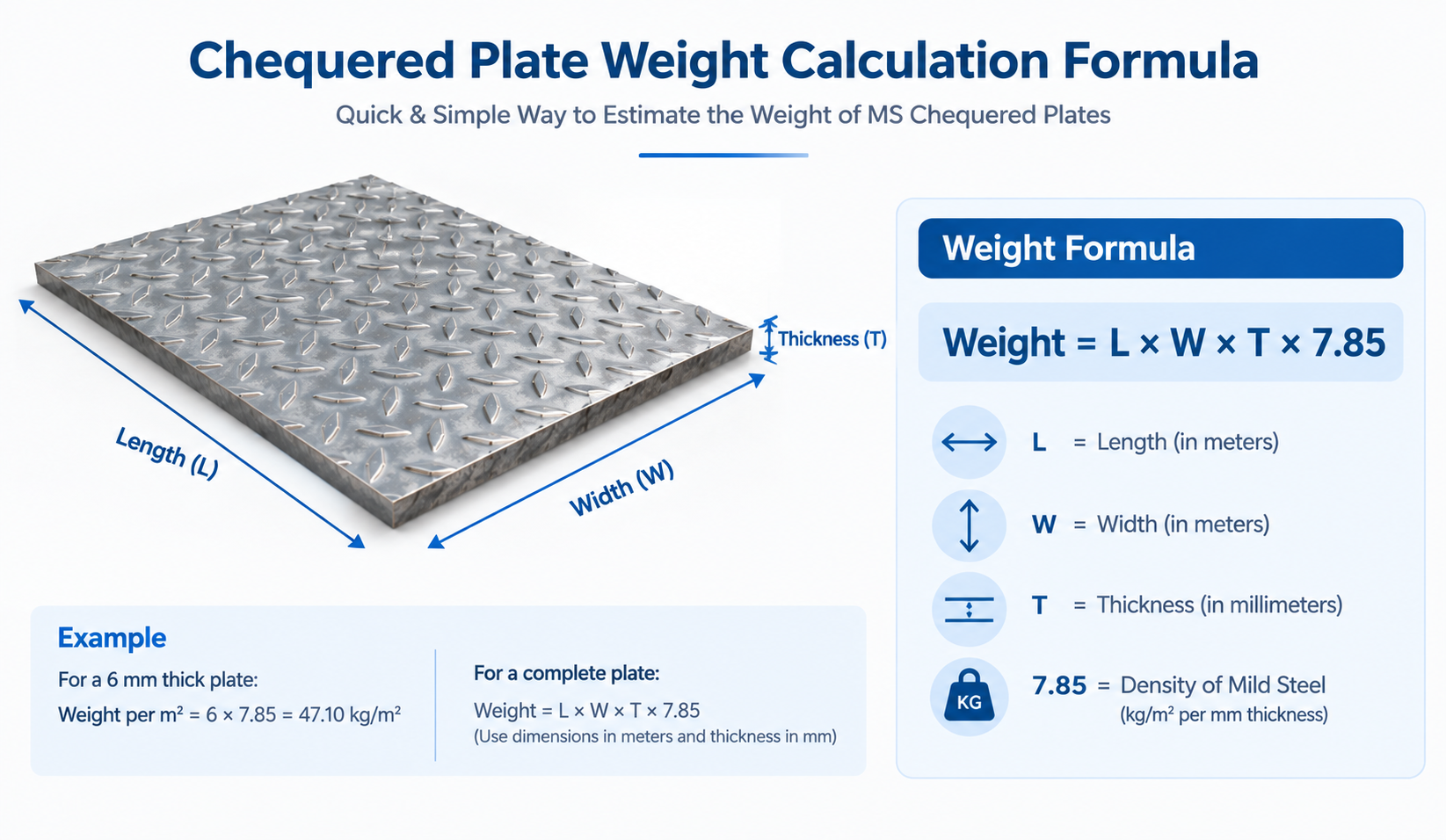
You can estimate the weight of a mild steel plate by using the following formula:

Weight of Flat Steel Plate (kg) = Length (m) × Width (m) × Thickness (mm) × 7.85

For a patterned or chequered plate, the raised surface pattern adds material above the nominal flat thickness. Therefore, the finished product can weigh more than the theoretical weight calculated for a plain plate.

Example

For a 2500 mm × 1250 mm × 6 mm chequered plate:

  • Length = 2.5 m
  • Width = 1.25 m
  • Area = 3.125 m²
  • Reference weight = 50.10 kg/m²

Therefore:

3.125 × 50.10 = 156.56 kg

So, a 2500 × 1250 × 6 mm plate has an approximate reference weight of 156.56 kg.

Actual supplied weight should be confirmed against the manufacturer’s dimensional and weight tolerances.

MS Chequered Plate Weight Chart 2026


MS Chequered Plate Weight Chart 2026


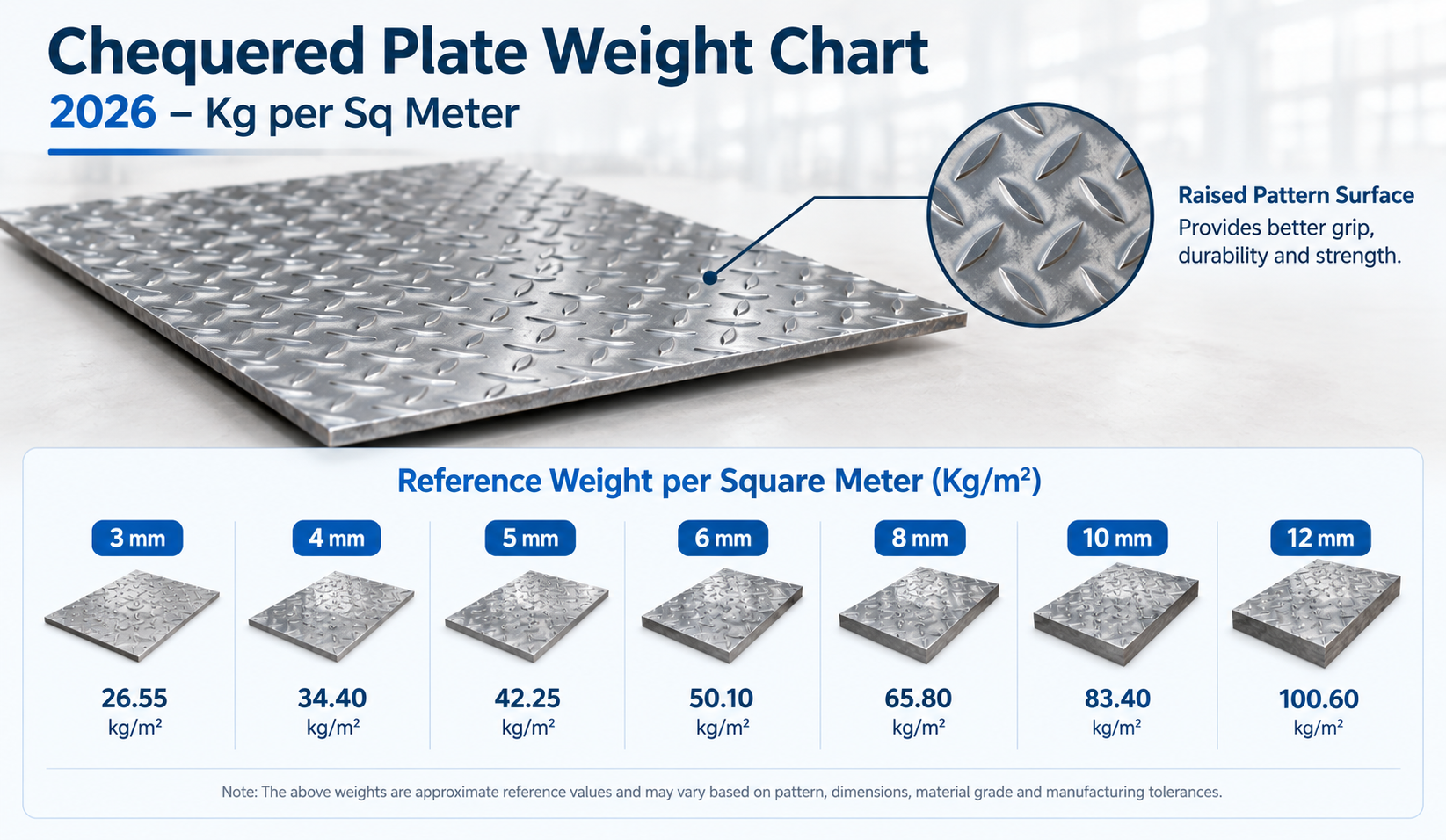
The following table provides approximate reference weights for commonly used mild steel chequered plate thicknesses.

Thickness Approx. Weight per m²
3 mm 26.55 kg/m²
4 mm 34.40 kg/m²
5 mm 42.25 kg/m²
6 mm 50.10 kg/m²
8 mm 65.80 kg/m²
10 mm 83.40 kg/m²
12 mm 100.60 kg/m²

Note: These are nominal/reference values for estimation purposes. The actual weight of a supplied chequered plate may differ because of pattern height, manufacturing tolerances, steel density, and other dimensional variations.

MS Chequered Plate Weight Chart 2026

Understanding Chequered Steel Plate Weight

The weight of a steel plate mainly depends on three basic dimensions:

  1. Length
  2. Width
  3. Thickness

For plain mild steel, a density of approximately 7.85 g/cm³, or 7850 kg/m³, is commonly used for theoretical calculations.

Chequered plates have a raised pattern on one surface. Because of this additional material, their finished mass can be higher than the theoretical weight of a flat plate having the same nominal thickness.

For purchasing and logistics, it is therefore useful to distinguish between:

  • Theoretical flat-plate weight
  • Nominal reference weight
  • Actual finished product weight

How to Calculate Steel Plate Weight

The basic calculation is straightforward.

Formula

Weight (kg) = Length (m) × Width (m) × Thickness (mm) × 7.85

Step 1: Convert dimensions into metres

For example:

Length = 2500 mm = 2.5 m

Width = 1250 mm = 1.25 m

Thickness = 6 mm

Step 2: Calculate the area

2.5 × 1.25 = 3.125 m²

Step 3: Calculate theoretical flat-plate weight

3.125 × 6 × 7.85 = 147.19 kg

This is the approximate theoretical weight of a 6 mm flat mild steel plate.

A chequered plate of the same nominal thickness can have a higher finished weight because of the raised pattern.

Why Does a Finished Chequered Plate Weigh More?

A chequered plate contains a raised pattern on its surface. The pattern may be produced in different designs and dimensions depending on the manufacturing process and specification.

The raised portion contributes additional steel mass.

Therefore, when estimating the weight of a finished product, simply multiplying nominal thickness by steel density may not provide the final supplied weight.

For accurate procurement, the following should be considered:

  • Nominal plate thickness
  • Pattern height
  • Pattern geometry
  • Plate dimensions
  • Manufacturing tolerances
  • Steel density
  • Applicable product standard
  • Actual weighed mass

This distinction is especially important when ordering large quantities.

Theoretical Weight vs. Reference Weight

The following comparison shows the difference between theoretical flat-plate calculations and the nominal/reference values used for chequered plates.

Thickness Theoretical Flat Plate Reference Chequered Plate
3 mm 23.55 kg/m² 26.55 kg/m²
4 mm 31.40 kg/m² 34.40 kg/m²
5 mm 39.25 kg/m² 42.25 kg/m²
6 mm 47.10 kg/m² 50.10 kg/m²
8 mm 62.80 kg/m² 65.80 kg/m²
10 mm 78.50 kg/m² 83.40 kg/m²
12 mm 94.20 kg/m² 100.60 kg/m²

Theoretical values are calculated using a steel density of 7.85 g/cm³. The chequered-plate figures are reference values and should not be treated as a universal guaranteed finished weight for every manufacturer or pattern.

Nominal vs Theoretical Chequered Plate Weight


Worked Example: 2500 × 1250 × 6 mm Plate

Suppose you need to estimate the mass of a chequered plate measuring:

2500 mm × 1250 mm × 6 mm

Plate area

2.5 × 1.25 = 3.125 m²

Using the reference value

3.125 × 50.10 = 156.56 kg

Therefore:

Approximate plate weight = 156.56 kg

If you require 10 plates:

156.56 × 10 = 1,565.6 kg

or approximately:

1.566 metric tonnes

For transportation planning, the actual dispatch weight should be confirmed from the supplier’s final weighment or packing list.

MS Chequered Plate Weight by Number of Plates

You can calculate the total material requirement by multiplying the weight of one plate by the required quantity.

Example

If one plate weighs approximately 156.56 kg:

Quantity Approx. Total Weight
1 plate 156.56 kg
5 plates 782.80 kg
10 plates 1,565.60 kg
20 plates 3,131.20 kg
50 plates 7,828.00 kg

These figures are for estimation and may vary from actual supplied weights.


4 × 8 Feet Chequered Plate Weight

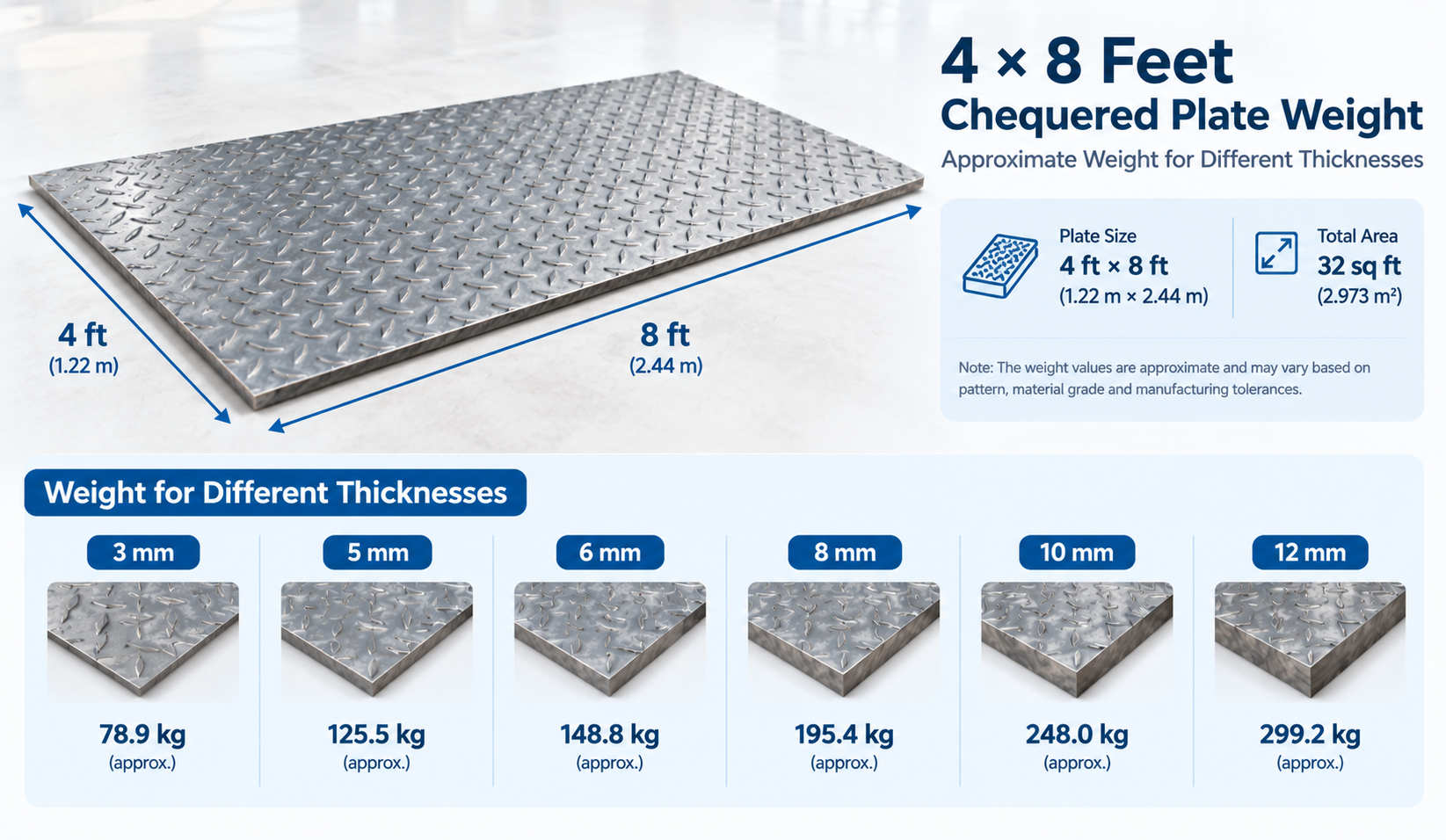
The commonly used 4 × 8 feet plate has an approximate area of:

4 × 8 = 32 square feet

32 square feet is approximately 2.973 m².

Using the reference values above:

Thickness Approx. Weight for 4 × 8 ft
3 mm 78.9 kg
5 mm 125.5 kg
6 mm 148.8 kg
8 mm 195.4 kg

These values are approximate and should be used for planning rather than final commercial weighment.


Steel Plate Weight Per Square Foot

If you need to estimate the weight per square foot, the metric value can be converted using:

1 m² = 10.7639 ft²

For example, if a plate weighs approximately 50.10 kg/m²:

50.10 ÷ 10.7639 ≈ 4.66 kg/ft²

This can be useful when estimating floor loading, transportation weight, and material requirements for projects designed using imperial dimensions.


Converting Kilograms to Metric Tonnes

For bulk purchases, steel plate weight is often expressed in tonnes.

Conversion

1 metric tonne = 1,000 kg

For example:

1,565.6 kg ÷ 1,000 = 1.5656 tonnes

Therefore, 10 plates weighing approximately 156.56 kg each would have a combined reference mass of approximately 1.566 tonnes.


Common MS Chequered Plate Specifications

Typical specifications may include:

Specification Common Options
Material Mild Steel
Manufacturing Hot Rolled
Surface Raised Chequered Pattern
Thickness 3 mm to 12 mm and as required
Width 1250 mm, 1500 mm, 2000 mm, and custom
Length 2500 mm, 5000 mm, 6000 mm, and custom
Common Grades IS 2062, ASTM A36, and equivalent grades
Patterns 5-Bar, Diamond, Lentil/Teardrop
Application Flooring, Platforms, Stairs, Walkways, Ramps

Exact grade availability, dimensions, tolerances, and pattern specifications should be confirmed before placing an order.

MS Chequered Plate Sizes Thickness and Specifications


What Is an MS Chequered Plate?

An MS chequered plate is a mild steel plate manufactured with a raised pattern on one surface. The raised design improves surface grip compared with a smooth flat plate.

It is commonly selected where a combination of strength, durability, accessibility, and slip resistance is required.

The pattern also gives the plate a distinctive industrial appearance, making it suitable for structural and fabrication applications.

Common Chequered Plate Patterns

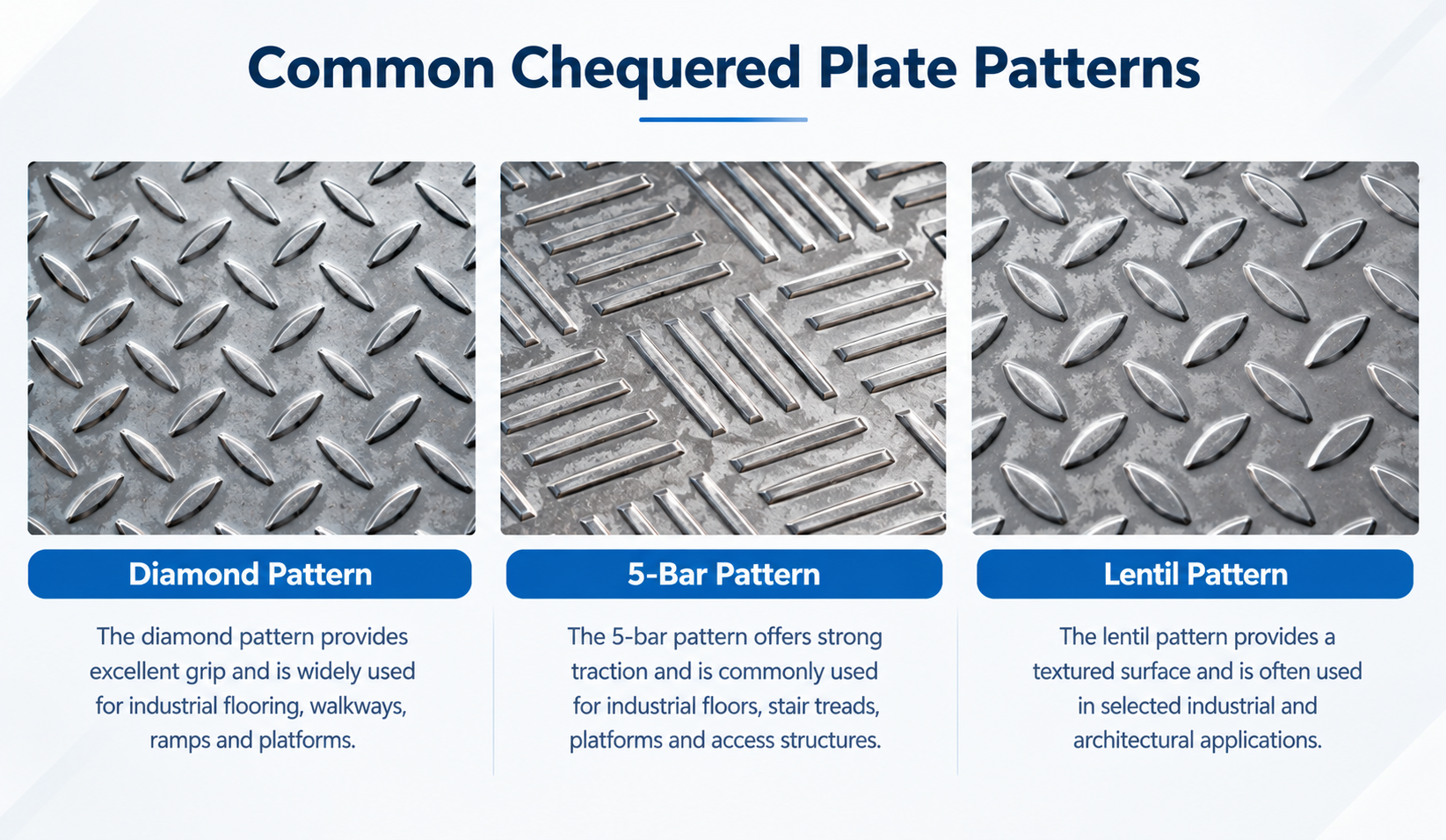
Different patterns can be available depending on the manufacturer and applicable specification.

1. 5-Bar Pattern

A five-bar design is widely used for industrial flooring, platforms, staircases, and walkways.

2. Diamond Pattern

Diamond-patterned surfaces provide a textured finish and are used in many fabrication and flooring applications.

3. Lentil / Teardrop Pattern

This pattern provides a raised textured surface and can be selected for industrial and architectural applications.

Pattern availability may vary by manufacturer, thickness, width, and production facility.


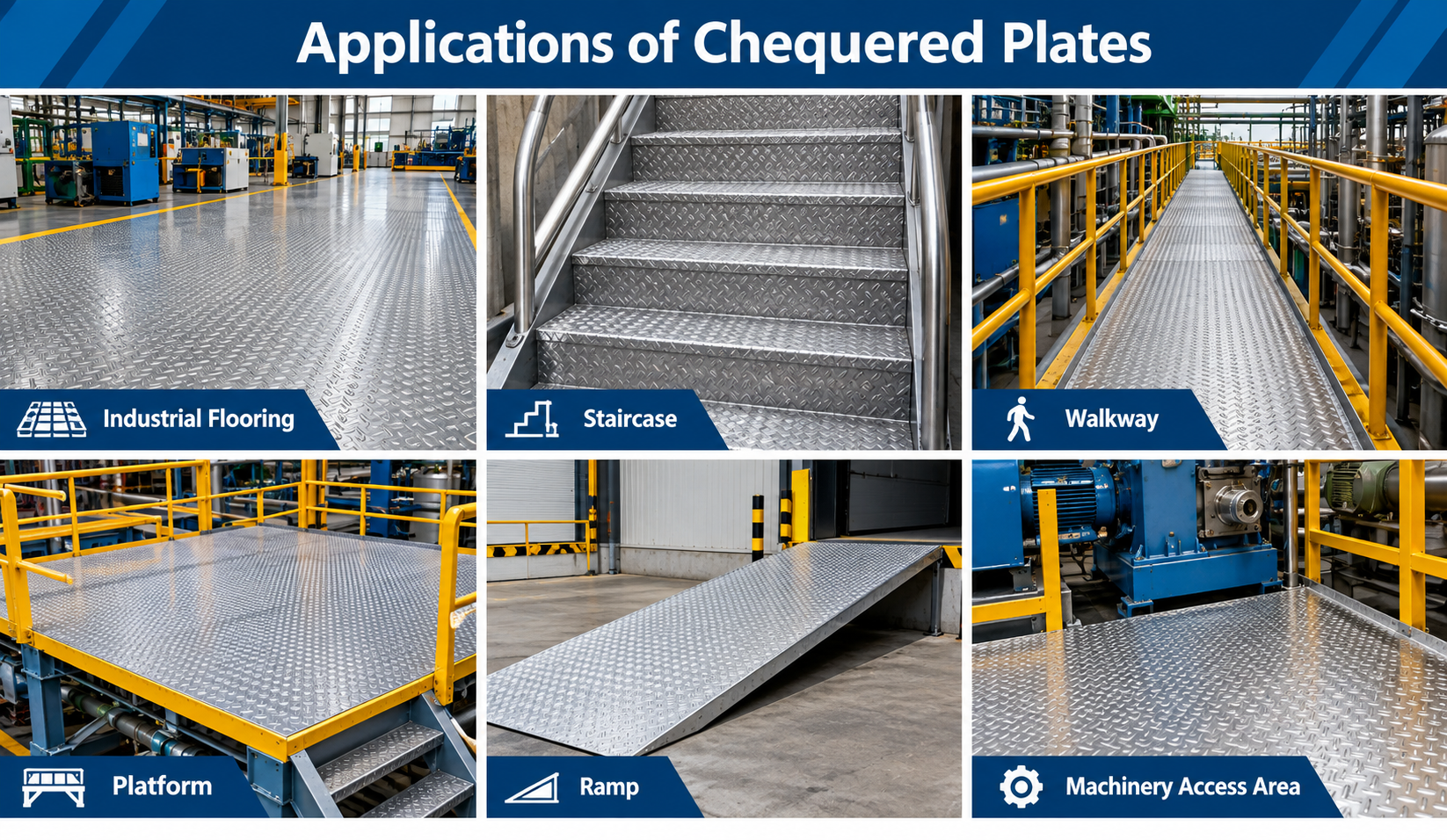
Applications of MS Chequered Plates

Mild steel chequered plates are used across a wide range of industries.

Industrial Flooring

They are commonly used for factory floors, maintenance areas, and work platforms.

Staircases

The textured surface can provide improved foot grip for industrial stairs and access platforms.

Walkways

Chequered plates are suitable for industrial walkways and elevated access areas.

Ramps

The raised pattern can help provide additional surface traction for ramps and loading areas.

Platforms

They are frequently used for machine platforms, maintenance platforms, and industrial structures.

Transportation Equipment

Chequered plates can be used in selected truck bodies, trailers, and other fabricated structures.

Machinery Areas

They can be used around industrial machinery where a durable metal walking surface is required.

Factors Affecting Plate Weight

Several factors can influence the final weight of a chequered plate.

1. Nominal Thickness

Increasing the nominal thickness generally increases the weight per square metre.

2. Plate Dimensions

Longer and wider plates naturally contain more material and therefore weigh more.

3. Raised Pattern

The geometry and height of the raised pattern contribute to the finished mass.

4. Steel Density

Small differences in material composition and density can affect theoretical calculations.

5. Manufacturing Tolerances

Actual thickness and dimensions may vary within the applicable tolerance range.

6. Surface Condition

Surface scale, finishing, and processing can have an effect on final weighment.

7. Cutting and Fabrication

Cutting a full plate into smaller pieces changes the individual piece weights and dimensions.


MS Chequered Plate vs Plain MS Plate

Both products are manufactured from mild steel, but their surface characteristics are different.

Feature Plain MS Plate Chequered MS Plate
Surface Flat Raised pattern
Grip Lower Higher
Typical Use Fabrication & structures Flooring & access areas
Surface Pattern No Yes.
Weight Based mainly on thickness Can be higher due to raised pattern
Appearance Smooth Textured

The appropriate product depends on the structural, functional, and surface requirements of the project.


How to Select the Correct Thickness

Choosing thickness depends on the intended application and design requirements.

Consider:

  • Expected load
  • Span between supports
  • Foot traffic
  • Equipment movement
  • Impact conditions
  • Required rigidity
  • Fabrication method
  • Environmental conditions
  • Structural design requirements

For load-bearing structures, plate thickness should be selected according to the applicable engineering calculations and project specifications rather than weight alone.


MS Chequered Plate Price 2026

The price of mild steel chequered plates can change based on market conditions, steel prices, quantity, dimensions, grade, pattern, manufacturing requirements, location, and transportation.

Important price factors include:

  • Steel market price
  • Plate thickness
  • Width and length
  • Grade
  • Pattern
  • Order quantity
  • Cutting requirements
  • Surface condition
  • Delivery location
  • Freight and taxes

Because steel prices fluctuate, a fixed price should not be treated as a universal 2026 rate.

For the latest commercial price, customers should request a quotation based on the exact plate size, thickness, grade, quantity, and delivery location.


How to Order MS Chequered Plates

When requesting a quotation, provide complete product information.

Recommended details:

Product: MS Chequered Plate

Grade: Required grade

Thickness: Required thickness

Width: Required width

Length: Required length

Pattern: 5-Bar / Diamond / Lentil / Other

Quantity: Number of plates or total weight

Delivery Location: City / Country

Providing these details helps suppliers prepare an accurate quotation and estimated dispatch weight.

Quality and Documentation

Depending on the project requirements, customers may request supporting documents such as:

  • Material Test Certificate
  • Chemical composition
  • Mechanical properties
  • Heat number
  • Dimensional inspection details
  • Weight details
  • Mill certificates
  • Test reports
  • Packing list
  • Commercial invoice

Documentation requirements can vary according to the purchase order, application, destination country, and applicable material standard.

Benefits of MS Chequered Plates

MS chequered plates offer several practical advantages:

  • Durable steel construction
  • Raised surface for improved grip
  • Suitable for industrial environments
  • Easy to fabricate and cut
  • Available in multiple thicknesses
  • Suitable for platforms and walkways
  • Useful for stairs and ramps
  • Cost-effective for many industrial applications
  • Available in different patterns and dimensions

Corrosion Protection and Maintenance

Mild steel can be susceptible to corrosion when exposed to moisture, chemicals, or harsh environmental conditions.

Depending on the application, protective measures may include:

  • Painting
  • Priming
  • Protective coatings
  • Regular cleaning
  • Proper drainage
  • Keeping surfaces dry
  • Periodic inspection

The appropriate protection system should be selected according to the operating environment.


MS Chequered Plate Applications for Flooring Stairs Platforms and Ramps

Why Choose Sachiya Steel International?

Sachiya Steel International Private Limited supplies a wide range of steel products for industrial, commercial, fabrication, and engineering requirements.

Customers can provide their required:

  • Product
  • Grade
  • Thickness
  • Size
  • Quantity
  • Application
  • Delivery location

Our team can assist with product selection, availability, technical requirements, and quotation requests.

For bulk requirements and project enquiries, customers are advised to share complete specifications to receive the most suitable commercial offer.


Get a Quotation for MS Chequered Plates

For a quotation, provide the following information:

Product: MS Chequered Plate
Thickness: Required thickness
Size: Length × Width
Grade: Required grade
Pattern: Required pattern
Quantity: Number of plates / total quantity
Delivery Location: Required destination

Sachiya Steel International Private Limited

Phone: +91 9769056007

Email: [email protected]

Website: www.sachiyasteel.com

Frequently Asked Questions

1. What is the weight of a 3 mm MS chequered plate per square metre?

The approximate reference value used in this guide is 26.55 kg/m². Actual supplied weight can vary depending on pattern geometry and manufacturing tolerances.

2. What is the weight of a 5 mm chequered plate per square metre?

The approximate reference value is 42.25 kg/m².

3. What is the weight of a 6 mm chequered plate per square metre?

The approximate reference value is 50.10 kg/m².

4. How do I calculate the weight of an MS plate?

For a theoretical flat mild steel plate, use:

Length (m) × Width (m) × Thickness (mm) × 7.85

For chequered plates, a suitable reference value should be used because the raised pattern contributes additional material.

5. Why is a chequered plate heavier than a plain plate?

A chequered plate contains a raised surface pattern. This additional material can increase its finished mass compared with a plain plate having the same nominal thickness.

6. What is the weight of a 4 × 8 feet chequered plate?

The weight depends on thickness and the applicable reference value. For example, a 6 mm plate is approximately 148.8 kg using the reference value in this guide.

7. Which grades are commonly used for MS chequered plates?

Commonly specified materials can include IS 2062, ASTM A36, and equivalent grades, depending on the project and supplier requirements.

8. What are MS chequered plates used for?

They are commonly used for industrial flooring, platforms, staircases, walkways, ramps, machine areas, and selected transportation or fabrication applications.

9. Does actual plate weight exactly match the weight chart?

Not necessarily. Weight charts provide reference or nominal values. Actual weight can vary because of dimensions, pattern geometry, tolerances, material density, and manufacturing conditions.

10. How can I get the latest price of MS chequered plates?

Steel prices fluctuate according to market conditions and product specifications. For an accurate quotation, provide the required grade, thickness, dimensions, pattern, quantity, and delivery location.

Related Steel Weight Resources

To help visitors calculate weights for other steel products, you can internally link this page to relevant resources such as:

Use descriptive anchor text rather than repeatedly linking the same exact keyword.

Final Summary

MS chequered plates are widely used for industrial flooring, platforms, staircases, ramps, walkways, and fabrication applications where a textured metal surface is beneficial.

The approximate reference values provided in this guide range from 26.55 kg/m² for 3 mm to 100.60 kg/m² for 12 mm.

For theoretical calculations of a flat mild steel plate, the commonly used formula is:

Weight (kg) = Length (m) × Width (m) × Thickness (mm) × 7.85

Because chequered plates contain raised patterns, their finished mass can differ from the theoretical weight of a flat plate.

For purchasing, transportation, structural planning, and commercial billing, always confirm the final dimensions, applicable standard, tolerance, and actual supplied weight with the manufacturer or supplier.

For quotations and bulk requirements, contact Sachiya Steel International Private Limited with your required thickness, size, grade, pattern, quantity, and delivery location.

By |2026-09-09T11:18:09+05:30November 14th, 2025|Plates|

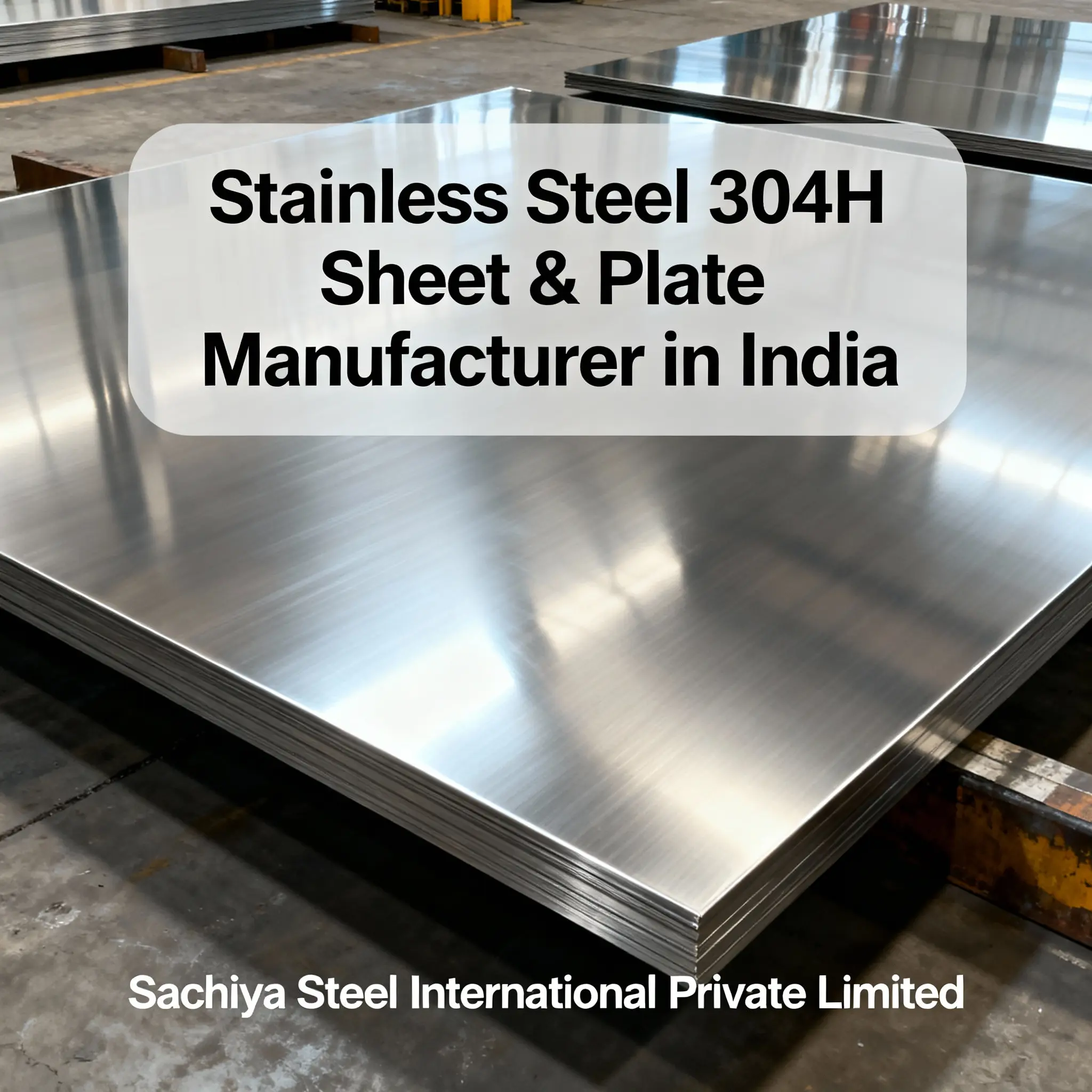
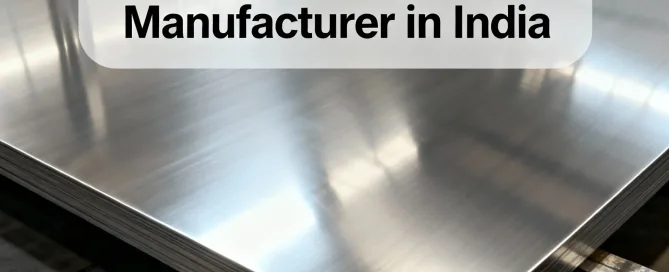
Stainless Steel 304H Sheet & Plate Manufacturer in India

Stainless Steel 304H Sheet & Plate Manufacturer in India: Sachiya Steel International Private Limited

Sachiya Steel International Private Limited is one of India’s leading manufacturers and exporters of high-quality Stainless Steel 304H Sheet & Plate. With a commitment to providing the best products and customer satisfaction, we have earned a trusted reputation for delivering superior stainless steel solutions to various industries. Whether you’re looking to buy SS304H plate or explore its applications, corrosion resistance, and mechanical properties, this article covers everything you need to know about Stainless Steel 304H plates.

What is Stainless Steel 304H Plate?

Stainless Steel 304H is a higher carbon version of SS304, specifically designed to provide higher strength at elevated temperatures. It is an austenitic stainless steel alloy, renowned for its excellent resistance to corrosion, heat, and oxidation. The SS304H plate is extensively used in industries that require high strength and durability, such as power plants, chemical processing, food processing, and construction.

Applications of SS304H Plate

The versatility of SS304H plates makes them ideal for several high-demand applications:

  • Heat exchangers and boilers: The ability to withstand elevated temperatures makes SS304H plates perfect for heat exchangers, reactors, and boiler systems.

  • Pressure vessels: SS304H is commonly used for manufacturing pressure vessels due to its mechanical strength at high temperatures.

  • Chemical and petrochemical industries: SS304H’s resistance to oxidation and corrosion makes it a reliable choice for pipes, fittings, and equipment in the chemical industry.

  • Food processing and pharmaceuticals: The high resistance to corrosion ensures that SS304H is used in food-grade equipment and pharmaceutical manufacturing.

Stainless Steel 304H Sheet & Plate Manufacturer in India

Corrosion Resistance of SS304H

One of the primary reasons SS304H stainless steel plates are preferred in various industries is their excellent corrosion resistance. The high chromium content, along with nickel, makes 304H plates highly resistant to rust and oxidation, even in aggressive environments. It is particularly resistant to:

  • Acids such as sulfuric acid and phosphoric acid.

  • Chlorides, making it a good choice for marine environments.

  • High temperatures and oxidation in outdoor applications.

Difference Between SS304H and SS304

Both SS304H and SS304 are part of the austenitic stainless steel family, but there are key differences between the two:

  • Carbon Content: The most significant difference lies in the carbon content. SS304H contains a higher percentage of carbon (0.04% to 0.10%) compared to SS304 (0.08% maximum). This increase in carbon enhances its strength at high temperatures.

  • Heat Resistance: SS304H plates have better heat resistance than SS304 plates, making SS304H a preferred option for high-temperature applications.

  • Mechanical Properties: SS304H offers superior strength and mechanical properties at elevated temperatures when compared to SS304.

Properties of SS304H Plate

SS304H plates possess remarkable properties, making them one of the best options for high-performance applications:

  • High Strength: The added carbon content provides increased strength, especially at temperatures above 500°C.

  • Durability: Excellent mechanical properties, ensuring long-term durability in harsh conditions.

  • Ductility: SS304H maintains its ductility even under extreme conditions.

  • Weldability: This material has good weldability, making it easy to work with during fabrication.

SS304H Chemical Composition

The chemical composition of SS304H plates typically includes the following elements:

  • Chromium: 18-20%

  • Nickel: 8-12%

  • Carbon: 0.04-0.10%

  • Manganese: 2.0%

  • Silicon: 0.75%

  • Phosphorus: 0.045% max

  • Sulfur: 0.03% max

These elements give SS304H its excellent strength, resistance to corrosion, and high-temperature stability.

SS304H Mechanical Properties

The mechanical properties of SS304H plates are critical for their use in high-temperature and high-stress environments:

  • Tensile Strength: 520 MPa minimum

  • Yield Strength: 205 MPa minimum

  • Elongation: 40% minimum

  • Hardness: Brinell hardness of 201 HB

These properties ensure SS304H plates remain durable and stable under mechanical stress and elevated temperatures.

SS304H Plate Equivalent Grades

When looking for SS304H plates, it is essential to know their equivalent grades in different standards:

  • AISI 304H (American)

  • UNS S30409 (Unified Numbering System)

  • EN 1.4948 (European Standard)

  • DIN 1.4948 (German Standard)

  • JIS SUS 304H (Japanese Standard)

SS304H Plate Heat Resistance

One of the standout features of SS304H plates is their heat resistance. These plates can perform well at temperatures up to 870°C in intermittent service and 925°C in continuous service. This high-temperature resistance makes SS304H an ideal choice for applications like boilers, heat exchangers, and furnaces.

SS304H Plate Industry Standards

At Sachiya Steel International Private Limited, we ensure that all our SS304H stainless steel plates adhere to the highest industry standards. We comply with:

  • ASTM A240

  • ASTM A312

  • ASTM A554

  • ASME SA240 These standards ensure that every SS304H plate is of the highest quality and suitable for critical applications.

SS304H Plate Manufacturing Process

The manufacturing process of SS304H plates involves the following stages:

  • Hot Rolling: The material is passed through rollers at high temperatures to form a flat plate.

  • Annealing: After rolling, the plates are heat-treated to reduce hardness and improve ductility.

  • Pickling: To remove scales and impurities, the plates undergo an acid cleaning process.

  • Cold Rolling: In some cases, cold rolling is used to further refine the thickness and finish of the plates.

SS304H Plate Price

The price of SS304H plates varies depending on factors such as size, thickness, and quantity. To get an accurate price quote for SS304H plates, it’s best to contact a reliable supplier like Sachiya Steel International Private Limited. We offer competitive pricing for SS304H plates, ensuring that our customers get the best value for their investment.

SS304H Plate Specifications and Thickness

The specifications of SS304H plates can include:

  • Thickness: From 1mm to 150mm (custom thicknesses are available)

  • Width: From 1000mm to 2500mm

  • Length: Custom lengths available upon request

These plates can be customized to meet specific requirements for various applications.

SS304H Plate Suppliers and Welding

Sachiya Steel International Private Limited is one of the most trusted SS304H plate suppliers in India. We also provide welding solutions for SS304H plates, ensuring that they are welded using the right techniques to maintain their strength and integrity. Whether you need to weld SS304H plates or require ready-made welded components, we offer comprehensive solutions to suit your needs.

SS304H Plate Versus SS304L

While SS304L offers better weldability due to its low carbon content, SS304H is better suited for high-temperature applications because of its higher carbon content. For applications involving extreme heat, SS304H plates are the preferred choice.

SS304H Plate Weight Calculator

To help you estimate the weight of SS304H plates, you can use a simple plate weight calculator that factors in the thickness, length, and width of the plate. This allows for accurate material estimation for your projects.

For example, let’s assume you need a SS304H plate that is:

  • Length: 2 meters (2000mm)

  • Width: 1 meter (1000mm)

  • Thickness: 10mm

Using the formula for calculating the weight of stainless steel plates:

Where the density of SS304H is approximately 7.93 g/cm³.

So, substituting the dimensions:

Weight=2000mm×1000mm×10mm×7.93g/cm

First, we need to convert the units to cm:

  • Length = 2000mm = 200cm

  • Width = 1000mm = 100cm

  • Thickness = 10mm = 1cm

Now, calculate the weight:

Weight=200×100×1×7.93g=158600grams=158.6kg

So, the weight of this SS304H plate is approximately 158.6 kg.

Conclusion

At Sachiya Steel International Private Limited, we take pride in being India’s leading Stainless Steel 304H Sheet & Plate Manufacturer and exporter. Our SS304H plates are trusted worldwide for their strength, heat resistance, and exceptional corrosion resistance. Whether you’re looking to buy SS304H plates, need assistance with welding, or want to explore custom SS304H plate thickness, our team is ready to assist you.

Contact us today for the best prices, quality, and service for SS304H plates.

By |2025-10-06T15:37:23+05:30October 6th, 2025|Plates, Sheets, Stainless Steel|

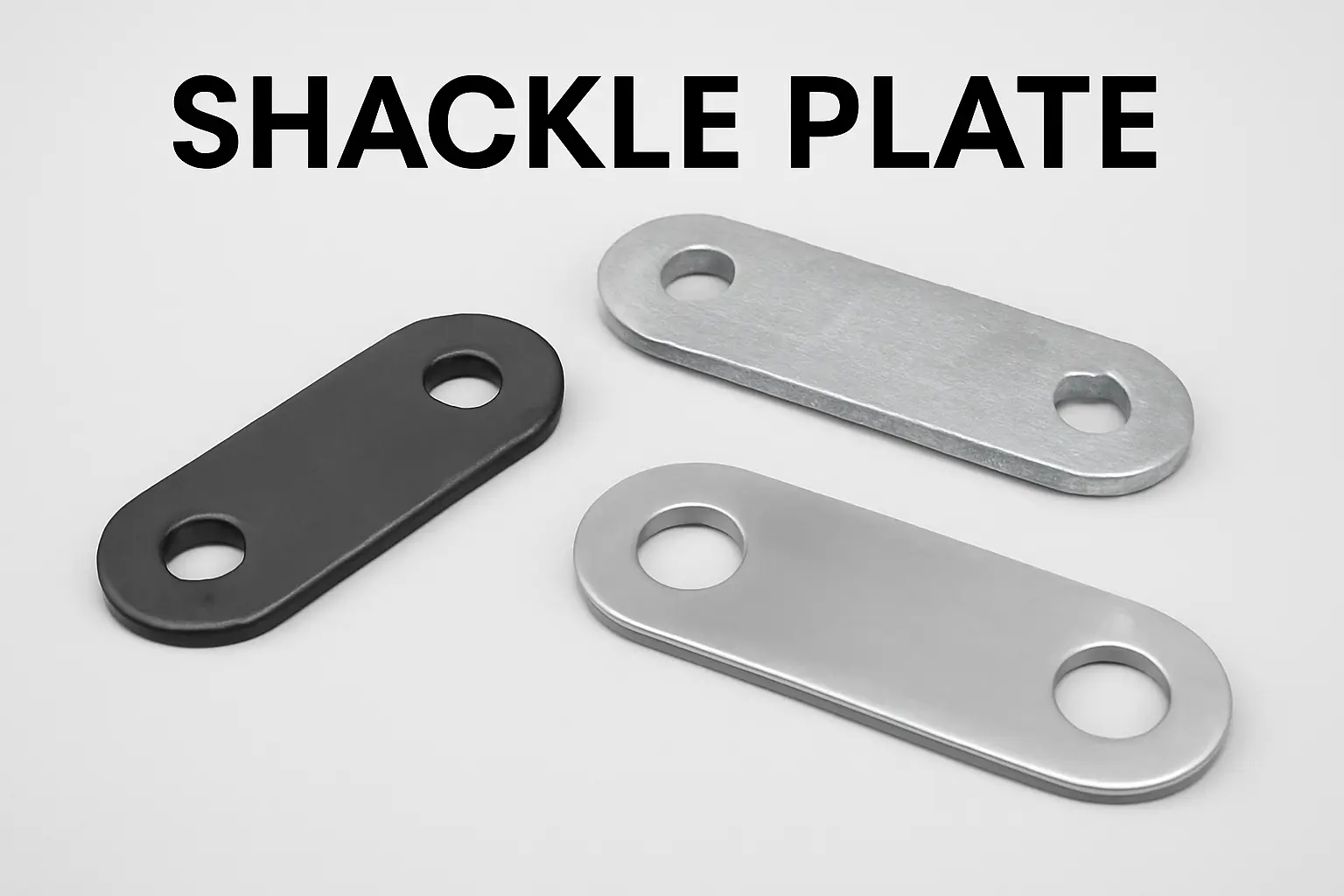
Shackle Plate Manufacturers in India

Shackle Plate Manufacturers in India: Leading the Industry with Sachiya Steel International

When it comes to high-quality Shackle Plates and SS Shackle Plates, Sachiya Steel International Private Limited stands as the leading manufacturer and exporter in India. Our company offers premium, durable, and highly reliable shackle plates used in various lifting, securing, and transportation applications across industries. With years of expertise, we specialize in crafting products that meet international standards of quality and strength.

What Are Shackle Plates?

Shackle plates are critical components of the shackle assembly, which is commonly used in lifting operations. These plates play an essential role in securing heavy loads during lifting, towing, and transportation processes. Typically made of high-strength materials, they offer the necessary support and stability to lifting systems. As Shackle Plate Manufacturers in India, we understand the significance of delivering products that offer the utmost safety and durability.

At Sachiya Steel International, we provide high-quality Shackle Plates that are designed to handle heavy-duty lifting operations with ease, ensuring the safety and efficiency of your operations.

Types of Shackle Plates We Manufacture

  1. Mild Steel Shackle Plates Our mild steel shackle plates are known for their reliability and cost-effectiveness. They are ideal for general-purpose applications in industries such as construction and logistics.

  2. Stainless Steel Shackle Plates (SS Shackle Plates) As leading SS Shackle Plate Manufacturers in India, we specialize in manufacturing stainless steel shackle plates. These plates are corrosion-resistant, offering superior strength and long-lasting durability, especially in harsh environments such as marine, chemical, and offshore industries.

  3. Hot-Dip Galvanized Shackle Plates For enhanced corrosion protection, we offer hot-dip galvanized shackle plates. This added layer of galvanization helps protect against rust and weather conditions, making them suitable for outdoor and marine applications.

  4. Customized Shackle Plates Understanding that industries have unique requirements, we also provide customized shackle plates. Whether it’s the material, size, or design, we work closely with our clients to deliver tailored solutions that meet their specific needs.

Shackle Plate Manufacturers in India

Why Choose Sachiya Steel International for Shackle Plates?

  1. Unmatched Quality At Sachiya Steel International, we prioritize the quality of our products. We manufacture shackle plates using high-grade materials and adhere to rigorous testing processes, ensuring durability, strength, and performance. Our SS Shackle Plates are engineered for both heavy-duty and specialized applications, providing exceptional load-bearing capabilities.

  2. Global Exporter As one of India’s premier Shackle Plate Manufacturers, we have successfully exported our products to over 50 countries, including the USA, Canada, UK, Germany, and Australia. Our extensive export network and international clients trust us for our consistent quality and timely delivery.

  3. Customization Options We understand that different industries have different demands. Our team offers a wide range of customizable options for shackle plates, including variations in size, material, load capacity, and surface finish. Whether you’re looking for a mild steel variant or a high-strength stainless steel plate, we’ve got you covered.

  4. Competitive Pricing We offer Shackle Plates at competitive prices without compromising on quality. Our efficient production methods, combined with our established supply chain, enable us to deliver cost-effective solutions for both small and large-scale projects.

  5. Expert Technical Support We pride ourselves on offering exceptional customer service. Our team of technical experts is always available to help you choose the right shackle plate for your application. We ensure that all our clients receive the necessary guidance to meet their lifting and securing needs effectively.

Technical Specifications of Our Shackle Plates

  • Material Options: Mild Steel, Stainless Steel (SS), Hot-Dip Galvanized Steel

  • Tensile Strength: High tensile strength, with customization options up to 1000 MPa

  • Finish: Galvanized, powder-coated, or painted finishes available

  • Custom Sizes: Available in a wide range of sizes, or customized to client specifications

  • Load Capacity: Customizable to meet different lifting requirements

  • Corrosion Resistance: Stainless Steel and Galvanized options offer superior protection

  • Industry Compliance: Meets international standards such as ASTM, ISO, and BS

Applications of Shackle Plates

Shackle plates are essential components in various industries, including:

  • Construction: Used for lifting construction materials such as steel beams, concrete blocks, and heavy machinery.

  • Marine: Vital for securing cargo, anchor chains, and mooring lines in maritime operations.

  • Mining: Used for lifting heavy mining equipment, machinery, and tools.

  • Oil and Gas: Required for securing pipes, pumps, and other essential equipment.

  • Shipping & Logistics: Used to secure shipping containers and cargo during transportation.

Quality Assurance at Sachiya Steel International

At Sachiya Steel International, we employ strict quality control measures to ensure the highest standards of product performance and safety. From material selection to the final inspection, every stage of production is closely monitored. Our commitment to quality is reflected in the certifications we hold, including ISO 9001:2015, ensuring our products meet both national and international standards.

Get in Touch with Sachiya Steel International Today

If you’re looking for Shackle Plate Manufacturers in India that offer exceptional quality, reliability, and competitive pricing, look no further than Sachiya Steel International Private Limited. We are your trusted partner for all your shackle plate needs. Contact us today for more information or to request a quote.


Conclusion

As one of the top Shackle Plate Manufacturers in India, Sachiya Steel International Private Limited offers superior products designed to meet the demands of industries that require heavy-duty, reliable, and safe lifting solutions. Our wide range of products, including SS Shackle Plates, mild steel variants, and customized options, ensures that we can provide solutions for any application. Our global customer base and strong reputation for quality and reliability make us the ideal choice for all your shackle plate needs.

By |2025-10-06T18:24:23+05:30October 3rd, 2025|Plates|

Top-Quality IS 2062 E250BR Sheet & Plate Supplier – Sachiya Steel International

Top-Quality IS 2062 E250BR Sheet & Plate Supplier

Sachiya Steel International Private Limited stands as a leader in the steel industry, specializing in the supply of high-grade IS 2062 E250BR Sheets and Plates. Our commitment to excellence ensures that our products meet the rigorous standards required for a variety of industrial applications worldwide.

Product Overview of IS 2062 E250BR Sheet & Plate:

The IS 2062 E250BR Sheets and Plates from Sachiya Steel International are manufactured using superior raw materials. These products are known for their exceptional mechanical properties, making them suitable for structural and fabrication projects.

Specifications of IS 2062 E250BR Sheet & Plate:

  • Grade: IS 2062 E250BR
  • Thickness: 5mm to 150mm
  • Width: 1000mm to 3000mm
  • Length: 3000mm to 18000mm
  • Finish: Hot Rolled (HR) and Cold Rolled (CR)

Chemical Composition of IS 2062 E250BR Sheet & Plate:

  • Carbon (C): 0.23% max
  • Manganese (Mn): 1.50% max
  • Sulphur (S): 0.045% max
  • Phosphorus (P): 0.045% max

Mechanical Properties of IS 2062 E250BR Sheet & Plate:

  • Yield Strength: 250 MP
  • Tensile Strength: 410 MPa
  • Elongation: 23%

Applications of IS 2062 E250BR Sheet & Plate:

IS 2062 E250BR Sheet & Plate

Our IS 2062 E250BR Sheets and Plates are utilized across various industries due to their robustness and versatility:

  • Construction: Ideal for building frameworks and structural support.
  • Automotive: Used in manufacturing vehicle parts and bodies.
  • Shipbuilding: Suitable for making hulls and other critical components.
  • Oil & Gas: Employed in the construction of rigs and refineries.

Special Features of IS 2062 E250BR Sheet & Plate:

  • High Tensile Strength: Ensures durability and performance under stress.
  • Corrosion Resistance: Suitable for use in harsh environments.
  • Excellent Weldability: Facilitates easy and secure welding processes.
  • Dimensional Accuracy: Precision manufacturing for reliable application.

Packaging and Delivery of IS 2062 E250BR Sheet & Plate:

Sachiya Steel International ensures safe and efficient delivery of all products. Our packaging options include:

  • Bundles (Hexagonal)
  • Wooden Boxes
  • Crates (Steel/Wooden)

We provide customizable packaging solutions based on customer requirements to protect against extreme weather and handling conditions.

Why Choose Sachiya Steel International for IS 2062 E250BR Sheet & Plate?:

  • Quality Assurance: Strict quality control processes to ensure premium product standards.
  • Competitive Pricing: Offering market-leading rates without compromising on quality.
  • Global Reach: Efficient logistics for timely delivery across the globe.
By |2024-07-22T19:04:25+05:30July 22nd, 2024|Plates, Sheets|

Wear Plate Manufacturers in India

Wear Plate Manufacturers in India

Wear plates are critical components in various industries, ensuring machinery durability and reducing downtime. They are designed to withstand extreme conditions such as abrasion, impact, and erosion. This article delves into the top wear plate manufacturers in India, with a special focus on Sachiya Steel International Private Limited, a leading name in the industry.

Leading Wear Plate Manufacturers in India

Sachiya Steel International Private Limited

Sachiya Steel International is renowned for producing high-quality wear plates that cater to diverse industrial needs. Their plates are known for their exceptional durability and performance, making them a preferred choice across various sectors.

Wear Plate Manufacturers in India

Key Features:

  • Superior Materials: Use of high-quality materials ensures high resistance to wear and tear.
  • Advanced Manufacturing: State-of-the-art processes including open arc welding with flux-cored wire.
  • Custom Solutions: Tailored overlay compositions to meet specific requirements.
  • In-House Capabilities: Comprehensive in-house facilities for design, engineering, and testing.

Types of Wear Plates

1. Borodur Wear Plates

  • Description: High C-Cr alloyed weld metal offering excellent abrasion resistance with mild impact.
  • Applications: Pumps, mixer parts, tracks hoppers, pipes, impellers, conveyor screws, coal and cement mill tyres, and liners.
  • Hardness: 56 – 62 HRC

2. Chromadur Wear Plates

  • Description: High C-Cr alloyed stainless weld metal with superior abrasion resistance.
  • Applications: Pumps, impeller screws, track hoppers, and bucket teeth.
  • Hardness: 55 – 64 HRC

3. Colmodur HT Wear Plates

  • Description: Highly alloyed C-Cr-Mo-Nb-W-V weld plate with extreme abrasion resistance at high temperatures.
  • Applications: Blast furnace bells, fire grates, crushers, sinter wheel breakers, and smelter loading chutes.
  • Hardness: 62 – 65 HRC

4. Colodur Wear Plates

  • Description: High C-Cr-Nb alloyed weld metal with excellent resistance to extreme abrasion wear.
  • Applications: Parts of coal mining equipment, steel industry, cement industry, and mineral industries.
  • Hardness: 58 – 62 HRC

5. Erodur 801 Wear Plates

  • Description: High alloyed deposit of Fe-C-Cr-Ni-B with excellent resistance to severe erosion and moderate impact.
  • Applications: Hardfacing on parts of coal mining equipment, cement, steel, and mineral industries.
  • Hardness: 60 – 67 HRC

6. Impactodur Wear Plates

  • Description: High C-Si-Cr alloyed hardface weld deposit with moderate resistance to abrasion under high impact.
  • Applications: Build-up of crusher parts, bucket teeth, and lips.
  • Hardness: 48 – 55 HRC

7. Diffusion Cordiff TT 400 Wear Plates

  • Description: Highly alloyed special metals for hardfacing parts subjected to extreme wear and impact.
  • Applications: Screens, wear plates.
  • Hardness: 48 – 58 HRC

Critical Wear Components

Sachiya Steel’s wear plates are integral to numerous critical components across industries, ensuring enhanced durability and reduced downtime. These include:

  • Grizzly Bars: Used in the steel industry to handle red hot sinter, enhancing life span by 300%.
  • Guide Vanes: Critical in cement plant separators for directing the material flow.
  • Rotor Wheels and Bearing Arrangements: Essential for cement plant separators, ensuring smooth and efficient operation.
  • Grit Cones and Separator Parts: Offering superior wear resistance and longevity in harsh environments.

Why Choose Sachiya Steel International Private Limited?

Sachiya Steel stands out due to its commitment to quality and innovation. Our wear plates are designed to deliver superior performance and longevity, reducing maintenance costs and downtime. Here are some reasons to choose Sachiya Steel:

  • Innovative Solutions: Custom overlay compositions developed by an expert R&D team.
  • High-Quality Standards: In-house facilities for comprehensive testing and quality assurance.
  • Customer-Centric Approach: Solutions tailored to meet specific industrial needs.

Wear plates are indispensable in industries where machinery is exposed to severe wear conditions. Choosing the right manufacturer is crucial to ensure the longevity and efficiency of your equipment. Sachiya Steel International Private Limited, with its innovative solutions and high-quality products, is a leader in the field, offering reliable and durable wear plates to meet your industrial needs.

By |2024-07-20T11:15:44+05:30July 19th, 2024|Plates|

Steel Plates Supplier In India

Steel Plates Supplier In India

Steel plates are essential components used in various industries for their durability, strength, and versatility. At Sachiya Steel International, we are committed to providing top-quality steel and Chequered Plates that meet the highest industry standards. In this article, we will explore the different types of steel plates, their applications, and the benefits they offer. Whether in construction, manufacturing, or any other industry, this guide will help you understand steel plates and make informed project decisions.

Steel plates are crucial in various industries, providing structural support, strength, and durability to various applications. Sachiya Steel International, a trusted supplier, offers an extensive selection of steel plates, ensuring high-quality materials for your projects. Whether you’re building bridges, constructing machinery, or fabricating structures, steel plates are essential components you can rely on for their superior performance.

What Is Steel Plates?

Steel plates are flat sheets of steel often used as structural components or base materials in construction, manufacturing, and other industries. They are manufactured through hot or cold rolling, resulting in different thicknesses and dimensions. Steel plates come in various grades, each offering specific properties suitable for different applications.

Types of Steel Plates:

3.1 Carbon Steel Plates: Carbon steel plates are the most common type of steel plates available. They contain a higher carbon content, providing excellent strength and toughness. Carbon steel plates, such as buildings, bridges, and machinery, are widely used in structural applications.

3.2 Stainless Steel Plates: Stainless steel plates are corrosion-resistant and offer excellent durability and aesthetic appeal. They are commonly used in the food processing, pharmaceutical, and chemical industries, where hygiene and resistance to corrosion are crucial.

3.3 Alloy Steel Plates: Alloy steel plates are made by adding chromium, nickel, or molybdenum to carbon steel, enhancing their mechanical properties. These plates are often used in high-stress applications, such as pressure vessels, oil and gas pipelines, and offshore structures.

Steel plates

3.4 High-Strength Low-Alloy (HSLA) Steel Plates: HSLA steel plates are known for their superior strength-to-weight ratio. They provide excellent weldability and formability while offering higher tensile strength than carbon steel plates. HSLA steel plates are commonly used in construction equipment, transportation, and structural applications.

Applications of Steel Plates:

4.1 Construction Industry: Steel plates are extensively used in the construction industry for various applications. They are used to fabricate beams, columns, and trusses for structural support. Steel plates are also used to construct bridges, highways, and buildings, providing the necessary strength and stability.

4.2 Manufacturing Industry: In the manufacturing industry, steel plates find applications in producing machinery, equipment, and components. They are used to manufacture heavy machinery, storage tanks, and industrial tools. Steel plates are also used in the automotive industry to fabricate vehicle frames and body parts.

4.3 Shipbuilding Industry: Shipbuilding requires materials that can withstand harsh marine environments. Steel plates with excellent corrosion resistance and high strength are used to construct ships and offshore structures. They ensure vessels’ structural integrity and durability, making them suitable for challenging maritime conditions.

4.4 Energy Sector: Steel plates are crucial in the energy sector for applications such as power plants, oil refineries, and pipelines. They are used to construct pressure vessels, storage tanks, and other critical components that handle high temperatures and pressures. Steel plates ensure the safe and efficient operation of energy infrastructure.

Benefits of Steel Plates:

5.1 Strength and Durability: Steel plates offer exceptional strength and durability, making them ideal for demanding applications. They can withstand heavy loads and extreme conditions, ensuring long-lasting performance.

5.2 Versatility: With a wide range of grades and dimensions available, steel plates offer versatility in various industries. They can be tailored to specific requirements, providing flexibility and adaptability for different applications.

5.3 Corrosion Resistance: Certain types of steel plates, such as stainless steel, exhibit excellent corrosion resistance. This makes them suitable for applications where exposure to moisture or chemicals is common.

5.4 Cost-Effective: Despite their superior properties, steel plates are cost-effective compared to alternative materials. Their long lifespan and low maintenance requirements contribute to overall cost savings.

5.5 Recyclability: Steel plates are highly recyclable, making them an environmentally friendly choice. They can be repurposed and reused, reducing the demand for new raw materials and minimizing waste.

Chequered Plates: Overview: 

Chequered plates, also known as Chequered plates or tread plates, are steel plates with a raised pattern of lines or diamonds on the surface. This pattern provides slip resistance and prevents accidents caused by slippery surfaces. Chequered plates are commonly used in flooring, stairs, and walkways where traction is essential. 

Chequered Plate Applications:

7.1 Construction Industry: In the construction industry, Chequered plates are widely used for flooring in areas prone to slip hazards. They provide a safe walking surface, especially in industrial buildings, factories, and warehouses.

7.2 Transportation Sector: Chequered plates find applications in the transportation sector, particularly trailers, truck beds, and loading docks. The raised pattern enhances grip and prevents cargo or vehicles from sliding during transportation.

7.3 Architectural Applications: Chequered plates add a decorative element while offering slip resistance in architectural and interior design. They are used in staircases, ramps, and other areas where safety and aesthetics are important.

7.4 Industrial Platforms: Industrial platforms, such as oil rigs and refineries, require sturdy flooring that can withstand heavy loads and provide traction. Chequered plates are commonly used in these environments to ensure worker safety.

FAQ’s:

What is the maximum thickness available for steel plates?

Steel plates are available in various thicknesses, ranging from a few millimeters to several inches. The maximum thickness can vary depending on the type of steel and the supplier. Contact Sachiya Steel International for specific thickness requirements.

Can steel plates be cut to custom sizes?

Steel plates can be cut to custom sizes based on your project’s specifications. Sachiya Steel International offers cutting services to provide the exact dimensions you need.

Are steel plates suitable for outdoor applications?

Yes, steel plates are commonly used in outdoor applications. However, certain steel plates, such as stainless steel, offer better corrosion resistance and are recommended for prolonged exposure to moisture or harsh weather conditions.

How are Chequered plates manufactured?

Chequered plates are manufactured through a process called rolling. Steel plates are passed through a rolling mill equipped with a patterned roller, which imparts the raised pattern on the surface.

Can Chequered plates be used in wet environments?

Chequered plates are designed to provide slip resistance, even in wet or slippery environments. The raised pattern on the surface enhances traction, reducing the risk of accidents.

What is the difference between Chequered plates and plain steel plates?

Chequered plates have a raised pattern on the surface, while plain steel plates have a smooth surface. The raised pattern on Chequered plates provides slip resistance, making them suitable for applications where traction is important.

Conclusion:

Steel and Chequered plates are essential in various industries, providing strength, durability, and versatility for countless applications. As a trusted supplier, Sachiya Steel International offers high-quality steel plates that meet industry standards. Whether you need carbon steel, stainless steel, or alloy steel plates, we have you covered. Our commitment to quality and customer satisfaction ensures that you receive the best project materials. Please browse our catalog or contact us today to discuss your steel plate requirements.

By |2024-06-05T11:03:44+05:30July 20th, 2023|Plates|
Go to Top