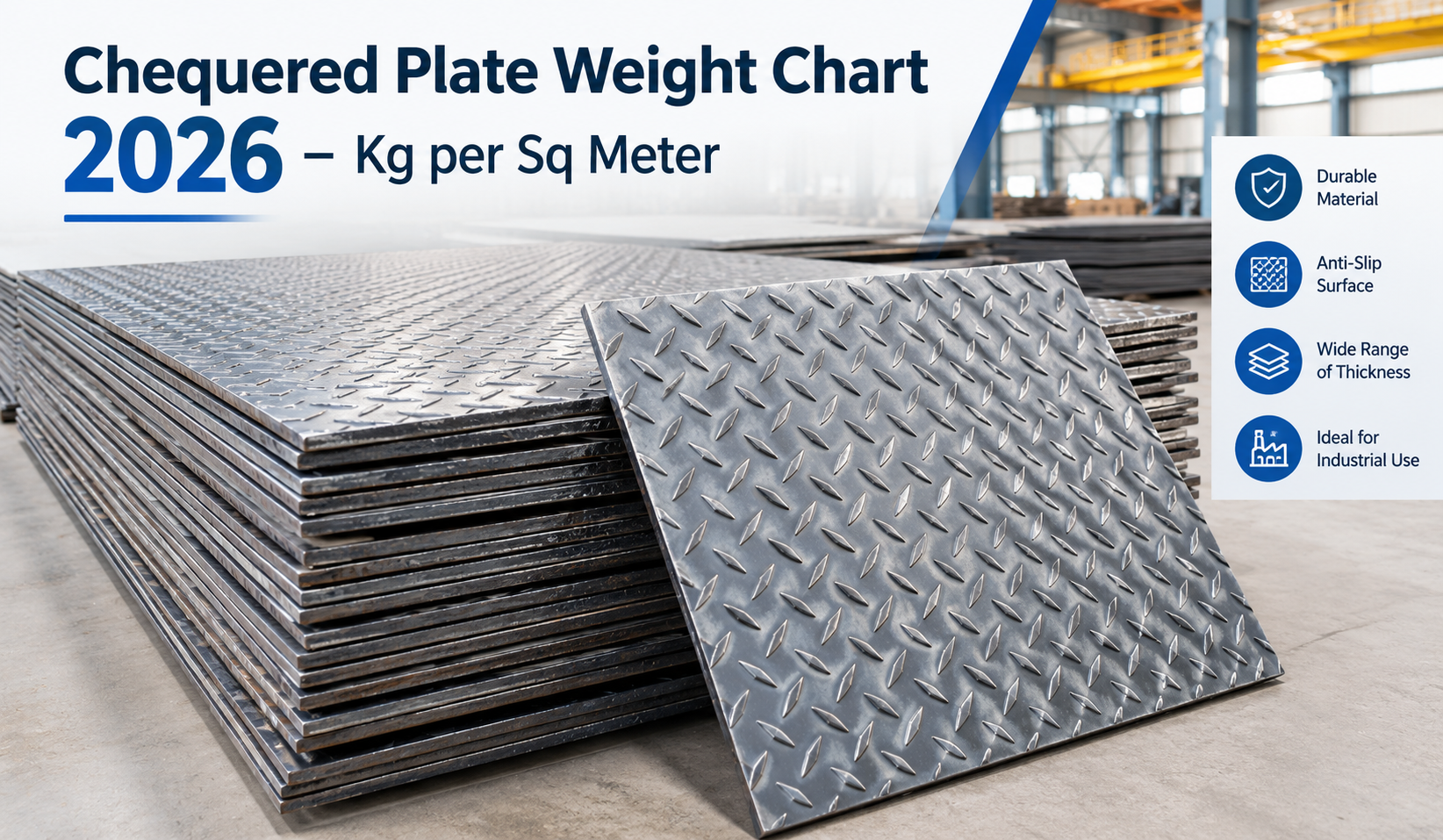
Chequered Plate Weight Chart 2026 – Kg per Sq Meter
Last Updated: September, 2026
Introduction
The Chequered Plate Weight Chart 2026 – Kg per Sq Meter is a useful reference for buyers, engineers, fabricators, contractors, project planners, and steel stockists who need to estimate the weight of mild steel chequered plates. Chequered plates have a raised surface pattern and are widely used for industrial flooring, platforms, stairs, walkways, ramps, machinery areas, trailers, and fabrication work.
Knowing the approximate weight of steel plate before purchasing helps with material estimation, transportation planning, structural calculations, lifting arrangements, stock management, and project costing. The weight depends primarily on thickness and area, while the raised pattern can also affect the final supplied weight.
This Chequered Plate Weight Chart 2026 – Kg per Sq Meter provides reference values for common thicknesses along with calculation methods, examples, specifications, applications, pricing factors, ordering information, and frequently asked questions.
The values shown are intended for estimation. Actual supplied weight can vary according to pattern geometry, dimensions, manufacturing tolerances, material specification, and supplier practices.
Chequered Plate Weight Chart
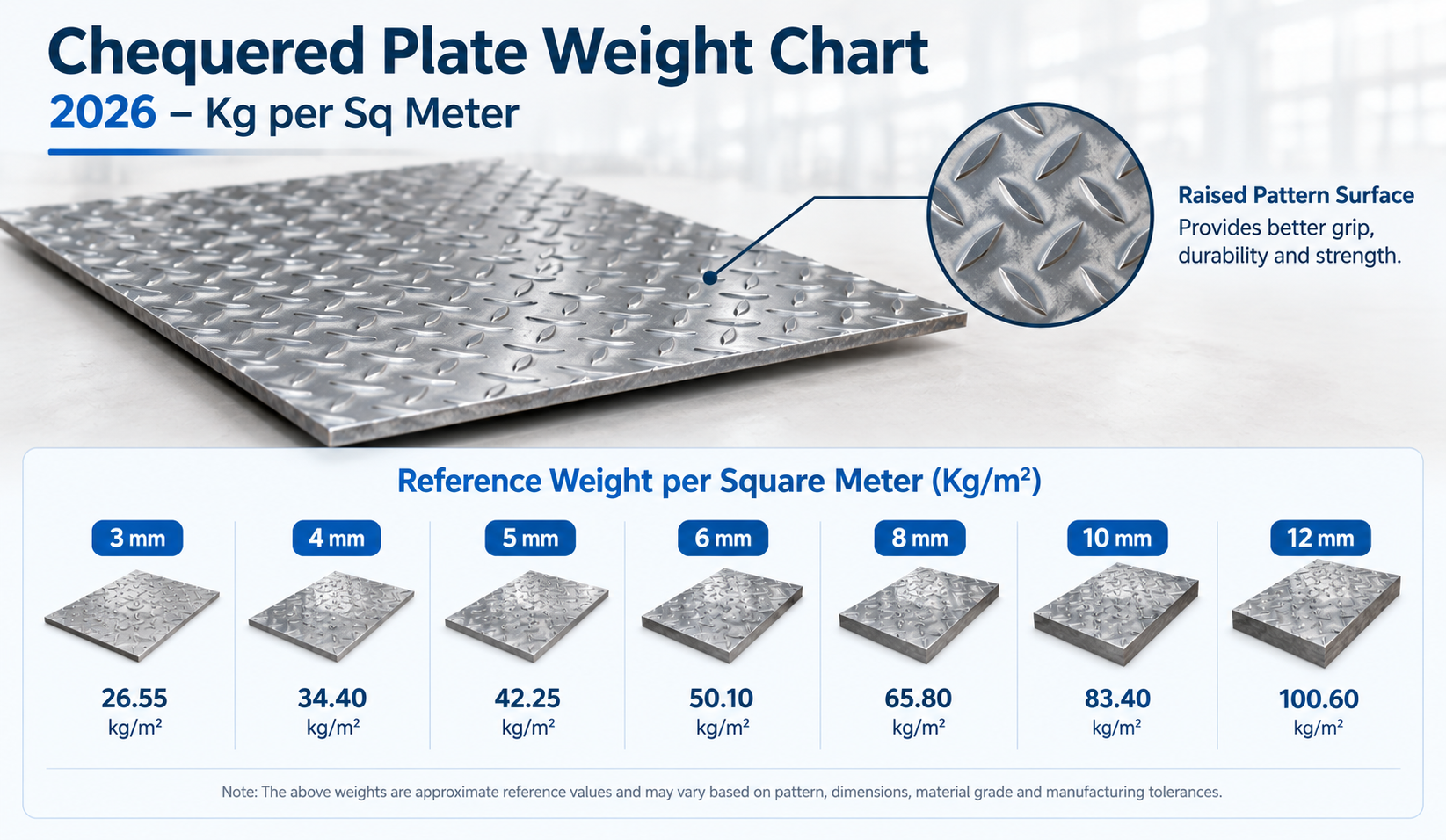
The following chart provides approximate reference weights for commonly used MS chequered plates.
| Thickness | Approx. Weight per Square Meter |
|---|---|
| 3 mm | 26.55 kg/m² |
| 4 mm | 34.40 kg/m² |
| 5 mm | 42.25 kg/m² |
| 6 mm | 50.10 kg/m² |
| 8 mm | 65.80 kg/m² |
| 10 mm | 83.40 kg/m² |
| 12 mm | 100.60 kg/m² |
These values can be used for preliminary material calculations. For commercial transactions, the actual finished weight should be confirmed from the supplier or agreed product documentation.
Understanding Chequered Plate Weight
A chequered plate differs from a plain steel plate because its upper surface contains a raised pattern. This pattern is designed to provide a textured surface and can contribute additional material to the finished product.
For this reason, a theoretical calculation based only on nominal thickness does not always represent the exact finished weight.
When estimating material requirements, consider:
- Nominal plate thickness
- Plate length
- Plate width
- Raised pattern
- Pattern dimensions
- Steel density
- Manufacturing tolerance
- Applicable material specification
- Actual supplier weight
The Chequered Plate Weight Chart 2026 – Kg per Sq Meter should therefore be treated as a practical estimation reference rather than a replacement for certified weighing.
Chequered Plate Weight Calculation Formula
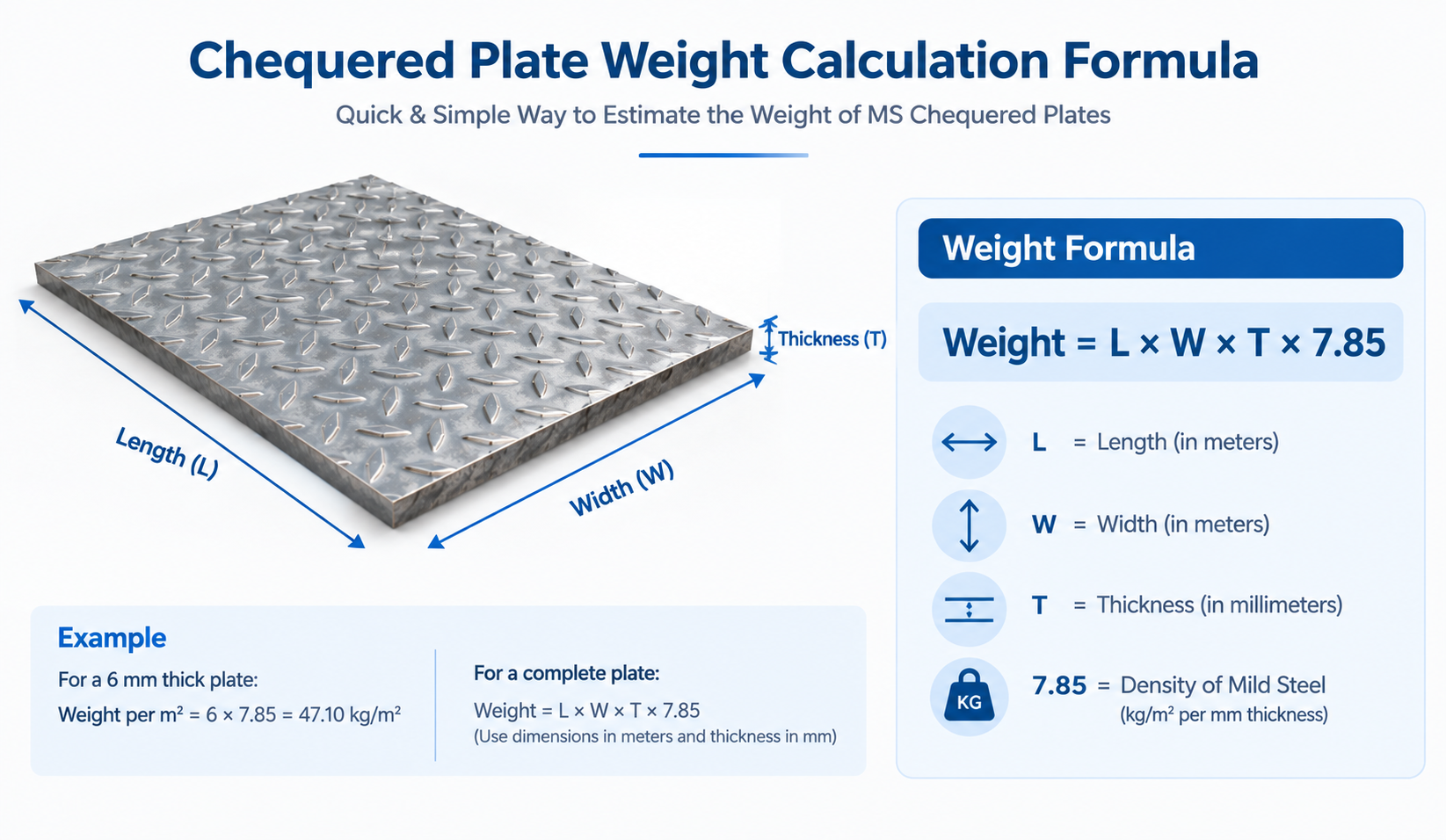
For a theoretical flat mild steel plate, the commonly used formula is:
Weight per square meter = Thickness in mm × 7.85
For calculating the weight of a complete rectangular plate:
Weight (kg) = Length (m) × Width (m) × Thickness (mm) × 7.85
The value 7.85 represents the commonly used theoretical density of mild steel in kg per square metre for a 1 mm thickness.
For example, for a 5 mm theoretical flat plate:
5 × 7.85 = 39.25 kg/m²
A finished chequered plate may weigh more because of the raised surface pattern.
Chequered Plate Weight Calculation Example
Consider a plate with the following dimensions:
- Length: 2500 mm
- Width: 1250 mm
- Thickness: 6 mm
Convert the dimensions into meters:
2500 mm = 2.5 m
1250 mm = 1.25 m
Area:
2.5 × 1.25 = 3.125 m²
Using the reference chart value of 50.10 kg/m²:
3.125 × 50.10 = 156.56 kg
Therefore, the approximate reference weight is:
156.56 kg per plate
The final supplied weight can vary and should be confirmed for commercial purchasing.
3 mm Chequered Plate Weight
The reference value for 3 mm material is approximately
26.55 kg/m²
This thickness can be considered for lighter fabrication, panels, access areas, and applications where lower material weight is required.
The actual suitability depends on load, support conditions, fabrication design, and project requirements.
4 mm Chequered Plate Weight
The reference weight for 4 mm material is
34.40 kg/m²
A 4 mm plate can be used for suitable industrial flooring, fabrication, platforms, steps, and access structures depending on the required load and support arrangement.
5 mm Chequered Plate Weight
For 5 mm material, the reference weight is
42.25 kg/m²
This thickness provides a heavier section than 3 mm and 4 mm material and can be used in a range of industrial and fabrication applications.
6 mm Chequered Plate Weight
The reference weight for 6 mm material is:
50.10 kg/m²
For a 2500 × 1250 mm plate:
3.125 × 50.10 = 156.56 kg
This example demonstrates how area and kg/m² values can be combined to estimate the total weight of one plate.
8 mm Chequered Plate Weight
The reference value for 8 mm material is:
65.80 kg/m²
As thickness increases, the total weight of each sheet also increases. Buyers should therefore consider lifting equipment, transportation capacity, storage requirements, and handling arrangements.
10 mm Chequered Plate Weight
The reference value for 10 mm material is:
83.40 kg/m²
This heavier plate thickness can be used for applications requiring increased section thickness, subject to engineering design and project specifications.
12 mm Chequered Plate Weight
The reference value for 12 mm material is
100.60 kg/m²
Large 12 mm plates can be significantly heavy, so appropriate lifting equipment and transportation planning are important when ordering full-size sheets.
4 × 8 Feet Chequered Plate Weight
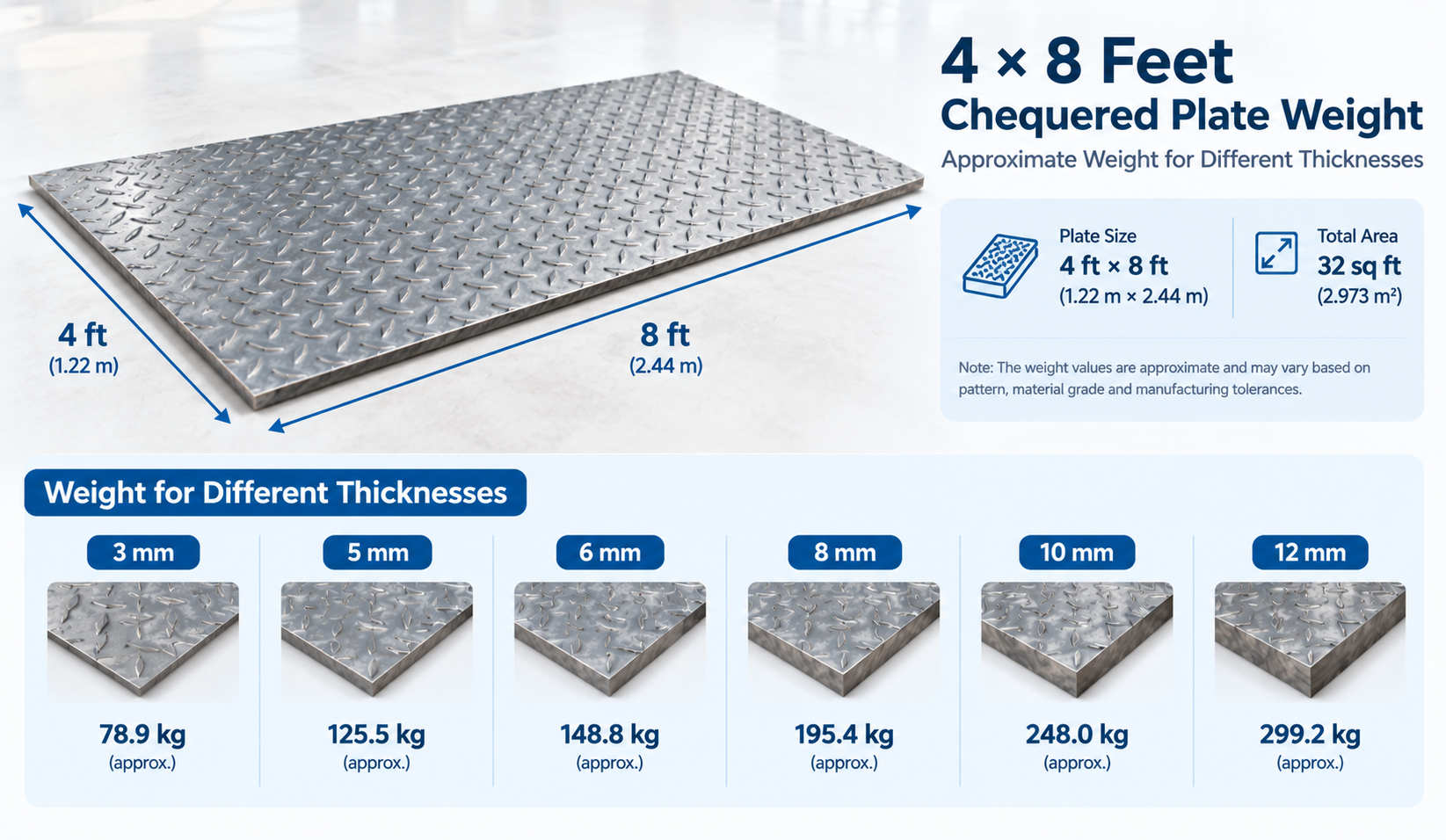
A 4 × 8-foot plate has an approximate area of:
32 square feet
or approximately:
2.973 m²
Using the reference values above:
| Thickness | Approx. Weight for 4 × 8 ft |
|---|---|
| 3 mm | 78.9 kg |
| 5 mm | 125.5 kg |
| 6 mm | 148.8 kg |
| 8 mm | 195.4 kg |
| 10 mm | 248.0 kg |
| 12 mm | 299.2 kg |
These figures are approximate and are intended for estimation and planning.
Chequered Plate Weight Per Square Foot
Many fabrication and construction projects use feet instead of meters for dimensions.
The conversion is:
1 square meter = 10.7639 square feet
Therefore:
Weight per square foot = Weight per square metre ÷ 10.7639
For example, using the 6 mm reference value:
50.10 ÷ 10.7639 = approximately 4.66 kg/ft²
This calculation allows buyers to convert between metric and imperial project measurements.
Factors Affecting Chequered Plate Weight
Several factors can influence the final weight of a chequered plate.
Thickness
Increasing the nominal thickness increases the amount of steel per square metre.
Plate Dimensions
A longer or wider plate contains more material and therefore has a higher total weight.
Surface Pattern
The raised pattern adds material to the surface and can change the finished weight compared with a plain plate.
Pattern Geometry
Different patterns may contain different amounts of raised material.
Manufacturing Tolerance
Actual dimensions and thickness can vary within applicable manufacturing tolerances.
Material Density
Theoretical calculations depend on the density used for the steel grade.
Cutting
Once a full plate is cut into smaller pieces, each individual piece has a weight based on its new dimensions.
Chequered Plate Specifications
Common purchasing specifications can include:
| Specification | Typical Requirement |
|---|---|
| Material | Mild Steel |
| Product Type | Hot Rolled Chequered Plate |
| Surface | Raised Pattern |
| Thickness | 3 mm to 12 mm and as required |
| Width | Standard or custom |
| Length | Standard or custom |
| Grade | As specified by the project |
| Pattern | Diamond / 5-Bar / Lentil / Other |
| Quantity | Plates or total weight |
Exact availability depends on the manufacturer, grade, dimensions, pattern, and order quantity.
Common Chequered Plate Patterns
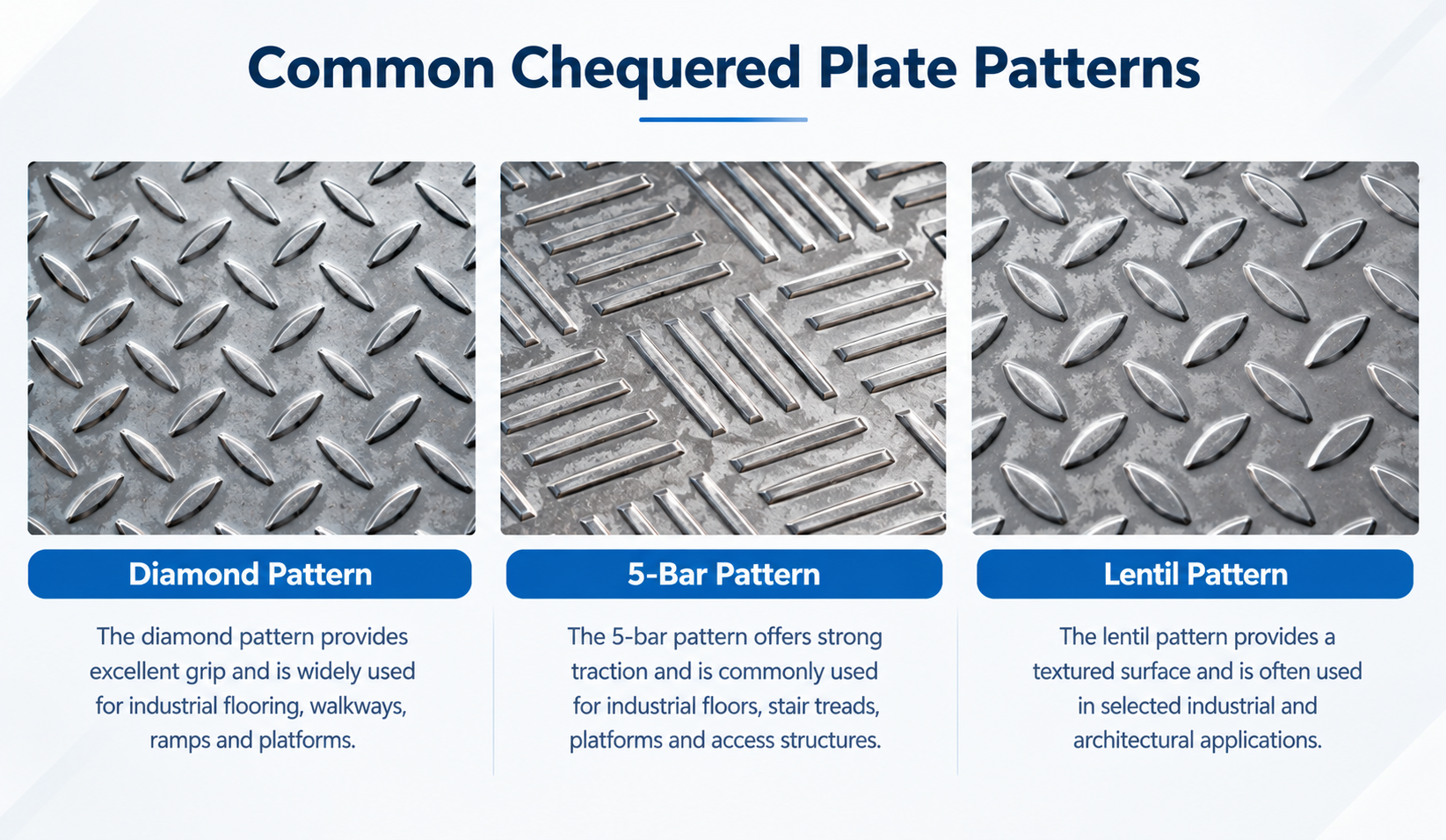
Diamond Pattern
Diamond-pattern plates are commonly used for industrial flooring, walkways, ramps, platforms, and access areas.
5-Bar Pattern
Five-bar surfaces are used for industrial floors, stair treads, platforms, and fabricated access structures.
Lentil Pattern
Lentil-pattern plates provide a textured surface and are used in selected industrial and architectural applications.
Other Patterns
Manufacturers may offer additional surface designs according to production capability and customer requirements.
Pattern should be specified when requesting a quotation because it can influence both appearance and weight.
Applications of Chequered Plates
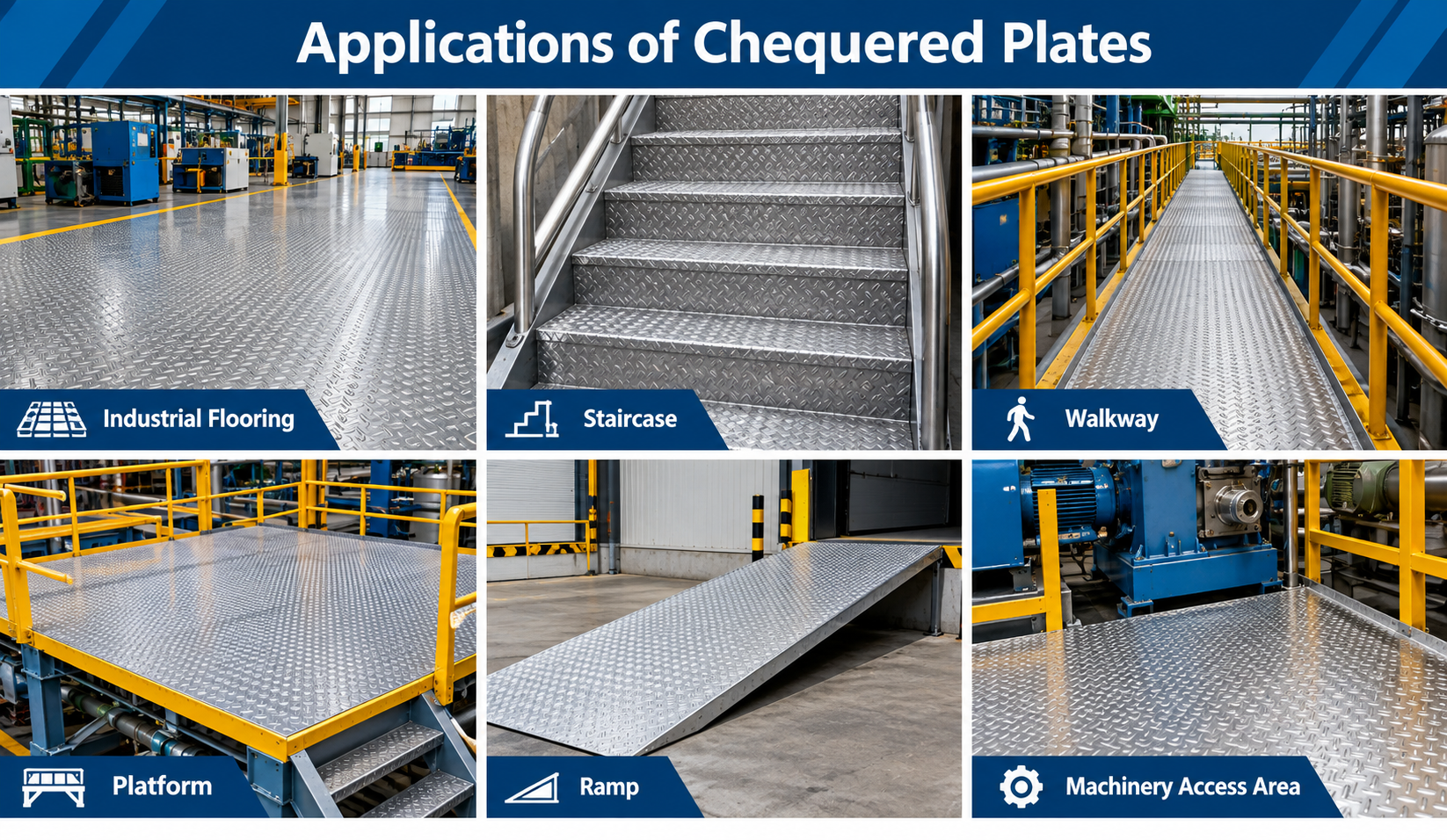
Chequered plates are used in many industrial and fabrication environments.
Industrial Flooring
They can be used for factory floors, workshops, maintenance areas, and industrial access surfaces.
Platforms
Chequered plates are commonly fabricated into equipment platforms, maintenance platforms, and elevated work areas.
Staircases
The raised surface can provide additional grip for industrial stairs and steps.
Walkways
They are suitable for selected walkways, maintenance paths, access routes, and elevated platforms.
Ramps
The textured surface can be used for ramps and loading areas where additional surface grip is required.
Machinery Areas
Chequered plates can be used around industrial equipment and machinery as maintenance or access flooring.
Trailers and Transportation
They can be used in selected truck bodies, trailers, loading platforms, and transportation fabrication projects.
How to Select the Correct Thickness
The correct thickness should not be selected only by comparing weight.
Consider:
- Expected load
- Span between supports
- Support arrangement
- Pedestrian traffic
- Vehicle traffic
- Impact
- Vibration
- Required rigidity
- Fabrication method
- Environmental conditions
- Corrosion protection
- Engineering requirements
For structural flooring and load-bearing applications, the required thickness should be established through appropriate engineering calculations.
Chequered Plate Price 2026
The Chequered Plate Price 2026 depends on the material specification and current steel market conditions.
Important price factors include:
- Material grade
- Plate thickness
- Width
- Length
- Pattern
- Quantity
- Market steel rate
- Cutting requirements
- Surface condition
- Packing
- Freight
- Delivery location
- Taxes
- Inspection or documentation requirements
Because steel prices can change, buyers should request a current quotation instead of relying on one fixed market price.
For an accurate quotation, provide the complete product specification, including thickness, dimensions, grade, pattern, quantity, and delivery location.
Ordering Information
When ordering chequered plates, provide the following details:
Product: MS Chequered Plate
Grade: Required grade
Thickness: Required thickness
Width: Required width
Length: Required length
Pattern: Diamond / 5-Bar / Lentil / Other
Quantity: Number of plates or total weight
Application: Flooring / Platform / Stair / Ramp / Fabrication / Other
Delivery Location: City and country
Complete information helps the supplier understand the requirement and prepare a more accurate quotation.
Quality and Documentation
Depending on the project and purchase requirement, customers may request supporting documentation.
Common documents can include:
- Material Test Certificate
- Chemical composition
- Mechanical properties
- Heat number
- Dimensional inspection
- Mill certificate
- Packing list
- Commercial invoice
- Weight details
- Inspection documentation
Documentation requirements should be agreed upon before order confirmation, particularly for engineering, export, infrastructure, and project-based purchases.
Storage and Handling
Proper storage is important for maintaining steel plate condition.
Store plates on suitable supports and avoid direct exposure to standing water. Plates should be handled with appropriate lifting equipment according to their dimensions and weight.
For larger and thicker plates, consider:
- Crane capacity
- Forklift capacity
- Lifting points
- Storage supports
- Plate stacking
- Transportation arrangement
- Loading and unloading space
Accurate weight estimation helps plan these activities before material reaches the site.
Why Choose Sachiya Steel International?
Sachiya Steel International Private Limited supplies steel products for industrial, engineering, fabrication, construction, and commercial requirements.
For chequered plate enquiries, customers can share:
- Required grade
- Thickness
- Width
- Length
- Pattern
- Quantity
- Application
- Delivery location
Providing complete technical information helps the sales team process enquiries efficiently and prepare a quotation according to the specified requirement.
Get a Chequered Plate Quotation
For quotation requirements, provide the complete specification:
Product: MS Chequered Plate
Thickness: Required thickness
Size: Length × Width
Grade: Required grade
Pattern: Required pattern
Quantity: Number of plates / total quantity
Delivery Location: Required destination
Sachiya Steel International Private Limited
Phone: +91 9769056007
Email: [email protected]
Website: www.sachiyasteel.com
Frequently Asked Questions
1. What is the Chequered Plate Weight Chart 2026 – Kg per Sq Meter used for?
It is used as a reference for estimating the approximate weight of chequered plates according to thickness. It can assist with purchasing, transportation, material estimation, fabrication planning, and stock calculations.
2. What is the weight of a 3 mm chequered plate per square meter?
The reference value in this chart is approximately 26.55 kg/m².
3. What is the weight of a 6 mm chequered plate per square meter?
The reference value is approximately 50.10 kg/m².
4. How can I calculate the weight of a chequered plate?
For a theoretical flat MS plate, use:
Weight (kg) = Length (m) × Width (m) × Thickness (mm) × 7.85
For finished chequered plates, the raised surface pattern should also be considered.
5. Why can actual weight differ from the chart?
Actual weight can vary because of pattern geometry, dimensions, manufacturing tolerances, material density, and supplier specifications.
6. What is the approximate weight of a 4 × 8 feet, 6 mm chequered plate?
Using the reference value in this article, a 4 × 8 ft, 6 mm plate weighs approximately 148.8 kg.
7. What are the common uses of chequered plates?
Common applications include industrial flooring, platforms, stairs, walkways, ramps, machinery areas, loading areas, trailers, and fabrication structures.
8. Which thickness should I select for industrial flooring?
The required thickness depends on the load, span, support arrangement, traffic, impact, and engineering design. There is no single thickness suitable for every flooring application.
9. What information is required to purchase chequered plates?
Provide the grade, thickness, width, length, pattern, quantity, application, and delivery location.
10. How can I get the latest Chequered Plate Price 2026?
Request a current quotation based on the exact grade, thickness, dimensions, pattern, quantity, and delivery destination because steel prices can change with market conditions.
Related Steel Weight and Calculation Resources
If you are calculating the weight of different steel products, you can also explore our related weight charts and calculation guides. For pipe requirements, see our MS Pipe Weight Chart 2026, which provides useful weight information for different pipe sizes and classes. If your project involves structural sections, our MS Angle Weight Chart 2026 and MS Channel Weight Chart 2026 can help with angle and channel weight calculations.
For hollow sections, refer to the MS Square Pipe Weight Chart 2026 for size-wise weight information. Readers working with galvanized steel can also check the GI Pipe Weight Chart 2026 for pipe weight references.
For general plate calculations, the Steel Plate Weight Chart provides additional information on plate weight estimation. Fabricators working with flat sections can refer to the MS Flat Bar Weight Chart, while projects involving solid round or square sections can use the Round Bar Weight Chart and Square Bar Weight Chart.
If you are working with stainless steel products, the Stainless Steel Weight Calculator can also be useful for estimating material weight based on dimensions and product type.
These related resources can help readers compare different steel products and select the appropriate weight calculation method for their project.
Conclusion
The Chequered Plate Weight Chart 2026 – Kg per Sq Meter provides a convenient reference for estimating the approximate weight of commonly used mild steel chequered plates. Thickness, plate dimensions, surface pattern, material density, and manufacturing tolerances all have an influence on the final product weight.
For theoretical flat MS plate calculations, the commonly used density factor is 7.85. However, the raised pattern on a chequered plate means that the finished weight may differ from a basic flat-plate calculation.
For purchasing and project planning, use the chart for preliminary estimation and confirm the final specification and actual supplied weight with the manufacturer or supplier.
For quotations, share the required grade, thickness, dimensions, pattern, quantity, application, and delivery location with Sachiya Steel International Private Limited.
Contact Sachiya Steel International:
Phone: +91 9769056007
Email: [email protected]
Website: www.sachiyasteel.com