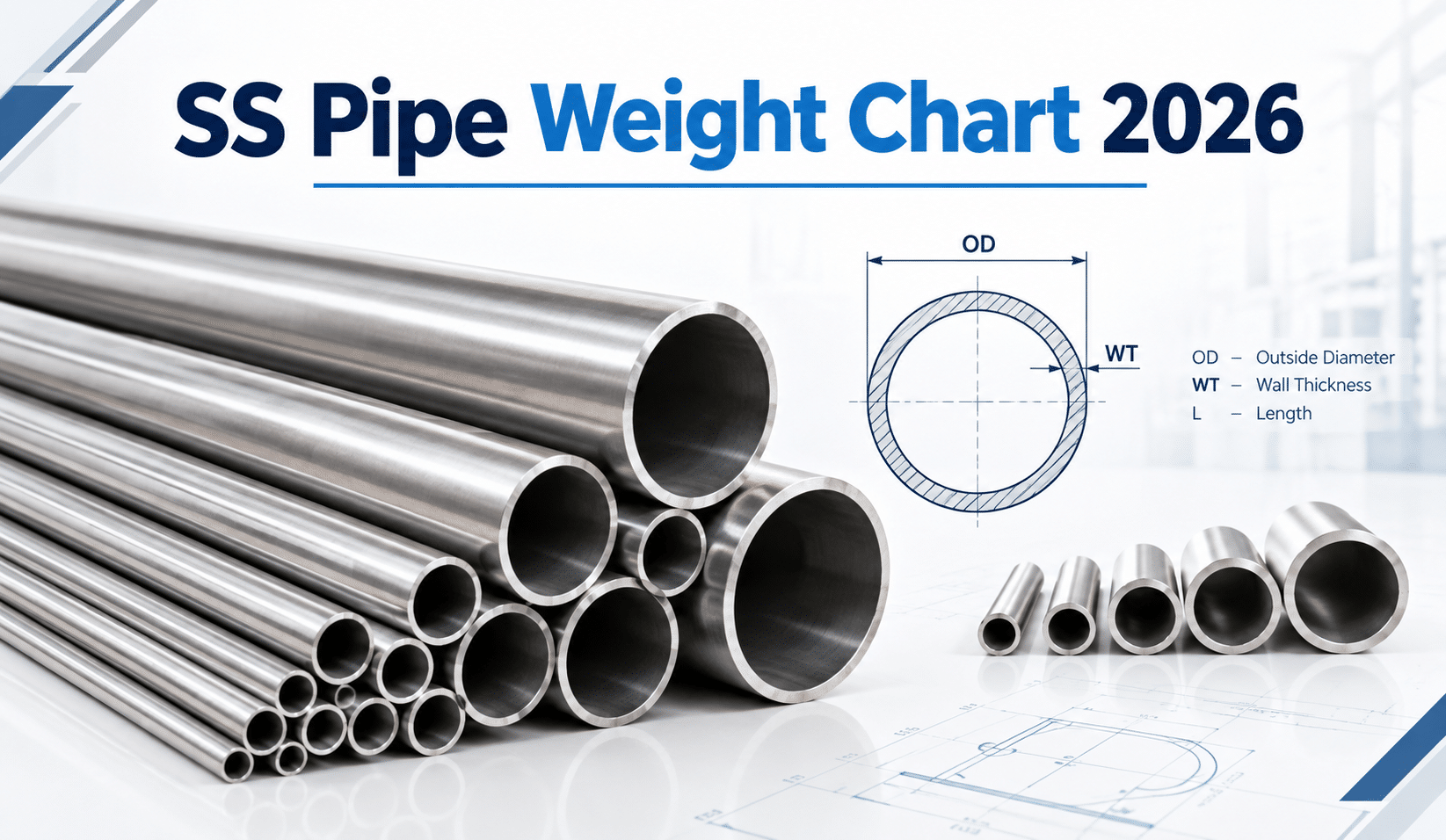
SS Pipe Weight Chart 2026 – Schedule & Kg/m Table
Last Updated: September, 2026
The SS Pipe Weight Chart 2026 – Schedule & Kg/m Table is a useful reference for calculating the approximate weight of stainless steel pipes according to nominal pipe size, outside diameter, wall thickness, and pipe schedule. Accurate stainless steel pipe weight information helps engineers, fabricators, contractors, procurement teams, stockists, and buyers estimate material quantities, transportation loads, handling requirements, inventory, and project costs.
Stainless steel pipes are available in different grades, including SS 304, SS 304L, SS 316, and SS 316L, with various schedules and wall thicknesses for industrial and engineering applications. The actual pipe weight primarily depends on the pipe dimensions, wall thickness, length, and material density.
For related stainless steel requirements, buyers can also explore stainless steel pipes and seamless pipes when selecting products according to grade, size, schedule, and manufacturing requirements.
What Is an SS Pipe Weight Chart?
An SS Pipe Weight Chart provides approximate stainless steel pipe weights, generally expressed in kilograms per meter (kg/m). It allows users to quickly estimate how much a particular pipe size and schedule will weigh without calculating every pipe individually.
A typical SS pipe weight chart includes:
- Nominal Pipe Size (NPS)
- Outside Diameter (OD)
- Wall Thickness
- Pipe Schedule
- Approximate Weight in kg/m
- Stainless Steel Grade
Pipe weight generally increases as the outside diameter or wall thickness increases. For the same nominal pipe size, a higher schedule generally means a thicker wall and therefore a greater weight per metre.
A weight chart is especially useful for material estimation, purchase planning, transportation calculations, warehouse management, fabrication, and project costing.
SS Pipe Weight Chart 2026 – Schedule & Kg/m Table
The following representative values can be used as a quick reference for selected stainless steel pipe sizes and schedules. Actual supplied weights can vary slightly according to manufacturing tolerances, dimensions, grade, and applicable product specifications.
| Pipe Size | OD (mm) | SCH 5 kg/m | SCH 10 kg/m | SCH 40 kg/m | SCH 80 kg/m | SCH 160 kg/m | SCH XXS kg/m |
|---|---|---|---|---|---|---|---|
| 1/2″ | 21.34 | 0.89 | 1.12 | 1.36 | 2.15 | 2.50 | — |
| 3/4″ | 26.67 | 1.14 | 1.38 | 1.82 | 2.94 | 3.75 | — |
| 1″ | 33.40 | 1.73 | 2.00 | 2.87 | 4.80 | 6.21 | 7.85 |
| 1-1/4″ | 42.17 | 2.33 | 2.62 | 3.88 | 6.56 | 8.39 | 10.75 |
| 2″ | 60.33 | 4.25 | 4.90 | 7.63 | 12.73 | 15.99 | 18.85 |
| 4″ | 114.30 | 8.23 | 9.80 | 16.43 | 33.04 | 41.20 | 50.25 |
| 10″ | 273.05 | 25.60 | 31.90 | 64.50 | 149.45 | 182.85 | 208.62 |
Note: The values above are representative reference values. For fabrication, pressure design, structural calculations, and purchasing, verify the required dimensions against the applicable pipe specification and manufacturer’s dimensional data.
How to Read the SS Pipe Weight Chart
Reading an SS pipe weight chart is straightforward when the three main dimensions are understood: nominal pipe size, outside diameter, and wall thickness or schedule.
First, identify the required nominal pipe size. Next, check the corresponding outside diameter. Then select the required pipe schedule, such as SCH 10, SCH 40, SCH 80, or SCH 160.
The corresponding value in the chart gives the approximate weight per metre.
For example, a 2-inch stainless steel pipe has an outside diameter of approximately 60.33 mm. The representative table above gives an approximate weight of 7.63 kg/m for a 2-inch SCH 40 pipe.
If the required quantity is 100 meters:
7.63 × 100 = 763 kg
Therefore, the estimated pipe material weight is approximately 763 kg, excluding packaging and other shipment components.
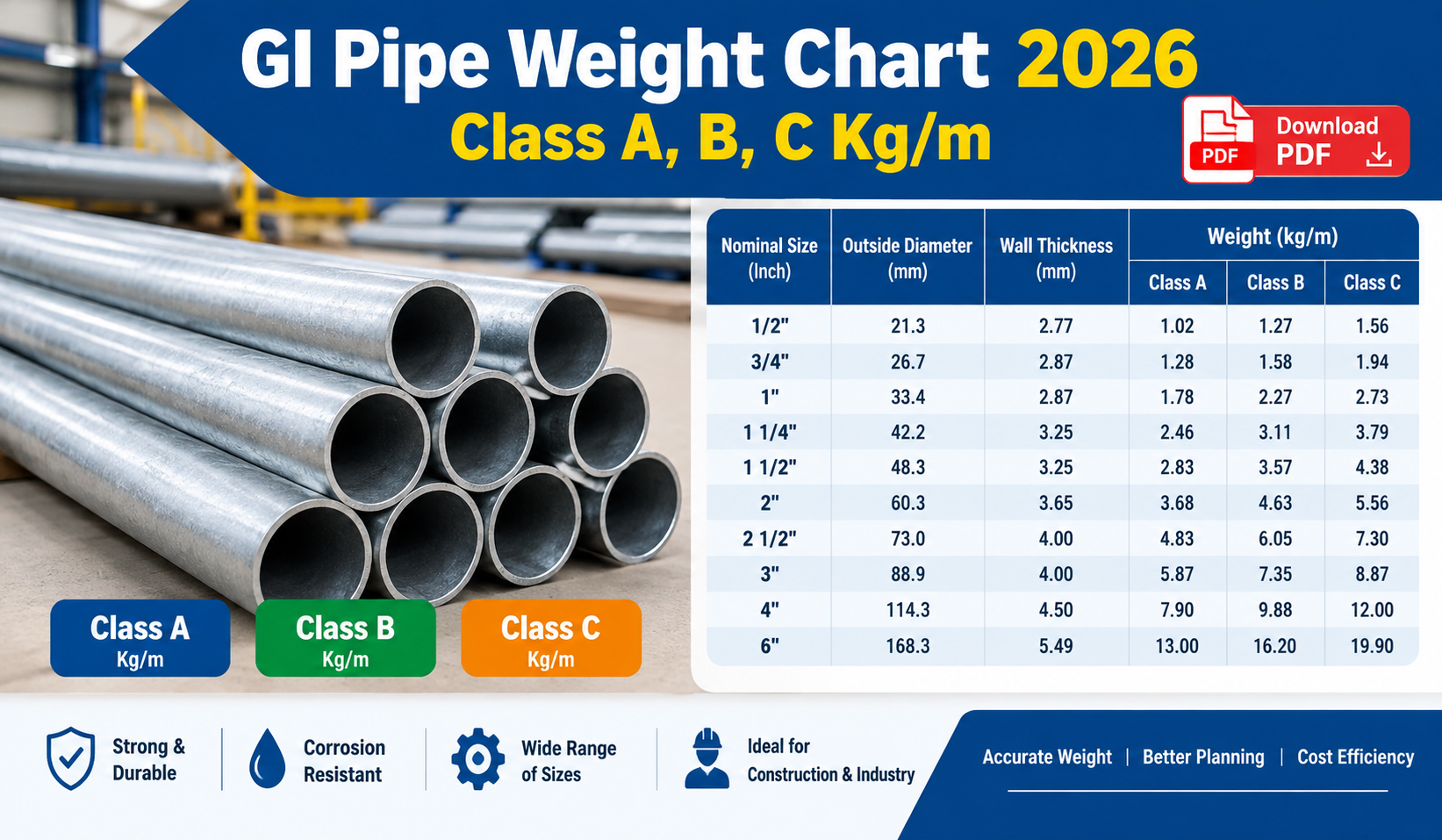
When comparing different steel products, readers can also refer to the MS Pipe Weight Chart 2026 for carbon steel pipe weight information.
SS Pipe Weight Calculation Formula
The approximate weight of a stainless steel pipe can be calculated using its outside diameter and wall thickness.
Formula
Weight (kg/m) = 0.02466 × T × (OD − T)
Where:
- OD = Outside diameter in mm
- T = Wall thickness in mm
- 0.02466 = Approximate calculation constant
- Weight = Approximate pipe weight in kg/m
For calculating the total weight of a required pipe length:
Total Weight (kg) = Weight per meter × Total Length in meters
SS Pipe Weight Calculation Example
Suppose the pipe dimensions are
- OD = 60 mm
- Wall thickness = 5 mm
- Length = 10 metres
The approximate weight per meter is
0.02466 × 5 × (60 − 5) = 6.78 kg/m
For a 10-meter length:
6.78 × 10 = 67.8 kg
Therefore, the estimated total weight is approximately 67.8 kg.
Actual commercial weight can differ because of dimensional tolerances, manufacturing variation, actual material density, and the applicable product specification.
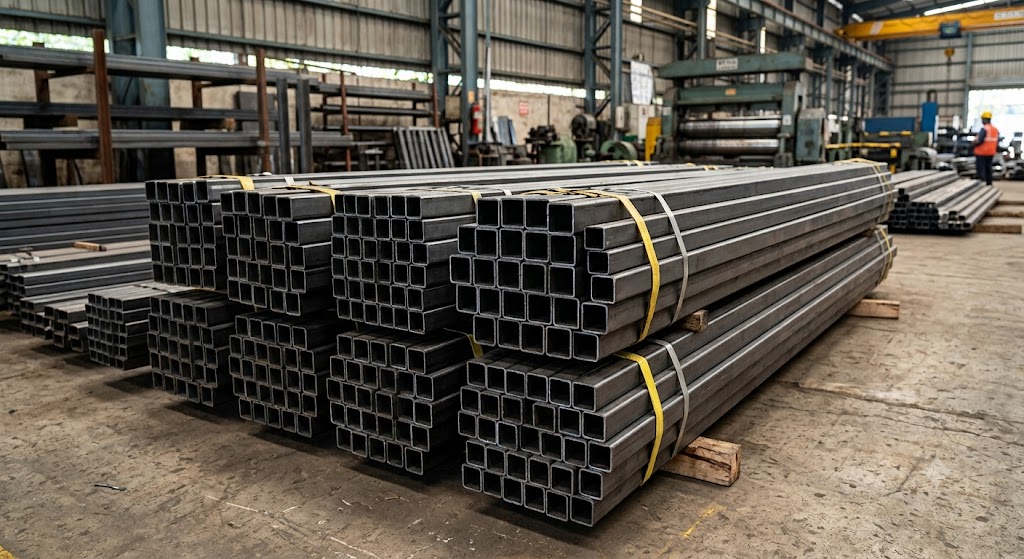
For other steel-section calculations, users can also refer to the MS Square Pipe Weight Chart 2026 when estimating square hollow-section material weight.
Stainless Steel Pipe Schedule and Weight
Pipe schedules are associated with wall-thickness ranges for standard pipe sizes. Common stainless steel pipe schedules include:
- SCH 5
- SCH 10
- SCH 10S
- SCH 40
- SCH 40S
- SCH 80
- SCH 80S
- SCH 160
- SCH XXS
For a given nominal pipe size, a higher schedule generally indicates a thicker wall. As wall thickness increases, the quantity of stainless steel used per unit length also increases, resulting in a higher kg/m value.
For example, the 2-inch representative values increase from 4.25 kg/m for SCH 5 to 7.63 kg/m for SCH 40 and 12.73 kg/m for SCH 80.
However, schedule selection should not be based on weight alone. Pressure requirements, temperature, corrosion conditions, design requirements, joining methods, and project specifications should also be considered.
SS 304 Pipe Weight
SS 304 is one of the most widely used stainless steel grades for general industrial and engineering applications.
SS 304 pipes are commonly used for:
- Food-processing equipment
- General fabrication
- Water systems
- Architectural applications
- Chemical equipment
- Industrial piping
- Engineering projects
The weight of SS 304 pipe is primarily controlled by the outside diameter, wall thickness, and length.
For pipes with identical dimensions, the difference in weight between common stainless steel grades is generally relatively small. For purchasing purposes, however, the exact grade, dimensions, and manufacturer’s product data should be confirmed.
For complete piping requirements, SS 304 pipes can be combined with suitable stainless steel flanges and butt weld fittings, depending on the piping-system specification.
SS 316 Pipe Weight
SS 316 contains molybdenum and is commonly selected for applications requiring improved resistance to chloride-containing and corrosive environments.
Typical applications include:
- Marine equipment
- Chemical processing
- Pharmaceutical facilities
- Coastal installations
- Petrochemical systems
- High-corrosion industrial environments
Like SS 304, the weight of SS 316 pipe is primarily determined by outside diameter, wall thickness, and length.
When purchasing SS 316 pipes, buyers should specify the exact grade, size, schedule, wall thickness, quantity, and applicable standard to obtain the correct commercial and technical specification.
SS Pipe Price Per Kg in 2026
The SS pipe price per kg in 2026 varies according to the material grade, pipe size, schedule, manufacturing method, surface finish, quantity, certification requirements, and market conditions.
Important factors affecting stainless steel pipe pricing include:
| Price Factor | Effect on Price |
|---|---|
| Stainless Steel Grade | SS 304, SS 316, SS 316L, and specialty grades have different costs |
| Pipe Schedule | Thicker walls require more material. |
| Pipe Size | Larger dimensions generally require more material. |
| Manufacturing Type | Seamless and welded pipes can have different prices. |
| Surface Finish | Polished and specialized finishes may increase cost. |
| Quantity | Bulk quantities may receive different commercial rates. |
| Certification | Testing and inspection requirements can affect pricing. |
| Market Conditions | Nickel and alloy costs influence stainless steel pricing. |
There is no single fixed SS pipe price per kg applicable to every size and specification.
For an accurate quotation, buyers should provide the grade, size, schedule, quantity, manufacturing type, standard, finish, certification requirements, and delivery location.
Stainless Steel Pipe Weight per Meter
Pipe weight per meter is particularly useful for procurement and logistics calculations.
The basic calculation is
Total Pipe Weight = Weight per Metre × Total Length
For example, if a pipe weighs 16.43 kg/m and the required quantity is 50 meters:
16.43 × 50 = 821.5 kg
Therefore, the estimated material weight is approximately 821.5 kg.
This calculation can help with:
- Transportation planning
- Warehouse handling
- Material procurement
- Inventory management
- Fabrication planning
- Purchase-order preparation
- Project costing
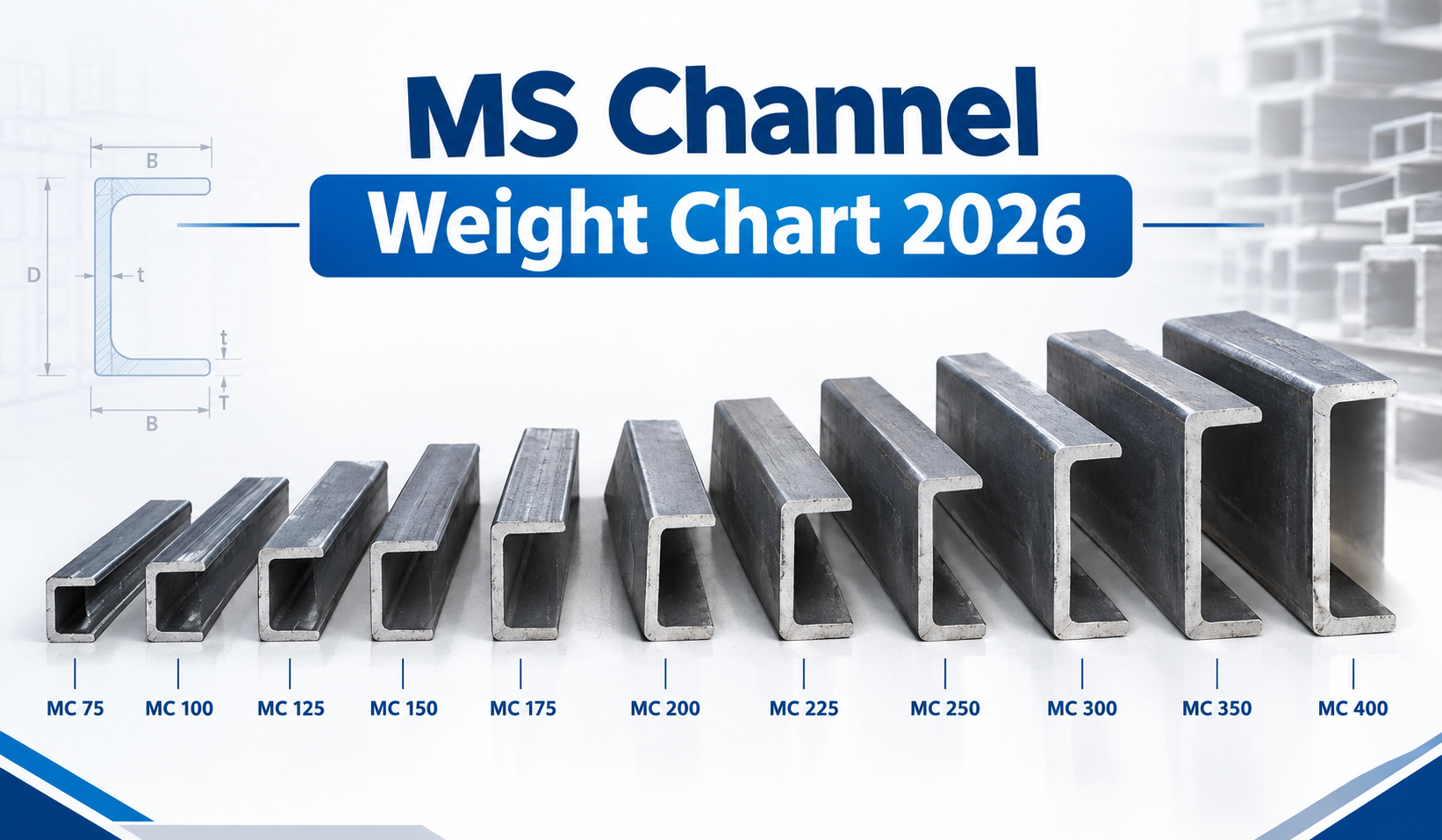
For buyers comparing stainless steel with carbon steel products, the MS Channel Weight Chart 2026 and other steel weight charts can provide additional reference information for material estimation.
Difference Between SS Pipe and SS Tube
Stainless steel pipes and tubes may look similar, but their sizing conventions can differ.
Stainless steel pipes are commonly identified by Nominal Pipe Size (NPS) and schedule, while stainless steel tubes are frequently specified by actual outside diameter and wall thickness.
Therefore, a 2-inch stainless steel pipe and a 2-inch stainless steel tube should not automatically be assumed to have identical dimensions or weight.
When requesting a quotation, provide:
- Outside diameter
- Wall thickness
- Grade
- Length
- Product type
- Manufacturing method
- Required standard
- Quantity
Providing complete specifications helps reduce errors during procurement and fabrication.
Applications of Stainless Steel Pipes
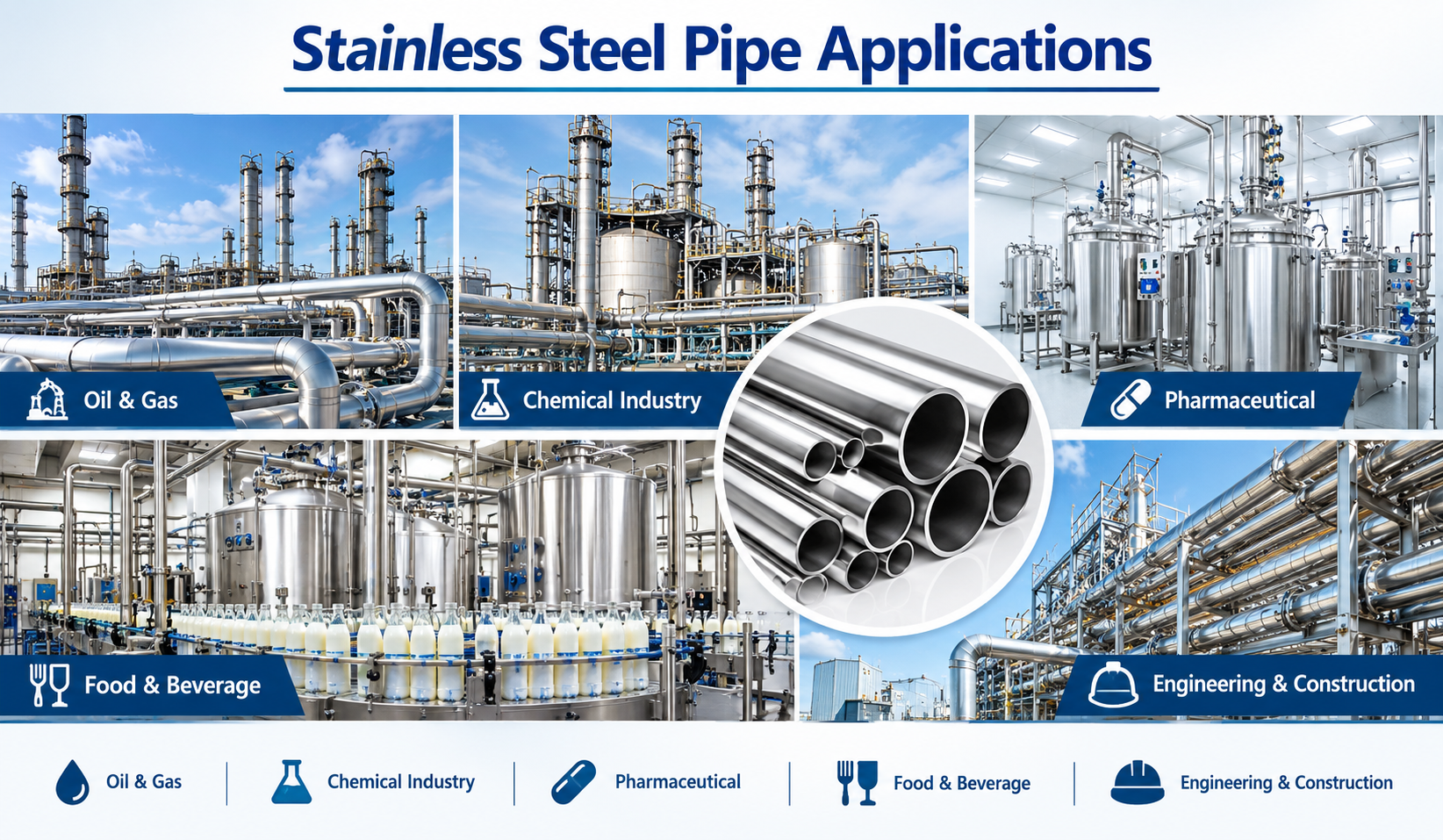
Stainless steel pipes are used across numerous industries because they provide corrosion resistance, durability, and suitability for different industrial environments.
Oil and Gas
Stainless steel piping is used in selected process, utility, and corrosive-service applications where material resistance and durability are important.
Chemical Industry
Chemical plants use stainless steel pipes for transferring fluids and process media where corrosion resistance is required.
Food and Beverage
Stainless steel piping is widely used in hygienic processing environments where cleanable and corrosion-resistant surfaces are important.
Pharmaceutical Industry
Stainless steel piping is used in process systems where cleanliness, corrosion resistance, and controlled fabrication are important.
Construction and Engineering
Stainless steel pipes and tubes are also used in architectural structures, fabrication, handrails, equipment, and engineering installations.
For projects requiring complete piping assemblies, stainless steel pipes may be specified together with Stainless Steel Fasteners, flanges, fittings, and other compatible components.
Factors That Affect Stainless Steel Pipe Weight
Several factors determine the final weight of a stainless steel pipe.
1. Outside Diameter
Increasing the outside diameter generally increases the quantity of material required.
2. Wall Thickness
A thicker wall adds more stainless steel and increases the kg/m value.
3. Pipe Length
Longer pipes naturally have a greater total weight.
4. Material Density
Different stainless steel compositions can have slightly different densities.
5. Manufacturing Tolerance
Actual dimensions can vary within permitted manufacturing tolerances.
6. Pipe Type
Seamless and welded stainless steel products can have different dimensional and weight characteristics.
Understanding these factors makes weight estimation more reliable.
SS Pipe Weight Calculator
An SS Pipe Weight Calculator can make calculations faster when the required size is not directly available in a standard chart.
Typically, the calculator requires:
- Outside Diameter
- Wall Thickness
- Pipe Length
- Material or density, where required
The calculator can then provide an estimated pipe weight.
For example, if a custom pipe has an outside diameter of 100 mm and a specified wall thickness, the weight can be estimated using the appropriate dimensional formula.
For custom dimensions, calculator results should still be compared with applicable dimensional tables and supplier documentation.
For calculations involving other steel products, a Metal Weight Calculator can also be useful when dimensions and material density are known.
Why Accurate SS Pipe Weight Matters
Accurate weight calculations are important throughout the supply chain.
Procurement
Weight information helps buyers estimate the quantity of material required for an order.
Transportation
Approximate shipment weight assists with vehicle capacity and freight planning.
Fabrication
Weight information can support material handling and lifting arrangements.
Cost Estimation
Calculated weight can be considered together with the applicable price per kilogram.
Inventory Management
Converting pipe lengths into approximate weight can make stock records easier to organize.
Project Planning
Engineers and contractors can use estimated pipe weights when planning material quantities, handling requirements, and logistics.
For these reasons, an updated SS Pipe Weight Chart 2026 is useful for both small fabrication projects and larger industrial requirements.
Related Steel Weight Information
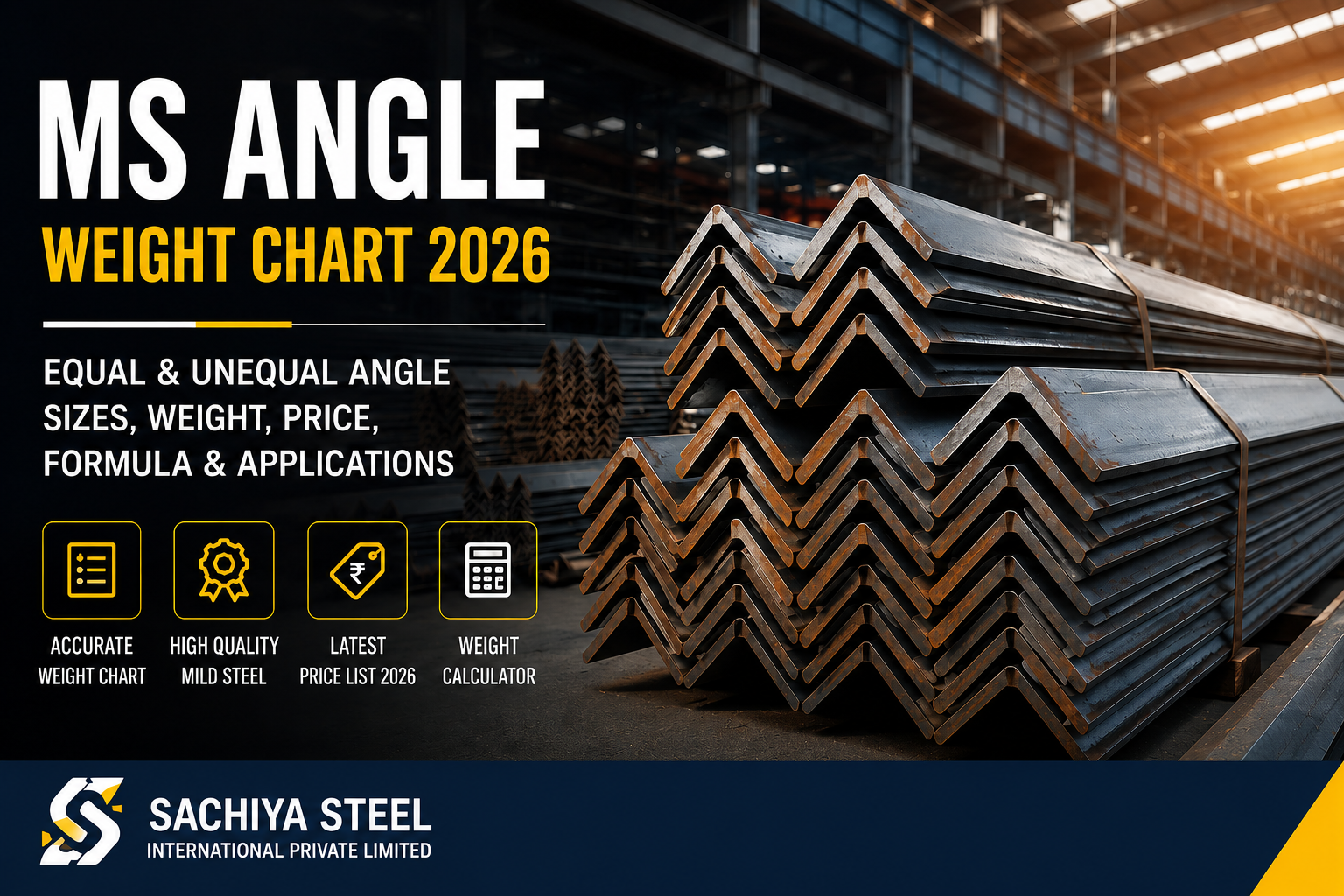
When calculating the weight of different steel products, users may also find our related weight references useful. For example, the MS Angle Weight Chart 2026 can be used for equal and unequal angle weight calculations, while the MS Channel Weight Chart 2026 provides reference information for channel sections.
For square hollow sections, the MS Square Pipe Weight Chart 2026 can help users compare dimensions and approximate kg/m values.
These contextual resources allow buyers, engineers, and fabricators to find related weight information without leaving the broader steel-calculation topic.
Why Choose Sachiya Steel International?
Sachiya Steel International Private Limited supplies stainless steel and other metal products for industrial, engineering, construction, petrochemical, and manufacturing requirements.
The company works with different stainless steel grades, sizes, specifications, and product forms and supports domestic and export requirements.
For a quotation, customers can provide:
- Grade
- Size
- Schedule
- Wall thickness
- Length
- Quantity
- Standard
- Testing requirements
- Certification requirements
Based on these details, the appropriate product specification and commercial quotation can be prepared.
For related requirements, customers can also explore Stainless Steel Pipes, Seamless Pipes, Stainless Steel Flanges, Butt Weld Fittings, and Stainless Steel Fasteners.
Conclusion
The SS Pipe Weight Chart 2026 – Schedule & Kg/m Table provides a practical reference for estimating stainless steel pipe weight according to nominal pipe size, outside diameter, wall thickness, and schedule.
The information is useful for procurement, fabrication, transportation, inventory management, material estimation, and project costing.
Pipe weight generally increases as the outside diameter and wall thickness increase. A higher schedule generally indicates a thicker wall and consequently a higher weight per metre for the same nominal pipe size.
The SS pipe weight formula can also be used when a required custom size is not available in the reference table. However, calculated values should be treated as approximate and checked against the applicable product specification and manufacturer’s dimensional data before final purchasing or engineering decisions.
For special sizes, large-diameter pipes, unusual wall thicknesses, or project-specific requirements, buyers should provide complete technical specifications when requesting a quotation.
Contact Sachiya Steel International for stainless steel pipe specifications, sizes, schedules, availability, and project quotations.
Phone: +91 9769056007
Email: [email protected]
Website: www.sachiyasteel.com
Frequently Asked Questions About SS Pipe Weight Chart 2026
1. What is an SS Pipe Weight Chart 2026?
An SS Pipe Weight Chart 2026 is a reference table that provides approximate stainless steel pipe weights according to nominal pipe size, outside diameter, wall thickness, and schedule.
2. How is stainless steel pipe weight calculated?
A commonly used approximate formula is:
Weight (kg/m) = 0.02466 × T × (OD − T)
where OD and T are measured in millimetres.
3. Does pipe schedule affect stainless steel pipe weight?
Yes. A higher schedule generally indicates a thicker wall for a particular nominal pipe size, resulting in a higher weight per metre.
4. What is the weight of a 2-inch SS pipe?
The weight depends on the schedule and wall thickness. In the representative table, a 2-inch SCH 40 stainless steel pipe has an approximate weight of 7.63 kg/m.
5. Is SS 304 heavier than SS 316?
For identical dimensions, the weight difference between common stainless steel grades is relatively small. Outside diameter and wall thickness have a greater effect on calculated pipe weight.
6. What is the difference between SS pipe and SS tube?
Stainless steel pipe sizing is commonly based on nominal pipe size and schedule, while stainless steel tubes are often specified using actual outside diameter and wall thickness.
7. Why is stainless steel pipe weight important?
Pipe weight information helps with purchasing, transportation, lifting, inventory management, fabrication planning, material estimation, and project costing.
8. Can I calculate SS pipe weight for a custom size?
Yes. For custom dimensions, use the outside diameter, wall thickness, and length with the appropriate pipe-weight formula or calculator.
9. Does SS pipe price depend on weight?
In many commercial transactions, stainless steel products are priced on a weight basis. However, the final quotation can also depend on grade, size, schedule, manufacturing method, finish, certification, quantity, and market conditions.
10. What information is needed to buy an SS pipe?
For an accurate quotation, provide the grade, size, schedule, wall thickness, length, quantity, standard, manufacturing type, and testing or certification requirements.