MS Channel Weight Chart 2026 – ISMC Sizes, Kg/m + PDF
Last Updated: September, 2026
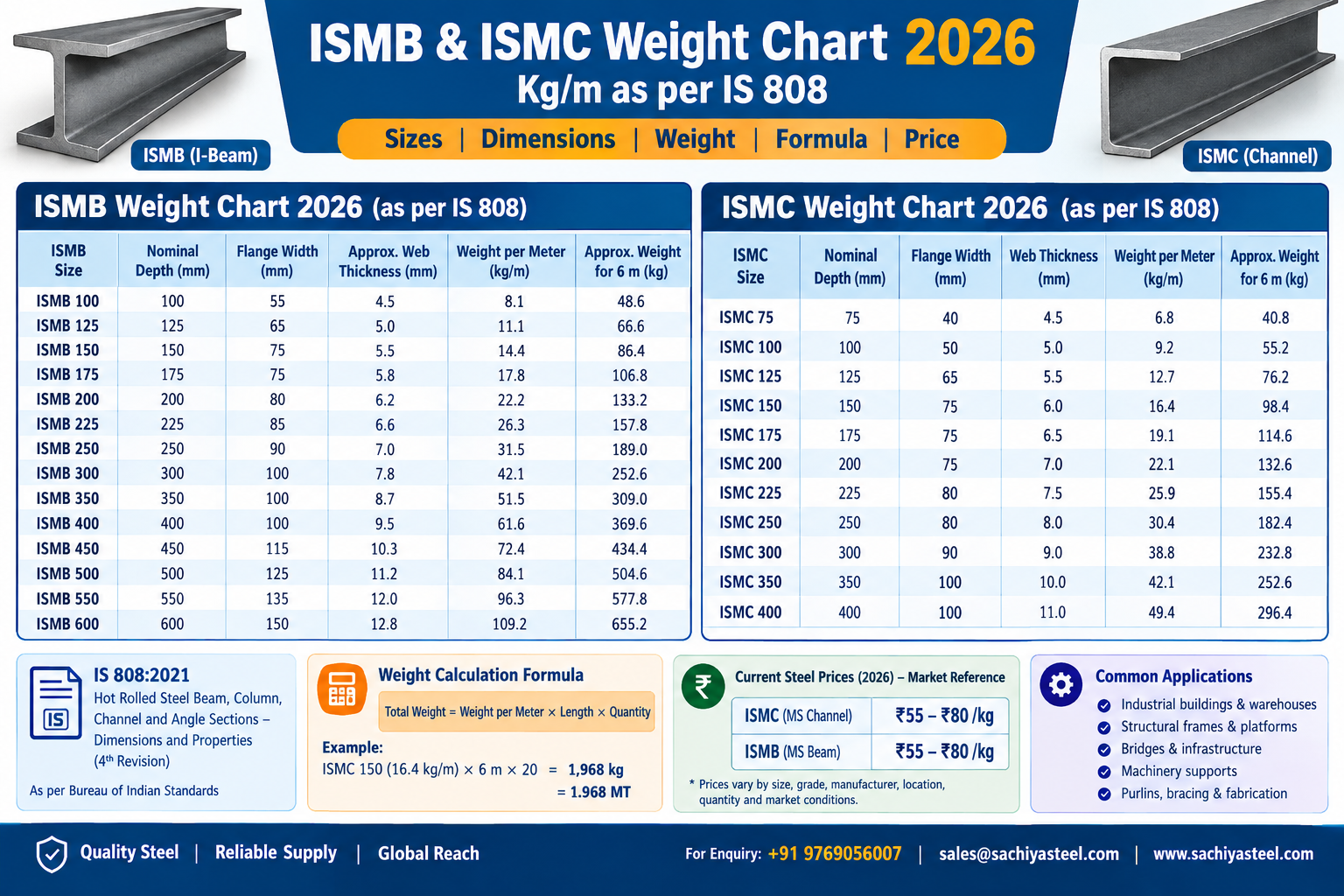
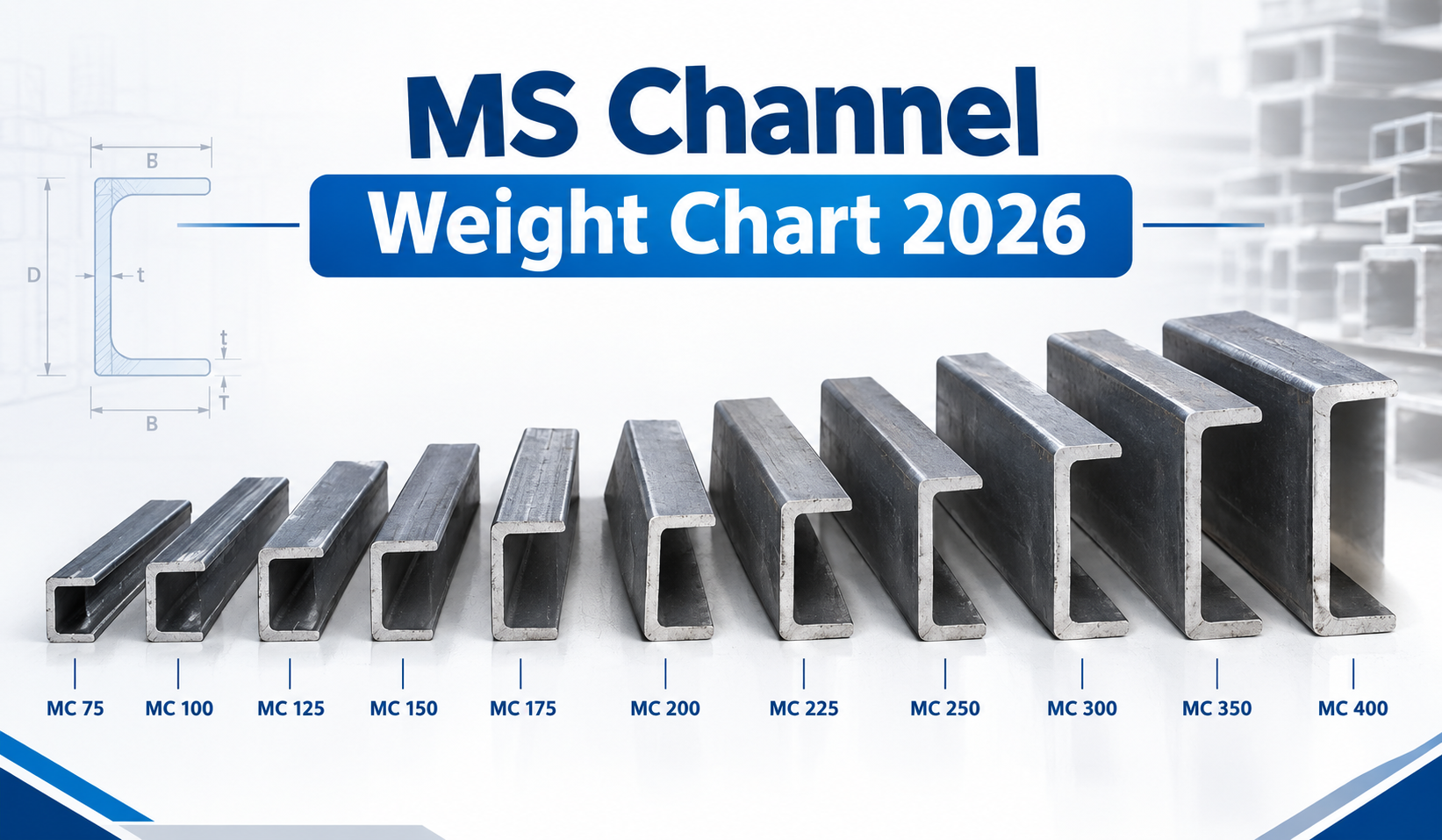
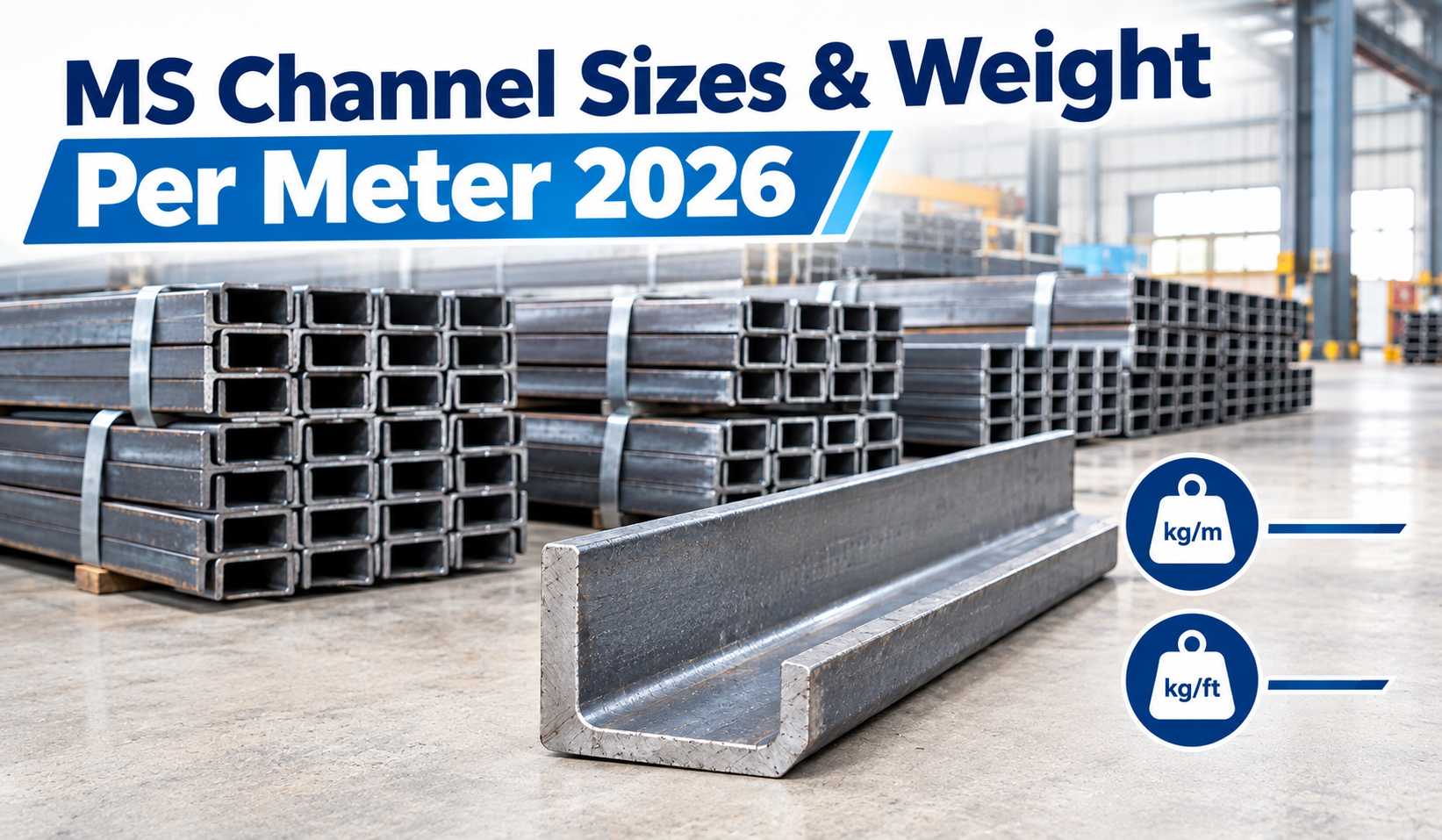
The MS Channel Weight Chart 2026 provides a practical reference for checking ISMC channel sizes, approximate weight in kg/m, weight per foot, dimensions, pricing, and calculation methods. Mild steel channels are widely used in construction, fabrication, industrial structures, equipment supports, platforms, sheds, pipe racks, and engineering projects. Their C-shaped profile provides a useful combination of structural strength, fabrication convenience, and material efficiency.
For engineers, contractors, fabricators, architects, quantity surveyors, and procurement teams, knowing the ISMC channel weight per meter helps in estimating material requirements, transportation loads, project costs, structural quantities, and purchase requirements. The following chart covers commonly used ISMC sections and provides a quick reference for MS channel sizes and kg/m.
MS Channel Weight Chart 2026 – ISMC Sizes and Kg/m
The table below presents commonly referenced Indian Standard Medium Channel sections with their approximate dimensions and theoretical unit weights.
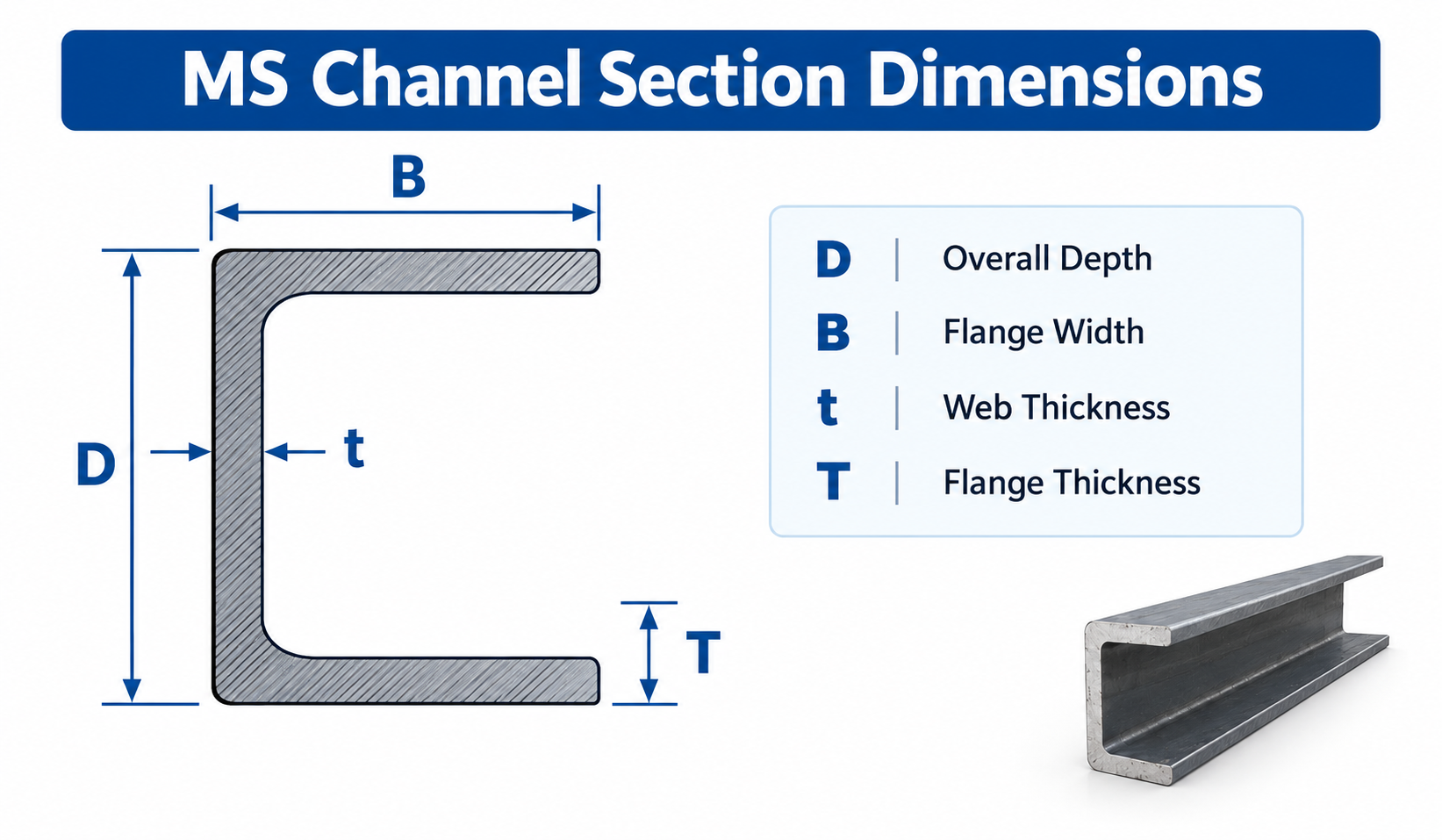
| ISMC Size | Web Height (mm) | Flange Width (mm) | Flange Thickness (mm) | Web Thickness (mm) | Weight (kg/m) | Weight (kg/ft) |
|---|---|---|---|---|---|---|
| ISMC 75 | 75 | 40 | 4.8 | 4.0 | 7.14 | 2.18 |
| ISMC 100 | 100 | 50 | 5.0 | 4.7 | 9.56 | 2.91 |
| ISMC 125 | 125 | 65 | 5.3 | 5.0 | 13.10 | 3.99 |
| ISMC 150 | 150 | 75 | 5.7 | 5.4 | 16.80 | 5.12 |
| ISMC 175 | 175 | 75 | 6.0 | 5.7 | 19.60 | 5.98 |
| ISMC 200 | 200 | 75 | 6.2 | 6.1 | 22.30 | 6.80 |
| ISMC 250 | 250 | 82 | 9.0 | 7.1 | 34.20 | 10.43 |
| ISMC 300 | 300 | 90 | 7.8 | 7.6 | 36.30 | 11.07 |
| ISMC 400 | 400 | 100 | 8.8 | 8.6 | 50.10 | 15.27 |
Note: The values above are approximate theoretical weights. Actual supplied dimensions and weight should be confirmed against the applicable standard, manufacturer’s documentation, and purchase specification.
Download the MS Channel Weight Chart PDF 2026.
📥 PDF Button
DOWNLOAD MS CHANNEL WEIGHT CHART PDF 2026
The PDF can be saved for offline reference while preparing material estimates, purchase orders, bills of quantities, fabrication calculations, transportation plans, and project material schedules.
MS Channel Price Per Kg 2026
The MS channel price per kg in 2026 depends on steel market conditions, channel size, grade, quantity, manufacturer, location, freight, taxes, and commercial terms.
For preliminary budgeting, an indicative price range of approximately ₹55–₹85 per kg may be considered. This is only a reference range and should not be treated as a fixed quotation.
| Material | Indicative Price |
|---|---|
| MS Channel | ₹55–₹85/kg |
| ISMC Structural Channel | ₹55–₹85/kg |
| Heavy MS Channel | Subject to size and specification |
For an accurate quotation, buyers should provide the ISMC size, quantity, length, grade, delivery location, and required specifications.
What Is an MS Channel?
An MS channel is a mild steel structural section generally manufactured with one web and two flanges. The profile resembles a C or U shape and is designed for use in different structural and fabrication applications.
ISMC means Indian Standard Medium Channel. These sections are available in standardised sizes and are commonly selected according to structural requirements, loading conditions, section properties, span, connections, and project specifications.
MS channels can be cut, drilled, welded, bolted, and fabricated into different structural assemblies. They are commonly used with other steel products such as pipes, plates, angles, beams, supports, and pipe clamps.
For industrial piping applications, MS channel structures may also be combined with DIN 3015 tube clamps and other pipe support components.
Why Is MS Channel Weight Important?
Knowing the unit weight of an MS channel is important for both engineering and commercial planning. The weight per metre helps users estimate the total quantity of steel required for a project.
MS channel weight information is useful for:
- Material quantity estimation
- Project cost calculation
- Transportation planning
- Crane and lifting calculations
- Structural load estimation
- Inventory management
- Fabrication planning
- Purchase order preparation
- Scrap and wastage estimation
- Comparing different ISMC sections
For example, if ISMC 200 weighs approximately 22.30 kg/m and a project requires 120 meters:
22.30 × 120 = 2,676 kg
Therefore, the theoretical material requirement would be approximately 2,676 kg.
ISMC Channel Weight Calculation Formula
The simplest formula for calculating total MS channel weight is:
Total Weight (kg) = Weight per Meter (kg/m) × Total Length (m)
For example, the approximate weight of ISMC 150 is:
ISMC 150 = 16.80 kg/m
If the required length is 50 metres:
16.80 × 50 = 840 kg
Therefore, the estimated theoretical weight is approximately 840 kg.
For custom channel sections, weight can also be estimated using cross-sectional area and steel density:
Weight = Cross-Sectional Area × Length × Density
A commonly used theoretical density for mild and carbon steel calculations is approximately 7,850 kg/m³.
Actual supplied weight may vary according to manufacturing tolerances and exact section geometry.
MS Channel Weight Per Meter and Total Weight
The standard unit weight is normally expressed in kg/m.
For example:
ISMC 100 = 9.56 kg/m
For one 6-metre length:
9.56 × 6 = 57.36 kg
For 10 pieces:
57.36 × 10 = 573.60 kg
This method can be used to estimate the theoretical weight of an order before purchasing material.
For final dispatch quantities, actual weighing and supplier documentation should be considered.
ISMC Channel Sizes and Selection
ISMC channel selection should not be based only on weight. Engineers should consider the structural requirement, section properties, loading conditions, span, connections, steel grade, and applicable project specifications.
ISMC 75
ISMC 75 is a relatively lightweight channel section used for smaller supports, brackets, secondary frames, fabrication work, and applications where the required structural properties are suitable.
ISMC 100
ISMC 100 offers greater section depth than ISMC 75 and may be used for frames, equipment supports, fabrication structures, and other engineering applications.
ISMC 150
ISMC 150 is a commonly referenced medium-size structural channel used for support frames, platforms, industrial structures, and fabrication projects subject to engineering requirements.
ISMC 200
ISMC 200 provides greater section depth and unit weight and can be considered for applications requiring higher structural capacity than smaller sections.
ISMC 250, ISMC 300 and ISMC 400
Larger ISMC sections provide increased depth and section properties. Their selection should be based on structural calculations rather than simply choosing the heaviest channel.
Applications of MS Channels
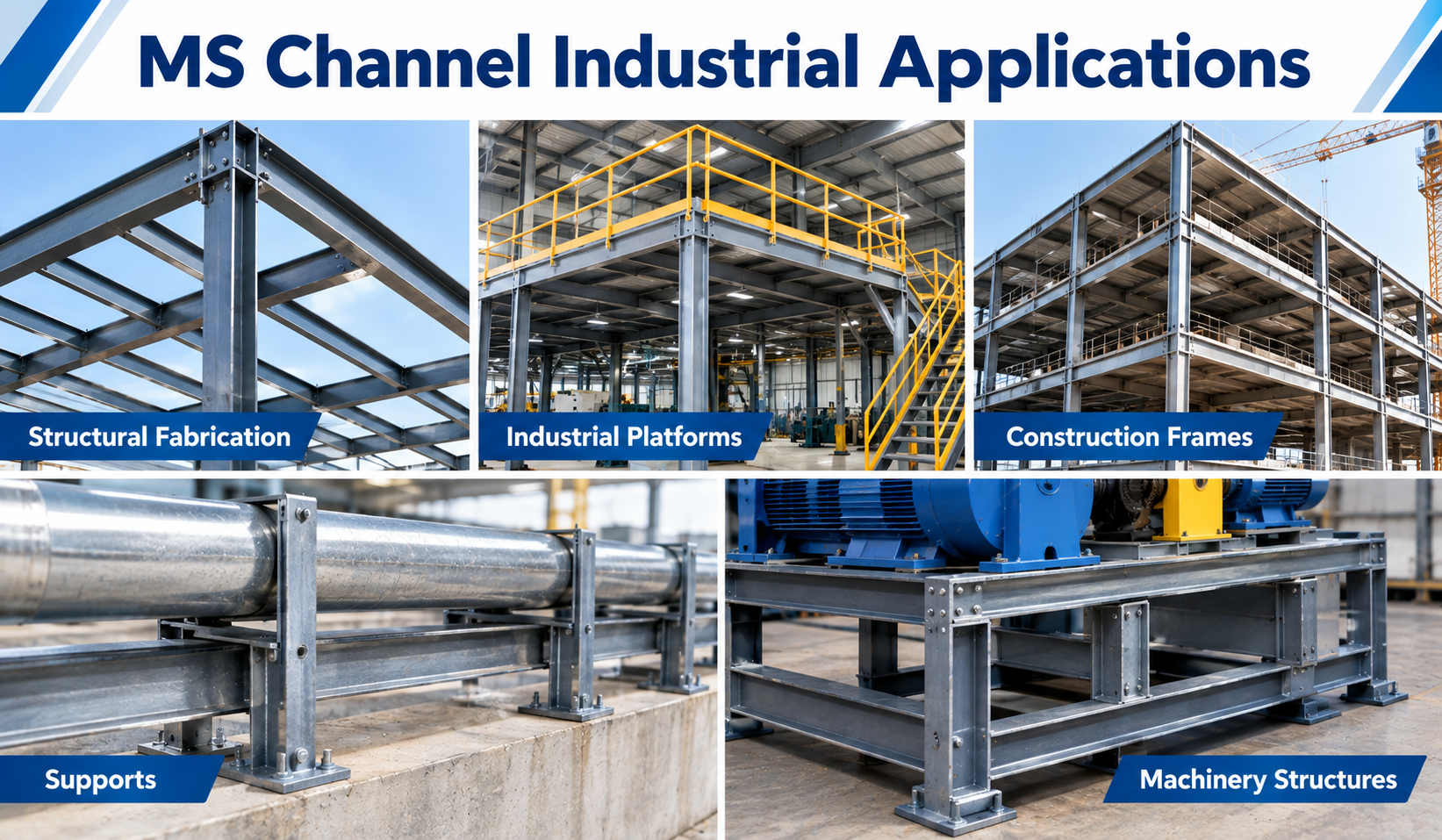
MS channels are used in a wide range of construction, industrial, fabrication, and infrastructure applications.
Construction
Common applications include:
- Building frames
- Platforms
- Stair structures
- Roofing supports
- Equipment bases
- Industrial sheds
- Structural supports
Industrial Fabrication
MS channels are also used for:
- Machine frames
- Equipment supports
- Storage systems
- Conveyor structures
- Material handling systems
- Industrial platforms
Piping and Plant Structures
Industrial facilities may use channels for pipe racks, equipment supports, access platforms, and auxiliary steelwork. Channel structures can also be combined with industrial pipe support clamps for piping installations.
MS Channel vs C Channel
The terms ‘MS channel’ and ‘C channel’ may sometimes be used interchangeably in commercial discussions, but buyers should verify the actual profile and specification before ordering.
An ISMC channel is a standardised structural section with defined dimensions and section properties. A commercially available C channel may have different dimensions, thicknesses, forming methods, and specifications.
Before purchasing, verify:
- ISMC section designation
- Web height
- Flange width
- Web thickness
- Flange thickness
- Unit weight
- Steel grade
- Applicable standard
- Required length
- Quantity
MS Channel Standards
MS structural channels in India may be specified according to applicable Indian Standards and project requirements.
Commonly referenced standards include:
- IS 808 – Dimensions for hot-rolled steel beam, column, channel, and angle sections
- IS 2062 – Hot-rolled medium- and high-tensile structural steel
The required grade and material specification should be selected according to the engineering design and purchase specification.
For projects requiring traceability, buyers may also request relevant material certificates and inspection documentation.
Factors Affecting MS Channel Price
MS channel pricing can change according to several factors.
Steel Market Conditions
Changes in raw material and steel market conditions can influence the base price of structural channels.
Channel Size
Heavier ISMC sections contain more steel per metre, which affects their overall material value.
Quantity
Large-volume orders and smaller purchases can have different commercial pricing.
Grade
The required material grade and documentation can affect the final quotation.
Freight and Delivery
Transportation cost depends on quantity, distance, vehicle type, loading conditions, and delivery location.
Taxes and Commercial Terms
GST, freight, packing, payment terms, and other commercial conditions can influence the final landed price.
MS Channel Weight Chart PDF for Project Planning
A downloadable MS Channel Weight Chart PDF 2026 can be useful for engineers, contractors, fabricators, quantity surveyors, procurement teams, and project planners.
The PDF can assist with:
- Bill of quantities
- Material requisitions
- Purchase orders
- Fabrication estimates
- Weight calculations
- Transportation planning
- Material schedules
- Project budgeting
DOWNLOAD MS CHANNEL WEIGHT CHART PDF 2026
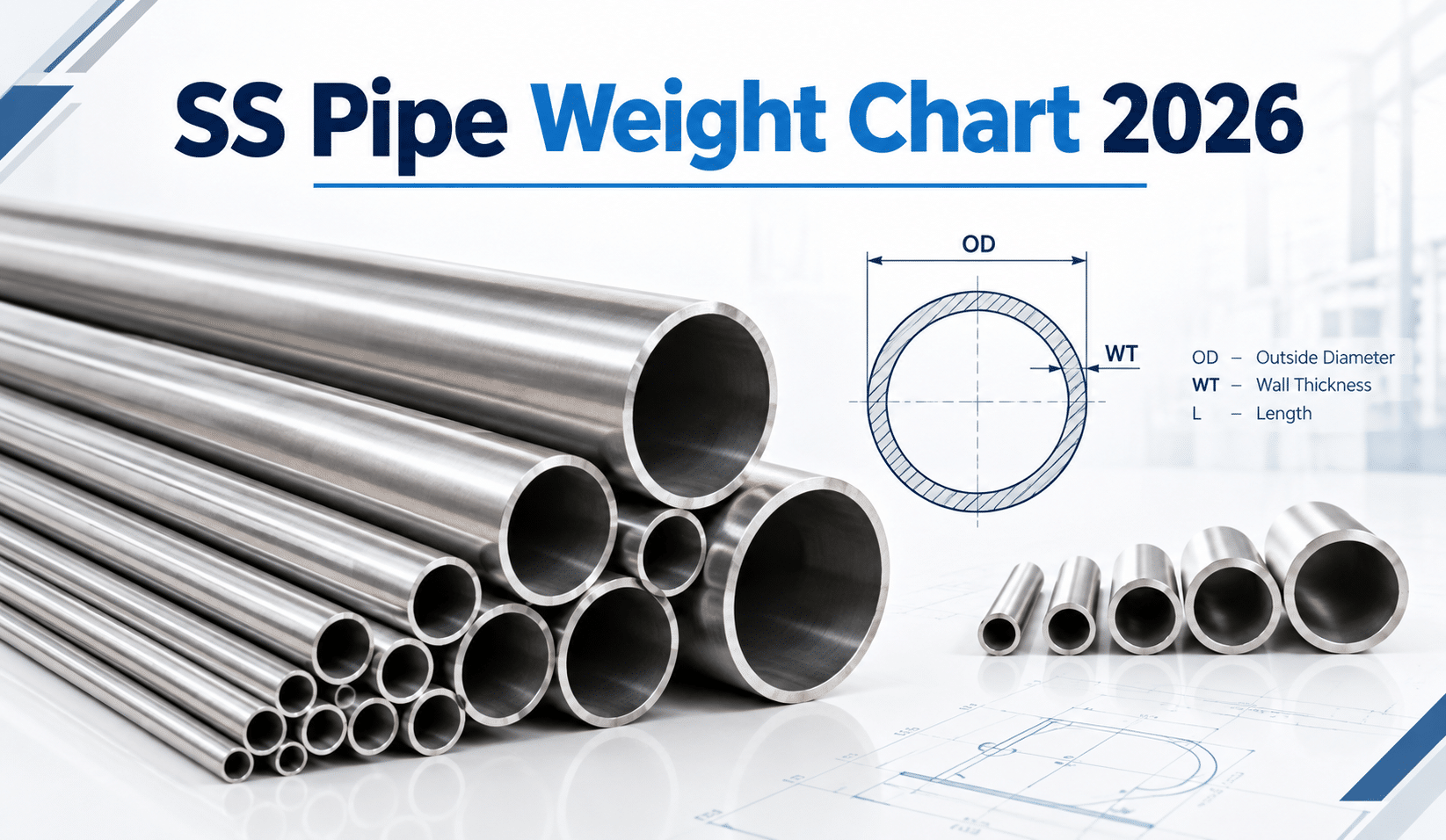
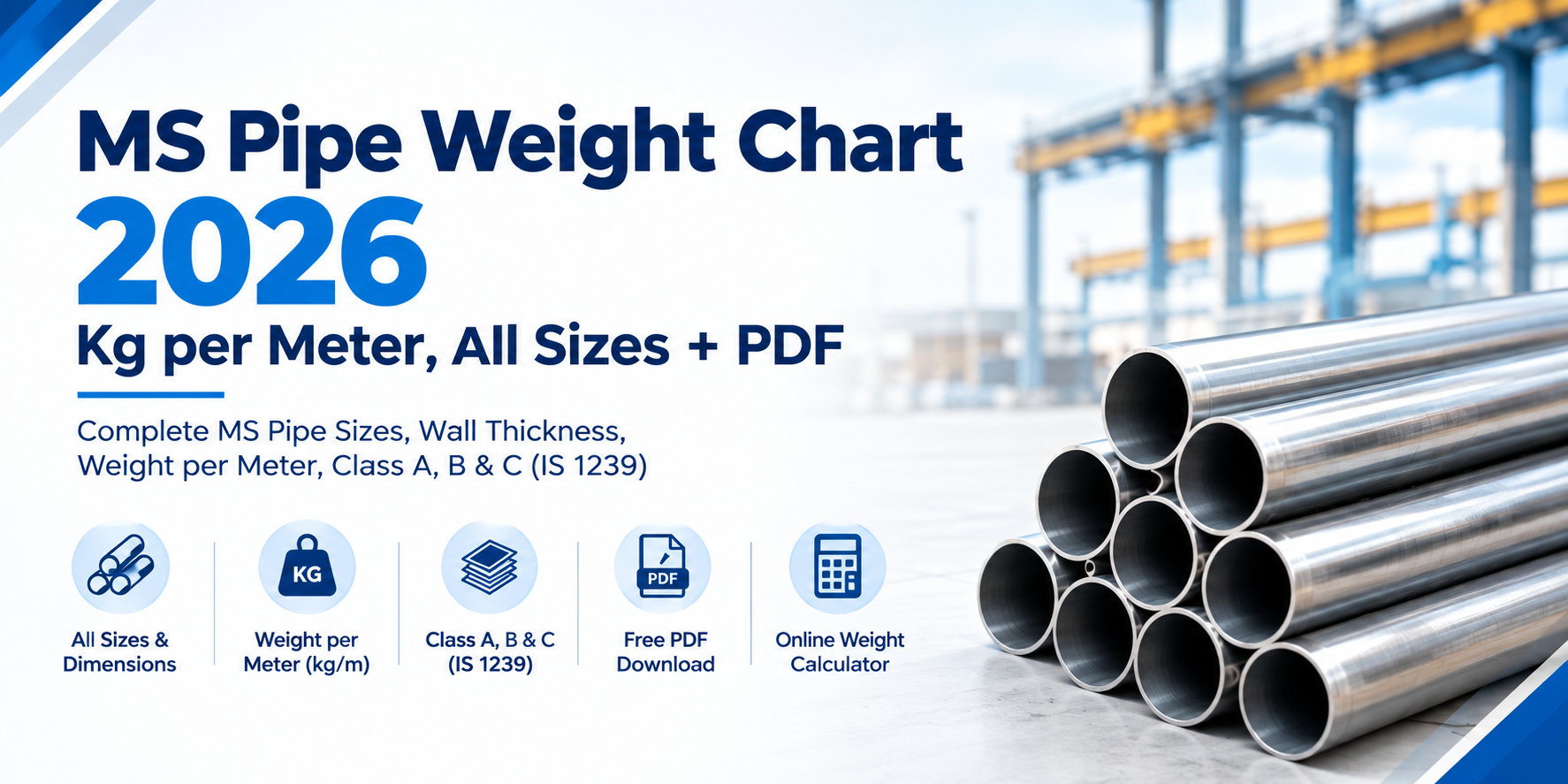
For additional steel reference information, you can also explore the MS Pipe Weight Chart and SS Pipe Weight Chart.
Use a Metal Weight Calculator.
Manual calculations are useful for checking individual quantities, but a calculator can make multiple calculations faster.
The Metal Weight Calculator can help when comparing different dimensions, lengths, thicknesses, and material quantities.
Always compare calculated results with the applicable standard section table when working with standardised ISMC profiles.
Quality and Procurement Checklist
Before purchasing MS channels, buyers should confirm:
- ISMC size
- Required quantity
- Individual length
- Steel grade
- Applicable standard
- Material certificate requirement
- Surface condition
- Delivery location
- Packing and loading requirements
- Required delivery schedule
For industrial projects, dimensional accuracy, material traceability, and documentation can be important parts of the purchasing process.
Frequently Asked Questions About MS Channel Weight
1. What is MS channel weight?
MS channel weight is the theoretical weight of a mild steel channel, normally expressed in kilograms per meter (kg/m). It depends on the section’s dimensions and geometry.
2. What is the weight of ISMC 100 per metre?
The approximate theoretical weight of ISMC 100 is 9.56 kg/m.
3. What is the weight of ISMC 150?
The approximate theoretical weight of ISMC 150 is 16.80 kg/m.
4. What is the weight of ISMC 200?
The approximate theoretical weight of ISMC 200 is 22.30 kg/m.
5. How do I calculate total MS channel weight?
Multiply the unit weight in kg/m by the total length in metres.
Total Weight = kg/m × Total Length
6. What does ISMC mean?
ISMC stands for Indian Standard Medium Channel. It refers to standardised structural steel channel sections used in construction, fabrication, supports, and engineering applications.
7. Which standard is commonly used for ISMC channel dimensions?
ISMC channel dimensions are commonly referenced to IS 808, while material requirements may be specified separately according to applicable standards such as IS 2062.
8. Can I calculate the weight of a custom MS channel?
Yes. A custom section can be estimated using its cross-sectional area, length, and steel density. Final supplied weight should be confirmed from the manufactured section and supplier documentation.
9. What affects MS channel price in 2026?
Price can vary according to steel market conditions, section size, grade, quantity, manufacturer, location, freight, taxes, and commercial terms.
10. Where can I download the MS Channel Weight Chart PDF 2026?
You can download the reference PDF using the button below:
DOWNLOAD MS CHANNEL WEIGHT CHART PDF 2026
Conclusion
The MS Channel Weight Chart 2026 – ISMC Sizes, Kg/m + PDF provides a convenient reference for checking ISMC section sizes, approximate unit weights, calculations, prices, applications, and procurement requirements. Understanding the weight per meter makes it easier to estimate total material quantities, transportation requirements, project costs, and fabrication needs.
For accurate procurement, always verify the ISMC size, dimensions, grade, standard, quantity, length, and applicable documentation before placing an order. The PDF chart can be retained as a quick reference for future estimation and project planning.
Download the MS Channel Weight Chart PDF.
📥 DOWNLOAD MS CHANNEL WEIGHT CHART PDF 2026
For additional steel calculations, use the Metal Weight Calculator and explore the related MS Pipe Weight Chart and SS Pipe Weight Chart resources.